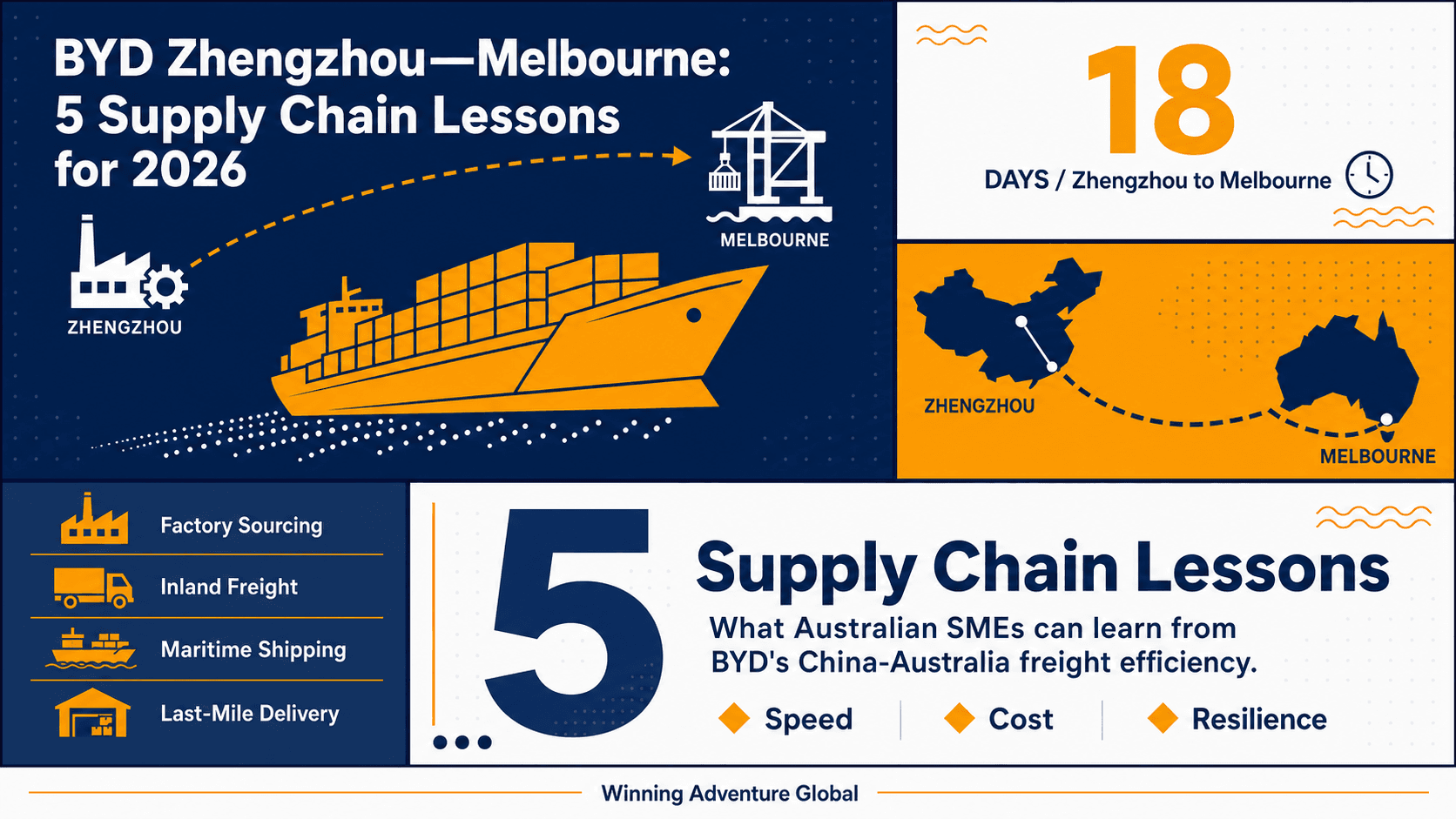
In June 2026, the first shipment of BYD vehicles rolling off the production line at the company's Zhengzhou manufacturing base began arriving at the Port of Melbourne. The vessels — carrying thousands of electric sedans and SUVs destined for Australian dealerships — completed the journey from central China to Victoria in approximately 16 to 18 days, including port handling at both ends.
For the Australian automotive press, this was a milestone in BYD's aggressive global expansion. For the logistics and import industry, however, the arrival told a different story — one that has nothing to do with electric vehicles and everything to do with supply chain infrastructure that any Australian business can access.
The Zhengzhou-Melbourne route is not some bespoke logistics corridor built exclusively for a $100 billion automaker. It runs on the same shipping lines, the same port infrastructure, and the same freight forwarding networks that move electronics, furniture, building materials, textiles, and industrial equipment from China to Australia every day. The difference is that BYD knows how to use these routes efficiently — and most Australian SMEs do not.
This article is not about cars. It is about what the Zhengzhou-Melbourne supply chain reveals about the state of China-Australia logistics in 2026, and the five practical lessons any Australian business can apply to their own importing operations.
BYD's Zhengzhou-Melbourne Route Explained
To understand why this route matters, you need to understand what makes Zhengzhou an unusual manufacturing hub for an automaker targeting Australia.
Zhengzhou, the capital of Henan province, sits approximately 800 kilometres inland from China's eastern seaboard. It is not a coastal city. It does not have a deep-water port. A casual observer might wonder why BYD would build a major export-oriented factory in a landlocked provincial capital when Shenzhen, Shanghai, Ningbo, and Guangzhou all offer direct port access.
The answer lies in Zhengzhou's logistics infrastructure — specifically, its position as China's largest inland rail hub and one of the country's most efficient multimodal freight nodes.
The Zhengzhou Logistics Advantage
| Infrastructure Asset | Capacity / Scale | Relevance to Australia-Bound Freight |
|---|---|---|
| Zhengzhou Railway Hub | 200+ freight trains daily, connects to all major Chinese ports | Containers move Zhengzhou to Qingdao/Shanghai/Ningbo in 12-18 hours by rail |
| Zhengzhou Xinzheng International Airport | 2.9 million tonnes annual cargo capacity (2025) | Air freight option for time-sensitive or high-value shipments |
| Zhengzhou-Lianyungang rail corridor | Dedicated freight line, 650 km | Fastest rail-to-port connection to the Yellow Sea |
| Henan Free Trade Zone | Customs clearance within 24 hours for bonded cargo | Duty deferral and streamlined export documentation |
| Zhengzhou inland port (dry port) | Container handling of 400,000 TEU/year | Full customs processing before containers even reach the coast |
BYD's factory near Zhengzhou does not need a seaport because the company leverages China's inland rail freight network to move containerised vehicles from the factory floor to the wharf at Qingdao or Shanghai in less than a day. From there, the containers are loaded onto vessels servicing the Australia route — predominantly on the A3 (Australia Northbound) and AAX (Asia-Australia Express) services operated by major shipping alliances.
The total transit time from Zhengzhou factory to Melbourne port ranges from 16 to 22 days depending on the specific vessel schedule and which coastal port the cargo departs from. For context, that is comparable to the transit time from Shenzhen or Guangzhou — and often faster than shipments originating from smaller coastal cities with less developed port infrastructure.
Why Melbourne, Not Sydney or Brisbane
BYD's choice of Melbourne as its primary Australian entry port is not random. The Port of Melbourne handles approximately 36% of Australia's containerised imports and is the country's largest general cargo port. It offers:
- Direct berth access for vessels up to 9,500 TEU — larger than what Brisbane can accommodate without tidal restrictions
- On-dock rail terminals connecting directly to Victoria's inland freight network, enabling same-day distribution to regional Victoria, South Australia, and southern New South Wales
- Customs and biosecurity clearance processing time averaging 2.3 days for compliant shipments, the fastest of any Australian capital-city port
For an SME importing from China, Melbourne's port infrastructure means lower drayage costs, faster customs clearance, and more frequent vessel calls from Chinese ports compared to Fremantle, Adelaide, or even Brisbane.
Ready to cut your China-Australia freight costs? Get a free logistics assessment from our team. We map your product supply chain against the fastest, most cost-effective routes from China to Australia — the same routes global manufacturers use.
Why This Route Matters for Australian Importers
The most important thing about the Zhengzhou-Melbourne route is not that BYD uses it. It is that the route existed long before BYD started shipping vehicles on it — and it will exist long after. This is public logistics infrastructure, not proprietary BYD capability.
The Misconception About China-Australia Shipping
Most Australian SMEs sourcing from China operate under a set of assumptions that were true in 2015 but are no longer accurate in 2026:
Misconception 1: "You need to source from coastal provinces to get fast shipping."
Reality: China's inland rail freight network has developed so rapidly over the past decade that factories in Henan, Hubei, and Sichuan can now get containers to port faster than factories in some coastal provinces with limited rail connections. The Zhengzhou-Qingdao rail corridor moves freight in 14 hours. A truck from a factory in rural Guangdong without direct highway access might take longer to reach Yantian port than a container train from Zhengzhou to Shanghai.
Misconception 2: "Small importers cannot access the same shipping lanes as big companies."
Reality: Container shipping is a commodity. The vessel that carries BYD vehicles also carries containers from dozens of other shippers — some filling hundreds of containers, some filling one. Freight forwarders consolidate less-than-container-load (LCL) shipments onto the same vessels. Your 20-foot container sits on the same ship, travelling at the same speed, arriving at the same port, as a global manufacturer's cargo. The difference is in the freight contract, not the physical logistics.
Misconception 3: "Direct shipping routes between China and Australia are limited."
Reality: As of mid-2026, the three major shipping alliances (2M, Ocean Alliance, and THE Alliance) collectively operate 12 to 14 weekly services connecting Chinese ports to Australian ports. This does not include smaller regional carriers or ad-hoc charter services. The frequency of sailings from China to Melbourne means that in most cases, a container booked on Monday can be on a vessel by Friday.
The Cost Equation
| Freight Component | Typical SME Cost (2026) | Optimised Cost | Potential Saving |
|---|---|---|---|
| Inland China transport (factory to port) | $800-1,200 AUD per 20ft | $450-650 AUD (rail vs truck) | 35-45% |
| Ocean freight (China to Melbourne) | $2,400-3,200 AUD per 20ft | $1,800-2,400 AUD (annual contract) | 20-30% |
| Port charges and terminal handling (Melbourne) | $450-600 AUD per container | $380-480 AUD (volume agreement) | 15-20% |
| Customs clearance and biosecurity | $350-500 AUD per shipment | $250-350 AUD (pre-lodged, compliant docs) | 25-30% |
| Last-mile delivery (Melbourne metro) | $400-700 AUD | $300-450 AUD (consolidated) | 25-35% |
Source: Freight forwarder quotes, Q2 2026; Port of Melbourne tariff schedule; industry interviews.
An SME importing two 20-foot containers per month from China to Melbourne could be overpaying by $2,000 to $4,000 per shipment simply by not optimising each component of the freight chain. Over a year, that is $24,000 to $48,000 in unnecessary logistics costs — money that could fund an additional container of inventory, a factory visit, or a product development cycle.
We have explored the broader logistics technology trends shaping these cost dynamics in our analysis of WiseTech Global and Australia-China freight technology in 2026.
How Australian SMEs Can Use the Same Supply Chain Infrastructure
The core insight from BYD's Zhengzhou-Melbourne operation is not about Zhengzhou at all. It is about how a sophisticated importer maps its supply chain end-to-end and optimises every link — from factory floor to final delivery. Here is how to apply that thinking to your own imports.
Lesson 1: Choose Your Factory Location Strategically
Most Australian importers choose suppliers based on product quality and price — and then accept whatever logistics cost and timeline comes with the factory's location. BYD chose Zhengzhou precisely because of its logistics infrastructure, not despite it.
What this means for your sourcing: When evaluating a potential Chinese supplier, add logistics infrastructure to your criteria alongside quality and price. A factory in Zhengzhou, Wuhan, or Chengdu with excellent rail-to-port connections may deliver lower total landed cost than a factory in Guangdong with cheaper unit pricing but slower, more expensive inland transport.
Ask your supplier: Which port does your freight normally route through? How do containers travel from your factory to that port — by truck or by rail? What is the typical transit time from factory gate to vessel loading? Suppliers who cannot answer these questions clearly are suppliers who do not manage their outbound logistics carefully.
Lesson 2: Use Inland Rail Instead of Trucking
China's freight rail network is the most underutilised logistics lever available to Australian importers. Container trains from inland manufacturing hubs to coastal ports are faster, cheaper, and more reliable than long-haul trucking — yet most Australian importers default to truck transport simply because it is the default their supplier offers.
A container shipped by rail from Zhengzhou to Qingdao costs approximately $450-550 AUD and takes 14 hours. The same container shipped by truck costs $850-1,100 AUD and takes 18-22 hours — and carries higher risk of delay, damage, and customs complications at intermediate checkpoints.
Your freight forwarder can arrange rail transport from any major inland manufacturing hub. You do not need special relationships or high volume — you just need to ask for rail instead of truck in your freight booking.
Lesson 3: Consolidate and Contract for Freight
BYD does not book shipping on the spot market. It negotiates annual or multi-year freight contracts with shipping lines, locking in rates and guaranteed space allocation. While an SME cannot command the same leverage as a global automaker, the principle scales down.
Even a business importing two to four containers per month can negotiate a quarterly or annual freight contract with a forwarder that secures rates 20-30% below spot market pricing. The trade-off is a volume commitment — but if your import volume is predictable, the savings far outweigh the commitment risk.
Lesson 4: Pre-Clear Customs Before Your Shipment Arrives
One of the most preventable causes of logistics delay and cost overrun is Australian Border Force and Department of Agriculture biosecurity inspection at the port of arrival. Shipments that arrive with complete, accurate documentation — commercial invoice, packing list, bill of lading, certificate of origin, and any product-specific permits — clear customs in 2-3 days. Shipments with incomplete or inaccurate documentation can sit at the wharf for weeks, accumulating storage and demurrage charges at $150-250 per day.
The fix is straightforward: lodge your customs documentation 48-72 hours before vessel arrival. This gives Australian Border Force time to review, flag issues, and request clarification before your container is physically available for inspection — dramatically reducing the chance of a hold at the terminal.
Lesson 5: Plan the Last Mile Before the First Mile
BYD does not ship vehicles to Melbourne and then figure out where they go. Every vehicle on that vessel has a destination dealership, a transport provider, and a delivery timeline before it leaves Zhengzhou.
Most Australian importers plan their ocean freight carefully and then scramble to arrange last-mile delivery after the container clears customs. This is backward. Your freight forwarder should provide a door-to-door quote that includes delivery from port to your warehouse or distribution centre — not just port-to-port. The cost difference is modest; the time and stress saved are substantial.
If you are importing to a single warehouse location, negotiate a fixed delivery rate with a Melbourne-based transport provider. If you distribute nationally, investigate whether splitting your shipment at port (partial delivery to Melbourne, partial rail freight to Sydney or Brisbane) is more cost-effective than road freight from Melbourne to the east coast.
Importing from China and want to stop overpaying for logistics? Our team has mapped every major China-Australia freight route and can identify where your supply chain is leaking money. Get your free logistics assessment — we analyse your current freight costs and show you where the savings are, no obligation.
China-Australia Shipping: Key Routes and Transit Times
Understanding the physical routes your cargo travels helps you make better sourcing and logistics decisions. Here are the primary China-Australia shipping corridors operating in 2026.
| Route | Port Pair (China → Australia) | Typical Transit | Vessel Frequency | Best For |
|---|---|---|---|---|
| North China Express | Qingdao/Tianjin → Melbourne | 16-20 days | 3-4 sailings/week | Heavy machinery, steel, industrial goods |
| Central China Corridor | Shanghai/Ningbo → Melbourne/Sydney | 14-18 days | 5-6 sailings/week | General cargo, electronics, consumer goods |
| South China Standard | Yantian/Shekou → Melbourne/Sydney | 12-16 days | 6-8 sailings/week | Electronics, textiles, furniture |
| Southeast Asia Feeder | Xiamen/Fuzhou → Melbourne (via Singapore/HK) | 18-24 days | 2-3 sailings/week | Stone products, ceramics, specialised goods |
| Direct Brisbane | Shanghai/Ningbo → Brisbane | 15-19 days | 3-4 sailings/week | Queensland-bound freight avoiding Melbourne drayage |
Australian Port Capabilities Comparison
| Port | Annual Container Volume | Max Vessel Size | Avg Customs Clearance | Rail Connection | Cold Storage |
|---|---|---|---|---|---|
| Melbourne | 3.2M TEU | 9,500 TEU | 2.3 days | On-dock | Yes |
| Sydney (Port Botany) | 2.7M TEU | 9,000 TEU | 3.1 days | On-dock | Yes |
| Brisbane | 1.5M TEU | 7,000 TEU | 3.5 days | Near-dock | Yes |
| Fremantle | 0.8M TEU | 6,500 TEU | 2.8 days | On-dock | Limited |
| Adelaide | 0.35M TEU | 4,500 TEU | 3.0 days | Near-dock | Limited |
Source: Port authority annual reports, FY2025; shipping line schedules, Q2 2026.
The data makes clear why BYD chose Melbourne: it offers the combination of large-vessel access, fast customs processing, and on-dock rail that maximises speed and minimises handling cost. For an Australian SME, the choice of destination port should be driven by a similar calculation — balancing ocean freight cost, port efficiency, and proximity to your final delivery destination.
We covered the strategic lessons from BYD's broader manufacturing model in our analysis of BYD's supply chain strategies for Australian importers.
FAQ
How long does shipping from Zhengzhou to Melbourne actually take?
Door-to-door transit from Zhengzhou to Melbourne typically takes 16 to 22 days. This breaks down as: factory to Chinese port by rail (1 day), port handling and vessel loading (1-2 days), ocean transit (12-16 days depending on routing), Melbourne port discharge and customs clearance (2-3 days), and last-mile delivery (0-1 day for metro Melbourne). Rush services with expedited rail and priority vessel loading can reduce total transit to 14-16 days.
Can a small Australian business actually use the same shipping routes as BYD?
Yes. The vessels, ports, rail corridors, and freight forwarders that serve BYD are the same ones that serve any importer shipping containerised freight from China to Australia. You do not need to be a large company to book space on a vessel or contract a freight forwarder. The difference between your shipment and BYD's is the negotiated rate and the volume commitment — not the physical logistics infrastructure.
Is Zhengzhou a good place to source products from China?
Zhengzhou and the broader Henan province are strong sourcing regions for industrial equipment, machinery, automotive parts, steel products, aluminium processing, textiles, and some electronics. The city's logistics infrastructure — particularly its rail connections to all major Chinese ports — makes it a practical sourcing destination even for importers who associate China sourcing exclusively with Guangdong and Zhejiang. Labour costs in Henan are approximately 20-30% lower than in coastal manufacturing provinces.
How can I reduce my China-Australia freight costs?
The four most effective ways to reduce freight costs are: (1) negotiate an annual or quarterly freight contract with a forwarder instead of booking on the spot market, (2) consolidate multiple suppliers' shipments into full container loads (FCL) instead of shipping less-than-container-load (LCL), (3) use rail instead of trucking for inland China transport, and (4) lodge customs documentation before vessel arrival to avoid port storage and demurrage charges. Most Australian importers can reduce total logistics costs by 20-35% by implementing these four changes.
What is the cheapest Chinese port to ship to Australia from?
Shanghai and Ningbo typically offer the most competitive ocean freight rates to Australia due to their massive container volume and high vessel frequency (5-6 weekly sailings to Melbourne/Sydney). However, the cheapest port is not necessarily the cheapest total logistics solution. A lower unit price from a factory near Qingdao may be offset by higher ocean freight from Qingdao compared to Shanghai. Always calculate total landed cost — ex-factory price plus inland transport plus ocean freight plus Australian port charges plus last-mile delivery — not just the ocean freight component.
Does the Port of Melbourne charge more than Sydney or Brisbane?
Port of Melbourne terminal handling charges are competitive with Sydney and generally lower than Brisbane on a per-container basis. More importantly, Melbourne's faster average customs clearance (2.3 days vs 3.1 at Sydney and 3.5 at Brisbane) means lower storage costs and faster delivery. The Port of Melbourne's on-dock rail terminals also eliminate the cost of trucking containers to an off-dock rail facility, which can add $150-250 per container at Sydney and Brisbane.
How do I find a reliable freight forwarder for China-Australia shipments?
Look for a forwarder with an Australian office (not just a Chinese office with an Australian agent arrangement), demonstrated experience with your product category, and transparent pricing that separates ocean freight, port charges, customs brokerage, and last-mile delivery into distinct line items. Ask for references from Australian importers in a similar volume range to your business. A forwarder handling 5,000 containers a year is not necessarily the right partner for an importer moving 20 containers a year — responsiveness and availability matter more than total volume.
Need to cut your China-Australia freight costs? Our team helps Australian businesses map their supply chains against the most efficient routes from China. We connect you with freight partners who deliver competitive rates, transparent pricing, and reliable transit times — whether you are importing from Zhengzhou, Shenzhen, or anywhere in between.
More than 200 Australian SMEs have used our sourcing and logistics network to reduce their China import costs by an average of 23%. Get your free logistics assessment today.
China Sourcing Strategy
Ready to tap into the same China-Australia supply chains as the world's biggest EV maker?
Whether you are importing one container or a hundred, we connect Australian businesses with the same efficient China-Australia logistics networks that global giants use. Free logistics assessment.
Get Free Logistics AssessmentFree initial consultation · We respond within 4 business hours