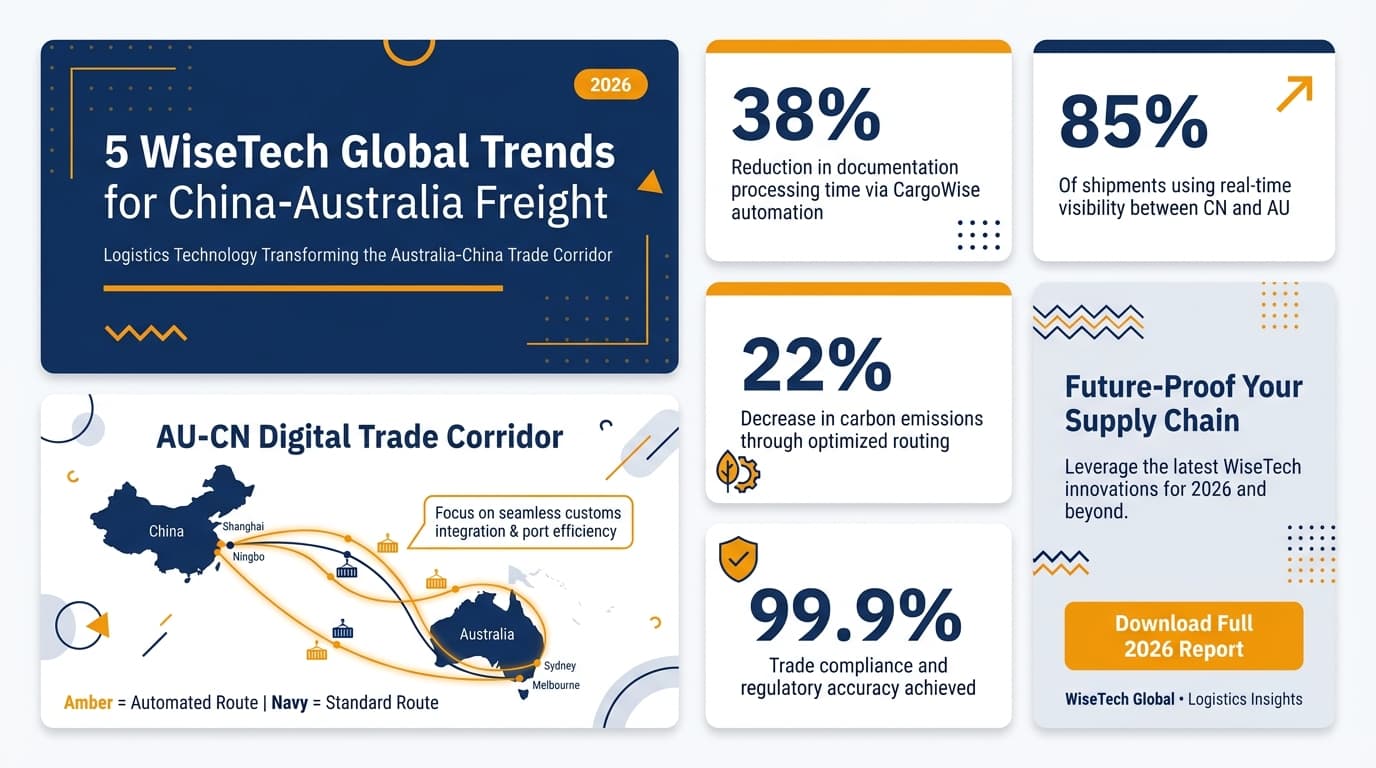
When you ship a container from Shanghai to Sydney, it passes through at least fifteen separate handoffs—freight forwarders, customs brokers, port operators, transport companies, and warehouse managers. Each handoff is a chance for delays, lost paperwork, and unexpected costs. And yet, despite billions of dollars moving through the Australia-China freight corridor every year, much of this chain still runs on email threads, spreadsheets, and phone calls.
That is why WiseTech Global matters. Founded in Sydney in 1994, WiseTech has grown into one of the world's largest logistics software companies, with its flagship CargoWise platform now powering freight operations for 17 of the world's top 25 freight forwarders. For Australian importers sourcing from China, the technology WiseTech pioneered is not an abstract success story—it is the operating system now running the supply chains that deliver their goods.
This article examines five technology trends reshaping Australia-China freight logistics in 2026, what they mean for Australian businesses importing from China, and how to evaluate logistics technology for your own import operations.
WiseTech Global: Australia's Logistics Tech Powerhouse
Before diving into the trends, it is worth understanding why WiseTech Global commands attention. The company's market capitalisation exceeded AUD 40 billion in early 2026, making it one of the ASX's largest technology companies. CargoWise, its core platform, processes more than 70 billion data transactions annually across 170 countries.
What began as a customs clearance software tool for a single Sydney freight forwarder has evolved into a comprehensive logistics operating system. CargoWise now handles freight forwarding, customs clearance, warehousing, shipping, tracking, land transport, and cross-border compliance on a single integrated platform.
The significance for Australian importers sourcing from China is direct: the freight forwarders, customs brokers, and shipping lines handling your goods increasingly run on CargoWise or competing platforms built on the same principles. Understanding what these systems do—and what they make possible—helps you make smarter decisions about your supply chain.
5 Technology Trends Transforming Australia-China Freight in 2026
Trend 1: Automated Customs Clearance
Customs clearance has historically been one of the slowest, most error-prone links in the import chain. A single missing tariff code or incorrect valuation can hold a container at port for days, accruing demurrage charges and delaying downstream operations.
In 2026, automated customs clearance through platforms like CargoWise has materially changed this picture. The Australian Border Force now accepts electronic lodgments processed through accredited software, with many entries receiving instant clearance without manual review. For goods sourced from China, where documentation complexity tends to be higher due to varied product categories and supplier documentation standards, automation reduces both clearance time and the risk of costly errors.
Key capabilities available to Australian importers through modern customs automation include automated tariff classification based on product descriptions and historical data, real-time duty and GST calculation, electronic document lodgment and status tracking, and integration with supplier documentation to pre-validate customs entries before goods arrive.
The practical result: clearance times that once averaged two to five business days now often complete within hours, and in some cases, within minutes of lodgment.
Trend 2: Real-Time Freight Tracking and End-to-End Visibility
For decades, the standard answer to "Where is my shipment from China?" was a container number, a shipping line website, and a hope that the vessel was somewhere between Shanghai and Sydney. Real-time visibility—if it existed at all—was reserved for enterprise logistics operations with dedicated control towers.
That has changed fundamentally. Real-time freight tracking, powered by IoT sensors, satellite data, and integrated platform APIs, now provides Australian importers with minute-by-minute visibility into the location and condition of goods in transit. CargoWise and competing platforms aggregate tracking data from multiple carriers and modes into a single view, giving importers a unified picture of their supply chain.
For businesses sourcing from China, this visibility translates into tangible operational benefits. You can see exactly when goods clear Chinese export customs, monitor vessel progress across the Pacific, receive alerts when containers are discharged at Australian ports, and track last-mile delivery to your warehouse in real time. The implications for inventory planning, customer communication, and exception management are significant.
Trend 3: AI-Powered Freight Planning and Route Optimisation
Artificial intelligence has moved from buzzword to practical tool in freight logistics. In 2026, AI-powered planning systems help importers and their logistics partners make better decisions about routing, carrier selection, and shipment consolidation.
These systems analyse historical freight data—transit times, carrier reliability, seasonal congestion patterns, port delays—to recommend optimal shipping strategies. For an Australian importer bringing goods from multiple Chinese suppliers across different regions, AI planning can determine whether it is more cost-effective to consolidate in Shenzhen or ship separately from Ningbo and Xiamen, factoring in current port congestion data, upcoming Chinese holidays, and Australian peak season demand.
The technology also enables dynamic rerouting. When a vessel is delayed, a port is congested, or a carrier changes schedules, AI systems can recalculate the optimal path and automatically propose alternatives—often before the importer even knows there is a problem.
One practical byproduct of AI-driven route optimisation is reduced demurrage and detention costs. These charges—fees for containers held at port beyond free time—cost Australian importers an estimated AUD 300 million annually according to industry data. AI systems that predict clearance timing and coordinate pickup scheduling can substantially reduce this burden.
Trend 4: Digital Documentation and Paperless Trade
The bill of lading, the commercial invoice, the packing list, the certificate of origin, the fumigation certificate—a single shipment from China can generate twenty or more paper documents that must be correct, complete, and coordinated across multiple parties. A single error on any of these documents can halt a shipment.
Digital documentation is changing this. Electronic bills of lading, now accepted by major shipping lines serving the Australia-China route, eliminate the physical couriering of original documents. Digital certificates of origin, verified through blockchain-based systems trialled by the Australia-China FTA implementation bodies, reduce fraud risk and processing time. Smart forms that validate data entries against regulatory requirements catch errors before documents are submitted.
CargoWise's document management capabilities allow all parties in a shipment—the Chinese supplier, the freight forwarder, the customs broker, and the Australian importer—to access, review, and approve documents in a single digital environment. This reduces the cycle time for document preparation and correction from days to hours.
For Australian importers, the practical implication is fewer Customs holds caused by documentation errors, faster release of goods from port, and less administrative overhead managing paper trails across time zones and languages.
Trend 5: Integrated Cloud Logistics Platforms
The most significant trend of all is the integration of previously siloed logistics functions into single cloud platforms. A decade ago, an importer might use one system for purchase orders, another for freight booking, another for customs clearance, another for tracking, and spreadsheets to tie it all together.
In 2026, platforms like CargoWise integrate all these functions. The purchase order in your system links directly to the freight booking, which links to the customs entry, which links to the delivery order. Data flows automatically between modules, reducing duplicate entry and the errors it creates.
For Australian businesses sourcing from China, the benefit of integration is particularly acute because of the number of parties involved. A typical import transaction involves a Chinese supplier, an origin freight forwarder, a shipping line, a destination freight forwarder, a customs broker, a transport company, and a warehouse operator. Without integration, information moves between these parties manually and asynchronously. With an integrated platform, the data moves automatically and in near real-time.
Integrated platforms also enable better financial management of import operations. Landed cost calculations—which must account for FOB price, ocean freight, insurance, customs duty, GST, port charges, and inland transport—can be automated and made visible at the purchase order stage, giving importers clarity on true product costs before goods even leave China.
Technology Impact on Australia-China Freight Operations
The table below summarises how logistics technology has changed key aspects of Australia-China freight operations.
| Operation | Traditional Approach (Pre-2020) | Technology-Enabled Approach (2026) | Typical Time/Cost Reduction |
|---|---|---|---|
| Customs Clearance | 2-5 business days, manual lodgment, paper forms | Hours to minutes, electronic lodgment, auto-validation | 70-90% faster |
| Shipment Tracking | Manual check via carrier website, container number lookup | Real-time dashboard, multi-modal visibility, automated alerts | Near-instant visibility |
| Documentation | Physical bill of lading couriered, manual data entry, paper files | Electronic documentation, digital verification, cloud storage | 60-80% reduction in doc cycle time |
| Freight Booking | Email/phone with forwarder, ad-hoc rate shopping | Platform-based booking, rate comparison, automated confirmation | 50-70% faster booking |
| Route Planning | Fixed routes, manual carrier selection, reactive changes | AI-optimised routing, dynamic carrier selection, proactive alerts | 15-25% cost reduction |
| Landed Cost Calculation | Spreadsheet estimates, post-shipment reconciliation | Automated pre-shipment calculation, real-time cost visibility | 80-90% reduction in calculation time |
What This Means for Australian Importers Sourcing from China
For Australian businesses that import from China, the technology trends described above are not distant possibilities—they are operational realities that your competitors may already be using to gain advantage. The specific implications for your sourcing operations include:
Lower Total Landed Cost: Faster clearance and reduced demurrage directly lower the cost of importing. Automated documentation reduces the administrative overhead of managing import compliance. AI-optimised routing can reduce freight spend by identifying consolidation opportunities and more efficient carrier choices.
Faster Time-to-Shelf: When goods clear Customs in hours instead of days, and when documents process electronically instead of physically, the total transit time from Chinese factory to Australian warehouse shrinks. For seasonal products, fashion items, or promotional goods, this speed advantage translates into revenue.
Reduced Supply Chain Risk: Real-time visibility and proactive alerts mean you know about problems when they occur—not days later when a customer calls to ask where their order is. The ability to respond quickly to disruptions reduces the commercial impact of delays.
Better Supplier Accountability: When your logistics platform provides granular data on what happens after goods leave your supplier's factory, you gain a factual basis for supplier performance discussions. Late shipments, incomplete documentation, and incorrect packing all become visible and measurable.
Australian importers sourcing custom merchandise, promotional products, apparel, and industrial components from China face the same logistics challenges regardless of industry. The technology solutions available in 2026 are not reserved for large enterprises—they are increasingly accessible to small and medium importers through freight forwarders and customs brokers who have adopted these platforms.
How to Evaluate Logistics Technology for Your Import Operations
If you import from China and have not recently reviewed your logistics technology stack, now is the time. Here are practical steps to assess where you stand and where you could improve.
Ask Your Freight Forwarder About Their Platform
The simplest technology upgrade available to most importers is choosing a freight forwarder that uses a modern platform like CargoWise. Ask your current forwarder what system they use. Ask whether they provide a client portal with real-time shipment visibility. If the answer is "we'll email you updates," you are operating with a technology disadvantage.
Audit Your Documentation Process
How are your import documents managed? If supplier invoices arrive by email attachment, get printed, get manually entered into a spreadsheet, and get forwarded to a customs broker by yet another email—you have multiple failure points. Even if you are not ready to adopt a full logistics platform, cloud-based document management tools can reduce errors and processing time.
Map Your Shipment Visibility Gaps
For your next three shipments from China, track exactly when you had information about each step of the journey. Did you know when goods left the supplier's factory? When the container was loaded onto the vessel? When it arrived at an Australian port? When it cleared Customs? When it was delivered? The gaps in this timeline are where your operations are vulnerable.
Calculate Your True Landed Cost
Most importers know their FOB price, their freight cost, and their duty rate. Far fewer can accurately calculate total landed cost including demurrage, detention, port charges, customs broker fees, transport, and the administrative cost of managing the paperwork. Until you know your true landed cost, you cannot evaluate whether logistics technology investments will pay for themselves.
Start with Visibility, Then Add Automation
For most Australian importers, the highest-impact first step is visibility: knowing where shipments are and what condition they are in. Once you have visibility, automation becomes the logical next step—automating the processes that visibility reveals to be slow, error-prone, or redundant.
Frequently Asked Questions
What is CargoWise and why does it matter for Australian importers?
CargoWise is a logistics execution platform developed by WiseTech Global, an Australian technology company. It handles freight forwarding, customs clearance, warehousing, and supply chain compliance on a single integrated system. For Australian importers sourcing from China, CargoWise matters because most major freight forwarders and customs brokers operating on the Australia-China route use it—meaning your goods are likely already being processed through CargoWise by your logistics partners. Choosing a forwarder that uses a modern platform gives you better visibility, faster clearance, and fewer documentation errors.
How does logistics technology reduce the cost of importing from China?
Logistics technology reduces import costs in several specific ways: automated customs clearance reduces port storage and demurrage fees by speeding up release times; real-time tracking enables proactive management of delays before they become costly; digital documentation eliminates courier fees and reduces error-related rework; and AI-driven freight planning identifies lower-cost routing and consolidation opportunities. Industry data suggests that importers using modern logistics platforms can reduce total landed cost by 10 to 20 percent compared to those relying on manual processes.
Can small and medium Australian businesses access the same logistics technology as large importers?
Yes. Cloud-based logistics platforms have significantly lowered the barrier to entry. Small and medium importers typically access these capabilities through their freight forwarder or customs broker rather than licensing platforms directly. When selecting a logistics partner, asking about their technology platform—specifically whether they use CargoWise or an equivalent integrated system—is one of the most important questions you can ask. The technology is available; the key is choosing partners who have invested in it.
What is the single biggest logistics technology mistake Australian importers make?
The most common mistake is relying on manual processes and assuming they are "good enough." Importers who manage shipments by email, track containers by manually checking carrier websites, and calculate landed costs on spreadsheets are incurring costs and risks they may not see. The hidden costs of manual logistics—demurrage from slow clearance, expedited freight from missed sailings, penalty duties from documentation errors—often exceed the visible costs. The technology to eliminate these costs exists and is accessible; the mistake is not using it.
How does technology help with Australia-China trade specifically, given the language and time zone differences?
The Australia-China trade corridor presents unique challenges: Chinese suppliers operate in a different language, time zone, and regulatory environment. Technology platforms address these challenges by providing bilingual documentation interfaces, automating document translation and validation, and enabling asynchronous collaboration across time zones. When all parties access the same cloud platform, the language barrier becomes less significant because data—shipment statuses, document statuses, exception flags—is standardised and visible to everyone. Chinese suppliers increasingly use CargoWise-compatible systems, particularly those exporting regularly to Australia.
WiseTech Global's rise from a Sydney startup to a global logistics technology leader reflects a broader truth: the technology that powers freight is advancing faster than most importers realise. For Australian businesses sourcing from China, the gap between what is possible and what is typical represents both a risk and an opportunity.
The risk is straightforward. Importers who rely on manual processes and outdated systems will face higher costs, slower delivery, and more supply chain disruptions than competitors who have adopted modern logistics technology. In competitive markets, these operational disadvantages compound into commercial ones.
The opportunity is equally clear. The same platforms used by the world's largest freight forwarders are available, through those forwarders, to Australian businesses of any size. Real-time visibility, automated clearance, digital documentation, and AI-driven planning are not enterprise-only capabilities—they are tools that any importer can access by choosing the right logistics partners and asking the right questions.
Understanding your supply chain technology is no longer optional. It is a core competency for any business that sources from China. The information you need is available—and the cost of not having it is higher than ever.
Free Logistics Assessment
Rising freight costs eating into your China import margins?
Our team helps Australian importers cut through logistics complexity with smart sourcing strategies and trusted freight partners who use modern tracking and automation technology. Get a no-obligation logistics assessment tailored to your Australia-China supply chain.
China Sourcing Strategy
Rising freight costs eating into your China import margins?
Our team helps Australian importers cut through logistics complexity with smart sourcing strategies and trusted freight partners who use modern tracking and automation technology. Get a no-obligation logistics assessment tailored to your Australia-China supply chain.
Get Free Logistics AssessmentFree initial consultation · We respond within 4 business hours