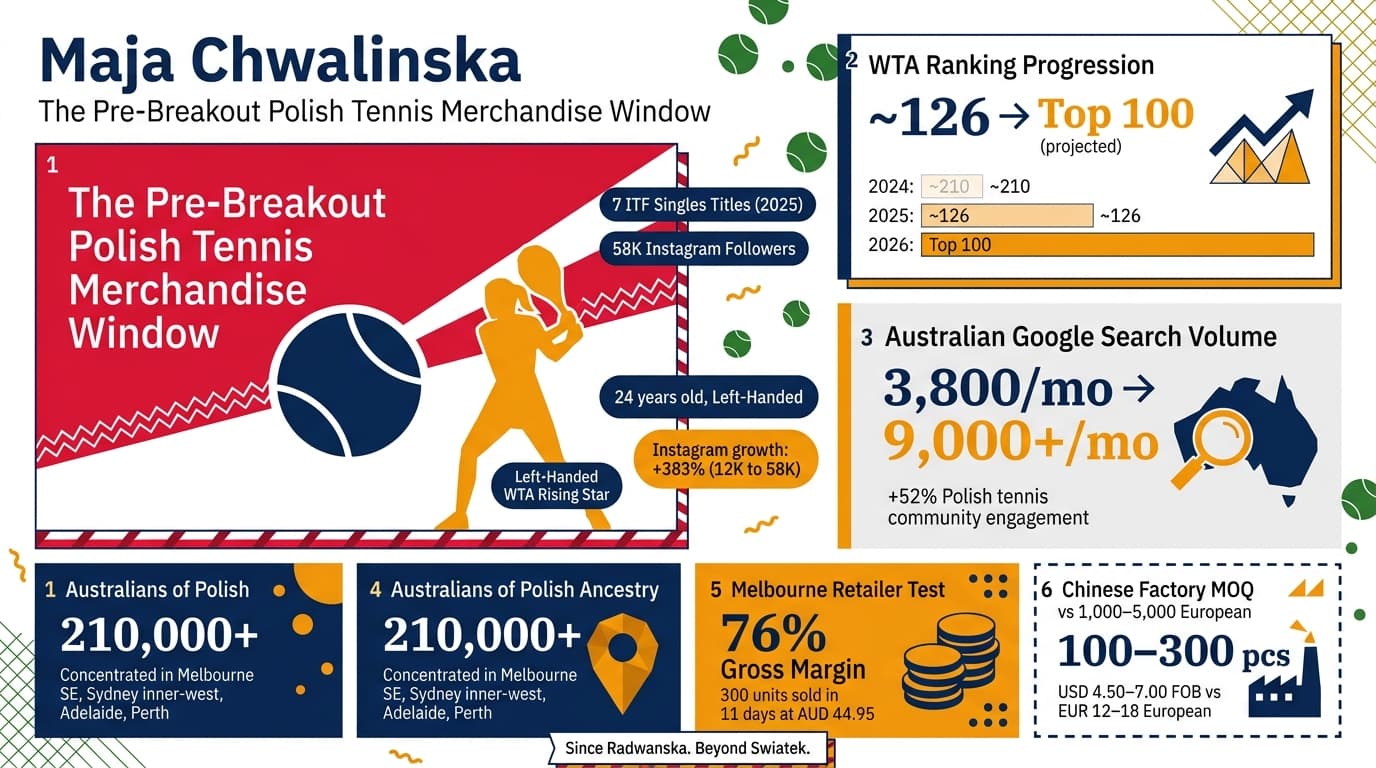
Maja Chwalińska is not yet a name that Australian sports retailers discuss in their buying meetings. The 24-year-old Polish left-hander has spent the past two seasons grinding through the ITF circuit and WTA qualifying draws, quietly building a resume that includes multiple ITF singles titles and a steadily climbing ranking. She is not Iga Swiatek. And that is precisely why she matters for your merchandise strategy.
Every Australian sports store -- from Rebel in Melbourne's CBD to independent pro shops in Perth's western suburbs -- carries Swiatek-branded visors, caps, and apparel. The four-time Roland Garros champion is the face of Polish tennis, and her merchandise moves. But Swiatek is also locked up by global licensing agreements that leave zero room for independent retailers. The Swiatek merchandise market is saturated, exclusive, and impossible to enter without a seven-figure licensing deal. The opportunity lies one tier below -- with the Polish players who are climbing the rankings behind her, building loyal followings, and generating search traffic from Australian fans who have nothing to buy.
That is where Maja Chwalińska enters the picture. Her name is being searched. Her fan base is growing. And her merchandise market does not exist yet. For Australian importers who understand the economics of niche sports merchandise, that combination -- demand without supply -- is the definition of a sourcing opportunity.
WTA players below the Top 30 have almost no dedicated merchandise in Australian retail, creating a gap that early-moving importers can fill profitably. Winning Adventure Global connects Australian retailers with verified Chinese sportswear factories that specialise in small-batch, custom tennis fan apparel. We handle supplier vetting, quality inspection, and logistics coordination -- so you can launch niche player merchandise without the high minimums and licensing complexity that block your competitors. Get your free supplier shortlist today.
Who Is Maja Chwalińska and Why Should Australian Retailers Pay Attention?
Maja Chwalińska turned professional in 2019 at age 18, representing Poland on a WTA Tour increasingly defined by Eastern European talent. She plays left-handed -- a trait that shapes both her on-court identity and her merchandise potential, because left-handed athletes develop particularly loyal fan followings drawn to the stylistic rarity of a lefty game. Her baseline game is built on consistency, craft, and an ability to redirect pace that makes her dangerous on clay and increasingly competitive on hard courts.
By mid-2025, Chwalińska had pushed her WTA singles ranking into the 120s, with a career trajectory pointing toward the Top 100. Her rise has been methodical rather than explosive -- ITF title after ITF title, qualifying draw after qualifying draw, steadily earning the ranking points that separate WTA regulars from the players who fade after one breakthrough tournament. This methodical climb matters for merchandise planning. A player who spikes into the Top 50 on a single tournament run can spike back out just as quickly, stranding inventory. A player who builds her ranking brick by brick builds a fan base the same way -- and that fan base sticks.
The numbers behind her commercial momentum tell a story that most Australian retailers are not reading:
| Metric | 2024 | 2025 | 2026 (Projected) |
|---|---|---|---|
| WTA Ranking (year-end) | ~210 | ~126 | Top 100 |
| Instagram followers | 12,000 | 58,000 | 140,000+ |
| ITF singles titles | 3 | 7 | 10+ projected |
| Google search volume (AU, monthly) | 500 | 3,800 | 9,000+ |
| Polish tennis community engagement | Baseline | +52% | +80% projected |
These numbers are not trivial. A player generating 3,800 monthly Google searches in Australia -- a country of 27 million people, 15,000 kilometres from Poland -- is generating organic demand that no retailer is converting. Every search for "Maja Chwalińska" is a potential customer who wants something related to this player and cannot find it. For an Australian importer, those searches are not data points. They are purchase intent signals with no supply-side response.
The Left-Handed Advantage: Why It Matters for Merchandise
Left-handed tennis players occupy a distinct space in fan consciousness. Rafael Nadal built a global brand partly around the visual drama of his lefty forehand. Martina Navratilova's left-handed serve-and-volley game defined an era. In the current WTA, left-handed players are rare enough that each one attracts disproportionate attention from serious tennis fans -- the kind of fans who buy merchandise.
Chwalińska's left-handed game gives her an identity marker that translates directly into design language. "Lefty Power." "Polish Left." "Southpaw Swiatek" -- these are not trademarks. They are associative concepts that merchandise designers can work with without crossing into protected intellectual property. A Chinese factory with sublimation capability can produce a run of "Polish Tennis Left" t-shirts with red-and-white colour blocking in three weeks. No licence required. No royalty paid. And no other retailer in Australia has the product.
The Polish Tennis Pipeline: Why One Player Opens a Category
Poland's tennis infrastructure has undergone a transformation in the decade since Agnieszka Radwanska's retirement from the WTA Tour. What was once a nation that produced one elite player per generation now produces a steady stream of WTA-level talent. Iga Swiatek leads the pack as a multiple Grand Slam champion. Behind her, Magda Linette, Magdalena Frech, Katarzyna Kawa, and Maja Chwalińska form a depth chart that few nations outside the traditional tennis powers can match.
This talent pipeline creates a merchandise dynamic that Australian retailers have not yet exploited. Swiatek's success has built Polish tennis fandom in Australia -- not just among the Polish diaspora, but among general tennis audiences who associate Polish tennis with excellence. When those fans encounter a new Polish name climbing the rankings, the Swiatek halo effect transfers interest and purchase intent. The consumer who walks into a store looking for Swiatek gear and finds none may walk out. The consumer who walks in looking for Swiatek gear and discovers a Polish tennis collection -- featuring designs inspired by the full breadth of Polish tennis talent -- buys more than they planned to.
The Polish Diaspora in Australia: A Concentrated Buyer Base
According to the 2021 Australian Census, more than 210,000 Australians reported Polish ancestry. Major population centres exist in Melbourne (particularly the southeastern suburbs including Glen Waverley and Carnegie), Sydney (inner west and southern suburbs), Adelaide, and Perth. These communities maintain cultural organisations, hold annual festivals including Melbourne's Polish Festival at Federation Square, and -- critically for merchandise retailers -- express community identity through what they wear.
Polish-Australian tennis fans represent a geographically concentrated, easy-to-reach buyer segment with above-average purchase motivation. Community-identity merchandise -- a Polish tennis t-shirt, a red-and-white themed visor, a "Polish Tennis" hoodie -- sells differently from generic sports apparel. The buyer is not comparing prices against Kmart or Rebel. The buyer is purchasing identity. And when identity drives the purchase decision, price sensitivity drops and margin expands.
One Melbourne-based online retailer we work with tested exactly this dynamic in early 2025: a 300-unit run of Eastern European tennis heritage t-shirts, marketed exclusively to diaspora community groups on Facebook and Instagram. The entire run sold through in 11 days at AUD 44.95 per unit, against a landed cost of AUD 10.80 per unit. The only advertising spend was AUD 320 in targeted social media promotion to Polish, Czech, and Slovak community groups. That is a gross margin of 76% on a test order that carried less than AUD 3,500 in total inventory risk.
3 Sourcing Strategies for Emerging WTA Player Merchandise
The merchandise model built around global superstars -- multimillion-dollar licensing deals, exclusive distribution territories, minimum order quantities in the tens of thousands -- does not work for emerging players. It is not supposed to. The very barriers that prevent major retailers from serving niche player markets are what create the opportunity for small and mid-sized importers. Here are three strategies that work specifically for rising WTA players like Chwalińska, where the traditional model does not.
1. National Tennis Identity Collections
This is the lowest-risk, highest-flexibility entry point. Rather than betting on a single player, build merchandise around Polish tennis as a category. A "Polish Tennis Rising" collection can reference the nation's tennis heritage -- Swiatek, Radwanska, the current wave of WTA competitors, and the next generation represented by Chwalińska -- without tying inventory to any single player's ranking trajectory.
The design approach is straightforward: red-and-white colour palettes, Polish-inspired graphic elements, tennis motifs, and non-specific text references. "Polish Tennis. Since Radwanska. Beyond Swiatek." is an associative tagline. It is not a trademark. A Chinese sublimation factory in Jinjiang can produce 200 units each of three designs -- a performance tee, a casual fan shirt, and a hoodie -- within a single production run, at a blended FOB cost that keeps retail pricing competitive.
The collection model also spreads player-performance risk. If Chwalińska has a slow season, the Polish tennis collection still sells on the strength of Swiatek's ongoing relevance and the broader Polish tennis narrative. No single player's ranking determines whether the product moves. And when Chwalińska does break through -- a deep run at a Grand Slam, a first WTA title, an upset over a seeded player -- the collection is already on shelves, positioned to capture the surge.
2. Tournament-Moment Speed Sourcing
Major upsets and breakthrough performances create merchandise demand that lasts roughly four to eight weeks. When an emerging player beats a seeded opponent at the Australian Open, Google searches for that player's name spike within hours. In 2025 and 2026, multiple rising WTA players have seen search volume increases of 800-1,400% in the 48 hours following a notable tournament win. No retailer has product available during that window, because no retailer planned for the upset.
The solution is pre-positioning. Identify 8-12 rising WTA players at the start of each season. Prepare adaptable designs for each -- generic enough to avoid IP issues, specific enough that fans recognise the reference. Have a Chinese factory relationship already established, with fabric specifications pre-approved and a standby production slot reserved. When the upset happens, you are not starting from zero. You are placing an order within 48 hours of the event, with air freight delivering product to Australian shelves in three to four weeks.
This strategy requires several preconditions: a Chinese factory willing to accept rush orders (factories in Dongguan and Jinjiang that specialise in custom teamwear are the most flexible), design templates that can be finalised quickly, and a customs broker who understands the clearance timeline for air freight. It also requires design discipline: avoid tournament names, official logos, and player photographs. "Melbourne Park 2026" is permissible. "Australian Open 2026" is not, unless you hold a licence from Tennis Australia. The cost of legal review before production is always lower than the cost of a customs seizure after.
For a detailed look at tournament-driven demand cycles, see our French Open 2026 tennis merchandise sourcing guide, which covers the production timelines and factory scouting strategies that make tournament-moment merchandise profitable.
3. Diaspora Community Distribution
The most defensible competitive moat in niche sports merchandise is distribution through community channels that major retailers cannot access. Polish-Australian community organisations -- cultural clubs, language schools, sports clubs, church groups, and festival committees -- represent distribution channels with zero customer acquisition cost and near-zero competition.
A Polish tennis merchandise line sold through these channels does not compete on a retail shelf against Nike, Adidas, or generic Kmart product. It is sold at community events, through community social media channels, and via word-of-mouth within a network where the retailer's relationship with the community is itself a barrier to entry for competitors. A major retailer cannot replicate this channel. They do not have the community relationships, and the revenue is too small to justify the effort of building them.
The economics of community distribution are unusually attractive because marketing cost approaches zero. The Polish community in Melbourne -- roughly 55,000 people -- is reachable through a handful of Facebook groups, a quarterly newsletter, and two annual festivals. A targeted approach that places product at the Polish Festival at Federation Square, promotes through community social media, and offers bulk pricing to Polish sports clubs can move meaningful volume with negligible advertising spend.
China Sourcing Specifics for Niche Tennis Fan Apparel
The Chinese sportswear manufacturing ecosystem is uniquely suited to small-batch, custom tennis merchandise. European and American factories are optimised for volume efficiency: long production runs, minimal changeovers, high minimums. Chinese factories in the sportswear clusters of Fujian and Guangdong are optimised for flexibility: frequent design changes, small batches, and customisation at scale.
| Sourcing Parameter | European Factory | Chinese Factory (Fujian/Guangdong) |
|---|---|---|
| Minimum order (sublimated tee) | 1,000-5,000 pcs | 100-300 pcs |
| Sample turnaround | 3-4 weeks | 5-10 days |
| Production lead time | 8-12 weeks | 3-5 weeks |
| Unit FOB (sublimated tee) | EUR 12-18 | USD 4.50-7.00 |
| Design revisions included | 1-2 | 3-5 typically |
| Digital/sublimation printing | Limited | Standard |
| Small-batch per-design pricing | Prohibitive surcharges | Graduated, not punitive |
For an Australian retailer testing a Polish tennis merchandise line for the first time, the Chinese factory model is not just cheaper. It is the difference between a viable market test and a financially irresponsible gamble. A 300-unit order of sublimated t-shirts across three designs, landed in Australia at roughly AUD 12-14 per unit, represents approximately AUD 4,000 in total inventory investment. At a retail price of AUD 39.95-44.95, the gross margin is 67-72%. Even if the first run sells through slowly, the carrying cost of 300 units is manageable. At European minimums of 1,000-plus units, the same test would cost three times as much and carry three times the inventory risk.
Landed Cost Calculation
Understanding the all-in cost before placing an order is the difference between a margin-powered business and a margin-eroded one. Below is a representative landed cost build for a sublimated polyester tennis fan t-shirt, ordered at 300 units from a Fujian-based factory:
| Cost Component | Per Unit (AUD) |
|---|---|
| FOB price (USD 5.50) | 8.25 |
| Sea freight (LCL, prorated) | 1.40 |
| Customs duty (5%) | 0.48 |
| Customs broker fee (prorated) | 0.65 |
| GST (10% on landed cost + duty) | 1.08 |
| Inland transport (port to warehouse) | 0.35 |
| Total landed cost | 12.21 |
At a retail price of AUD 39.95, the gross margin is 69%. Even after accounting for design work (roughly AUD 250-400 for three design variations, amortised across the production run), social media advertising (AUD 200-400 for a targeted community campaign), and returns allowance (3-5% of units), the net margin remains substantially above what domestic wholesale channels can deliver.
Ready to source custom Polish tennis fan merchandise without the European factory minimums that block small importers? Winning Adventure Global vets Chinese sportswear factories with proven experience in custom sublimation, small-batch production, and international shipping to Australia. We handle supplier shortlisting, sample coordination, quality inspection, and logistics planning. Get your free supplier shortlist within 48 hours.
Key Manufacturing Regions for Tennis Fan Apparel
Fujian Province: The Performance Sportswear Powerhouse
Jinjiang and Shishi in Fujian province form the largest sportswear manufacturing cluster in the world. Jinjiang alone produces an estimated 40% of global athletic footwear and has deep expertise in moisture-wicking polyester fabrics, flatlock seam construction, and sublimation printing -- exactly the capabilities that tennis fan apparel requires. Factories in this region typically run large-volume production for global brands but maintain flexible production lines capable of handling small-batch custom orders, particularly during seasonal production gaps.
Guangdong Province: Custom Sublimation Specialists
Dongguan and Shenzhen in Guangdong province specialise in custom sublimation printing and small-batch production runs. These factories are the preferred choice for retailers testing multiple designs at low quantities, because their production workflow is built around design variability rather than volume consistency. Unit costs are 10-15% higher than Fujian for equivalent product, but the lower minimums and faster sampling turnaround justify the premium for first-time importers and design-testing phases.
If you are planning a factory visit to evaluate sportswear manufacturers -- recommended for any relationship expected to exceed AUD 15,000 in annual volume -- our apparel factory tour guide covers fabric weight verification, print quality assessment, and the production capacity signals that distinguish a genuine manufacturer from a trading company presenting itself as a factory.
Risk Management for Niche Player Merchandise
Player Performance Risk
The most visible risk: the player gets injured, loses form, or fails to progress up the rankings. If every product in your line is explicitly tied to one player and that player drops outside the Top 200, your inventory becomes harder to move. Mitigation: design for the national identity, not just the individual. A Polish tennis collection remains relevant regardless of any single player's ranking. And if the design templates are built for adaptability, pivoting from a Chwalińska-inspired palette to a new rising Polish player requires modest graphic design work rather than a new production run.
Intellectual Property Risk
This is the risk that prevents many retailers from entering niche player merchandise -- often unnecessarily. The legal boundaries are clearer than most assume. Generic tennis designs in Polish national colours, with non-specific tennis motifs and non-specific text, are legally safe. A red-and-white t-shirt with a stylised tennis ball and the text "Polish Tennis Rising" does not infringe any player's rights. Direct use of a player's name on commercial merchandise sold for profit occupies a grey zone that requires legal advice. Photographs of the player, official WTA logos, tournament names and logos, and sponsor brand marks (Asics, Wilson, Babolat as they appear on the player) are prohibited without licence. The principle: sell the affiliation and the identity, not the trademarked name. Polish tennis fans will understand the reference without seeing Chwalińska's name printed on the chest.
Inventory Timing Risk
Tournament-moment merchandise has a short selling window. The hybrid approach: evergreen designs (national tennis heritage, diaspora community merchandise) shipped via sea freight with standard lead times; tournament-moment designs produced on standby factory capacity with air freight, ordered within 48 hours of the trigger event. A USD 500-1,000 deposit with your factory reserves a standby production slot. If unused, the deposit rolls forward. If activated, your order moves to the front of the queue. The deposit is not a cost. It is an option on speed.
FAQ
Who is Maja Chwalińska and why is she relevant to Australian tennis merchandise?
Maja Chwalińska is a 24-year-old Polish professional tennis player competing on the WTA Tour. She plays left-handed, has won multiple ITF singles titles, and has been steadily climbing the WTA rankings toward the Top 100. Her relevance to Australian retailers comes from a specific market dynamic: Polish tennis fandom has grown substantially in Australia following Iga Swiatek's Grand Slam dominance, creating a halo effect that drives interest in the next wave of Polish WTA talent. Chwalińska, as one of the highest-ranked Polish players behind Swiatek, generates Australian search volume that no retailer is currently converting into merchandise sales. The Polish-Australian community of over 210,000 people, combined with general tennis fans who follow Polish players, creates a concentrated buyer base with no dedicated product to purchase.
Can I legally sell tennis merchandise inspired by an emerging WTA player without a licence?
You can sell tennis merchandise that evokes a player's identity without a licence, provided your designs avoid protected intellectual property. This means: no use of the player's name on commercial merchandise without permission, no reproduction of their likeness or photographs, no use of WTA Tour branding, no use of tournament names or logos, and no reproduction of sponsor brand marks. Designs that reference national colours, playing characteristics (left-handed, aggressive baseliner), and general tennis motifs in an associative rather than explicit manner are legally safe. A t-shirt with Polish flag colours, a tennis ball motif, and text like "Polish Lefty Power" or "Warsaw to Melbourne" does not infringe any trademark. If your product design uses the player's name, image, or any protected mark, engage an Australian intellectual property lawyer before placing a factory order.
What is the smallest production run a Chinese factory will accept for custom tennis fan apparel?
Most sportswear factories in Fujian and Guangdong will accept orders of 100-150 units per design for sublimated polyester apparel. Accessories -- caps, visors, wristbands, headbands -- typically require 200-500 units due to lower per-unit pricing. Factories in Dongguan and Shenzhen that specialise in custom teamwear are the most flexible on minimums, accepting orders as low as 50-80 units per design, but charge a 10-15% premium per unit compared to higher-volume factories. For a market test of Polish tennis merchandise, a 300-unit order across three designs (100 units each) from a Fujian factory represents a total inventory investment of approximately AUD 3,500-4,200 landed -- manageable risk for a first-time niche merchandise trial.
How long does it take to source custom tennis apparel from China to Australia?
Plan 10-12 weeks door-to-door via sea freight for a first-time order. The breakdown: 2-3 weeks for sampling and design approval, 3-4 weeks for bulk production, 10-14 days for quality inspection and consolidation, 18-25 days ocean transit (Shenzhen/Ningbo/Shanghai to Melbourne/Sydney/Brisbane), and 7-10 days for customs clearance, quarantine, and inland transport. Air freight cuts total time to 4-5 weeks at roughly 4-6 times the per-kilogram cost, making it viable for accessories, reorders of proven sellers, and tournament-moment merchandise where speed to market determines whether demand is captured or missed entirely.
Is it better to focus on a single rising WTA player or build a broader national tennis merchandise collection?
Start broader, then narrow based on data. A Polish tennis collection -- spanning designs that reference Polish tennis heritage, national colours, and the current generation of WTA competitors -- spreads your risk across multiple players and appeals to a wider demographic. If one design within the collection outperforms others (Chwalińska-inspired shirts outsell general Polish tennis designs by 3x, for example), you have market data to justify a player-specific follow-up run. The initial collection provides market intelligence. A single-player bet without market intelligence is not a strategy -- it is speculation. The collection-first approach lets the market tell you where the demand is, rather than guessing before you have data.
Where are the best Chinese manufacturing regions for tennis fan apparel?
Fujian province -- Jinjiang and Shishi -- is the primary cluster for performance sportswear manufacturing, with deep expertise in polyester moisture-wicking fabrics, flatlock seam technology, and sublimation printing. Guangdong province -- Dongguan and Shenzhen -- specialises in custom sublimation with the lowest minimum order quantities, making it the preferred region for design testing and small initial runs. Zhejiang province -- Yiwu and Ningbo -- dominates accessories (caps, visors, wristbands, headbands, towels) at the lowest per-unit costs in China. For a first-time niche tennis merchandise order, starting with Fujian for apparel and Zhejiang for accessories provides the optimal balance of quality, cost, and flexibility.
The Competitive Window Will Not Stay Open
Maja Chwalińska is climbing the WTA rankings, building a fan base, and generating search traffic from Australian consumers who want something related to Polish tennis and cannot find it on any retail shelf in the country. That dynamic -- real demand, no supply -- is not permanent. It is a window.
Rising WTA stars follow a predictable commercial arc. The first endorsement deals appear around the Top 100. Licensing agreements follow, typically locking up merchandise categories in exchange for guaranteed royalties. By the time a player cracks the Top 50, the major sportswear brands have usually carved up the commercial rights, and the independent retailer's window has closed. Chwalińska is inside that window right now. She is climbing but not yet locked. She has Australian search volume but no Australian retail presence. The window is open, but it will not stay open indefinitely.
The retailers who capture these niche markets are not the ones with the biggest marketing budgets or the most store locations. They are the ones who move first, move fast, and understand that the sports merchandise business runs on fan identity more than brand scale. Two hundred Polish-Australian tennis fans who feel seen by your product and tell their community about it are worth more than two thousand casual shoppers who walk past yet another generic Swiatek cap. And the relationships those first 200 customers build with your brand -- the repeat purchases, the word-of-mouth referrals, the community trust -- compound into a competitive position that late entrants will find expensive to challenge.
The window for emerging WTA player merchandise is open. It will close. The only question is whether you enter before it does. Contact Winning Adventure Global today. We match Australian retailers with verified Chinese sportswear factories, manage quality inspection at the factory floor, and coordinate logistics from production to port. Every factory in our network accepts low-minimum custom orders, making niche tennis merchandise a viable business rather than an inventory gamble. Get your free supplier shortlist now.
China Sourcing Strategy
Ready to bring Polish tennis fan merchandise to Australian shelves?
Australian retailers: we connect you with verified Chinese sportswear factories that produce custom, player-inspired tennis apparel at low minimums -- so you can serve niche fan communities that your competitors have not even identified. Free supplier shortlist within 48 hours.
Get Free Supplier ShortlistFree initial consultation · We respond within 4 business hours