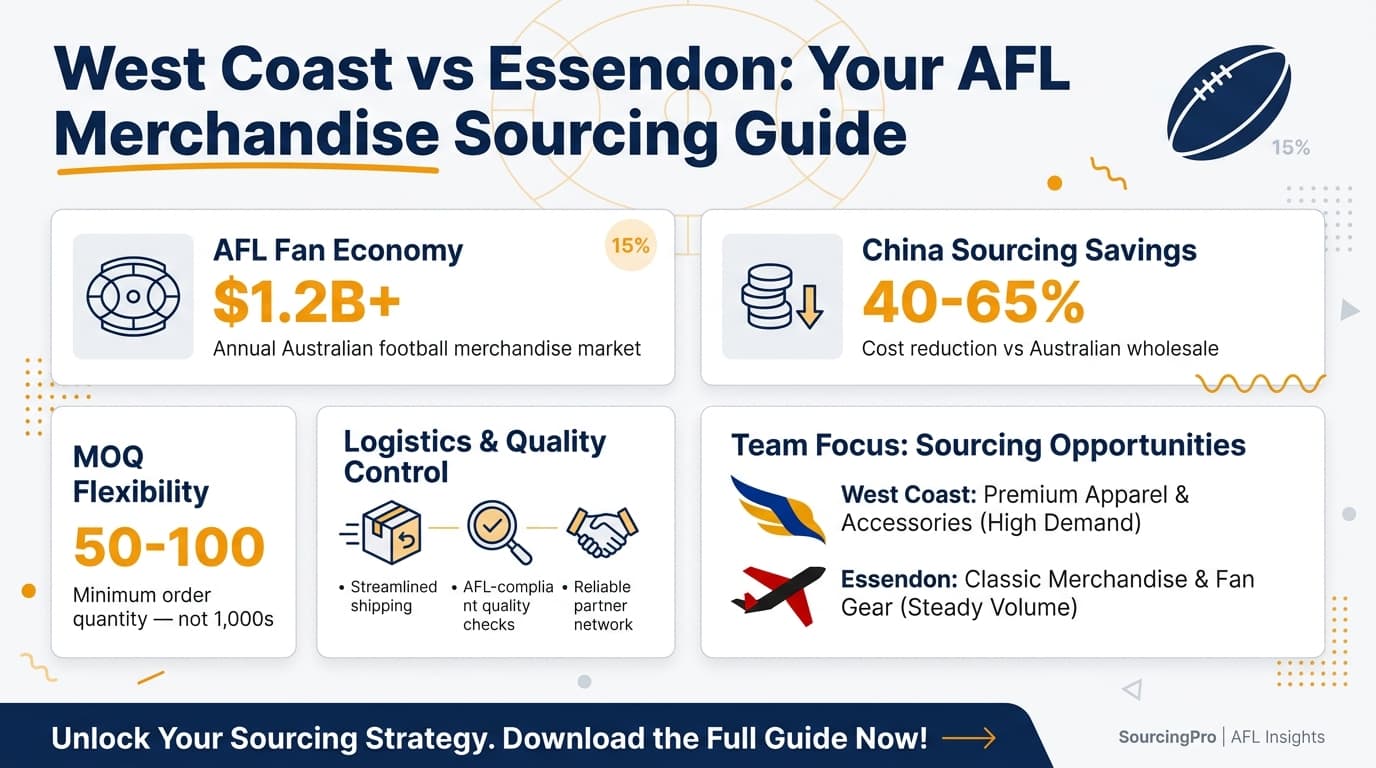
When West Coast faces Essendon at Optus Stadium, the sea of blue and gold clashing with red and black is more than a spectacle — it is a merchandise opportunity waiting to be captured. AFL fans spend an average of $180 per person on team gear each season, yet most local clubs and independent retailers are locked out of the supply chain. Official licensing agreements funnel production through a handful of major sportswear brands, leaving grassroots organisations paying retail markup on products their members could buy themselves at Rebel Sport.
There is a better way. Chinese manufacturers — the same factories producing for global sportswear brands — can manufacture custom AFL fan merchandise at wholesale rates that make community pricing viable. This guide covers how Australian clubs, sports retailers, and fan organisations can source quality team gear directly from China, navigate the licensing landscape, and build merchandise programs that actually generate surplus.
The West Coast vs Essendon Rivalry: What It Means for Merchandise Demand
West Coast and Essendon may not share the traditional suburb-versus-suburb proximity of a Carlton-Collingwood rivalry, but their clashes consistently rank among the highest-attended AFL fixtures outside Victoria. When these two powerhouse clubs meet, merchandise sales in Western Australia spike measurably — and retailers who understand the demand cycle can plan sourcing well in advance.
A Rivalry That Moves Product
The Eagles-Bombers matchup brings together two of the AFL's largest membership bases. West Coast consistently exceeds 100,000 members, while Essendon's supporter base spans every Australian state. When they play, the combined fan presence creates demand across multiple merchandise categories simultaneously — guernseys for match day, scarves for the winter terrace, beanies for the evening fixture, and flags for the pre-game march.
This concentrated demand is not limited to Perth or Melbourne. Essendon has strong supporter communities in Western Australia, and West Coast fans travel well to Marvel Stadium. Every interstate clash creates micro-markets for team merchandise in airports, hotels, and fan gathering venues along the travel corridor.
How AFL Fan Passion Translates to Consistent Sales
Unlike major American sports where merchandise demand cycles around a single championship period, AFL fandom generates year-round purchasing. The 24-round home-and-away season creates 22 to 24 merchandise events per club annually, plus pre-season, rivalry rounds, and finals. Even during the off-season, Christmas gifting and membership renewal packs sustain baseline demand.
For sourcing purposes, this means Australian businesses are not chasing a single seasonal spike — they are managing a continuous supply chain with predictable peaks. Understanding this rhythm is the foundation of profitable merchandise planning.
| Demand Period | Timing | Key Merchandise Categories | Sourcing Lead Time Required |
|---|---|---|---|
| Pre-season | January-February | Training singlets, caps, drink bottles | Order by October |
| Season launch | March | Guernseys, scarves, beanies | Order by November |
| Rivalry rounds | April-July | Commemorative scarves, banner flags | Order 10 weeks prior |
| Finals push | August | Premium guernseys, hoodies | Order by May |
| Grand Final | September | Championship merchandise | Air freight for speed |
| Christmas gifting | November-December | Gift packs, youth apparel | Order by August |
What AFL Fans Actually Buy: The Merchandise Opportunity Breakdown
Understanding what AFL fans purchase — and at what price points — is essential before committing to a sourcing strategy. The merchandise market breaks into distinct categories, each with different margin profiles, minimum order requirements, and manufacturing considerations.
Product Categories with Highest Margins
Scarves and beanies consistently deliver the strongest margins in AFL merchandise. Production costs for knitted acrylic scarves from Chinese manufacturers range from A$2.80 to A$5.50 per unit depending on complexity, while Australian retail pricing for team scarves sits comfortably at A$25 to A$40. That margin gap — often exceeding 80% — is what makes fan merchandise a viable revenue stream for clubs and retailers.
Custom guernseys require higher minimum orders and more complex production, but they command premium pricing that justifies the investment. Beanies and caps occupy the middle ground: moderate production costs, broad appeal, and simpler logistics due to one-size-fits-most sizing.
Price Points Australian Fans Will Pay
Australian AFL supporters have clear price expectations shaped by decades of purchasing from club shops and major retailers. These expectations create both floor and ceiling prices that sourcing strategies must respect.
| Product | China Production Cost (AUD) | Typical Australian Retail | Gross Margin |
|---|---|---|---|
| Knitted team scarf | $3.50-$5.50 | $29.95-$39.95 | 82-86% |
| Acrylic beanie | $2.80-$4.50 | $19.95-$29.95 | 80-85% |
| Custom guernsey (sublimated) | $12-$18 | $69.95-$99.95 | 75-82% |
| Pom-pom beanie | $3.50-$5.00 | $24.95-$34.95 | 80-85% |
| Team polo shirt | $8-$14 | $44.95-$69.95 | 72-80% |
| Banner flag (900x600mm) | $2.00-$3.50 | $19.95-$24.95 | 82-90% |
| Hoodie (fleece-lined) | $14-$22 | $59.95-$89.95 | 70-76% |
| Youth guernsey | $9-$14 | $49.95-$69.95 | 72-80% |
A Perth-based fan club supplying 200 members with custom scarves at A$30 each — produced at A$4.80 per unit from a verified Guangzhou manufacturer — generates A$5,040 in surplus from a single product line. That is money that stays in the club rather than flowing to a national retail chain.
Sourcing AFL Fan Gear from Chinese Manufacturers
The factories that produce for the world's largest sportswear brands are concentrated in specific regions of China, and many will accept orders from Australian businesses at quantities far lower than most retailers assume. The key is knowing where to look and how to approach supplier relationships.
Why China for AFL Merchandise
China has been the global centre of textile and apparel manufacturing for over three decades. The infrastructure advantages — integrated supply chains where yarn suppliers, knitting mills, dye houses, and finishing facilities operate within the same industrial precinct — cannot be replicated elsewhere at comparable cost. For AFL merchandise categories dominated by knitted and cut-and-sew products, these clusters deliver quality, speed, and pricing that domestic production cannot match.
Australian businesses sometimes express concern about quality consistency from Chinese manufacturers. The reality is more nuanced: factories producing for European football clubs and NBA teams already operate at quality levels exceeding Australian consumer expectations. The challenge is not finding capable manufacturers — it is identifying which of the thousands of factories will treat a 500-unit order with the same care as a 50,000-unit order.
Key Manufacturing Regions for Sports Apparel
Different Chinese manufacturing regions specialise in different product categories relevant to AFL merchandise:
Guangdong province (Guangzhou, Dongguan, Shenzhen): The primary hub for knitted accessories — scarves, beanies, caps — and cut-and-sew apparel including guernseys and polo shirts. Factories here routinely produce for European football clubs and understand the colour-matching precision that sports fans demand.
Zhejiang province (Yiwu, Ningbo, Hangzhou): The global centre for promotional merchandise including flags, banners, temporary tattoos, and novelty fan items. Yiwu's wholesale markets support very low minimum order quantities, making it ideal for small clubs testing new product lines.
Jiangsu province (Suzhou, Wuxi): Specialised in mid-to-premium knitted garments including fleece hoodies and performance wear. The quality tier here suits clubs seeking merchandise that competes with major brand offerings.
Shandong province (Qingdao): Strong in cotton and cotton-blend apparel, particularly t-shirts and polo shirts. Many factories in this region hold certifications required by Australian import standards.
Minimum Order Quantities That Work for Australian SMEs
The single most common misconception among Australian businesses is that Chinese factories require container-load minimum orders. In practice, many manufacturers serving the sports merchandise sector accept orders far below that threshold:
| Product | Typical MOQ | Negotiable To | Best Region |
|---|---|---|---|
| Knitted scarves | 200-300 pcs | 100 pcs (solid colour) | Guangdong |
| Beanies | 200-500 pcs | 100 pcs | Guangdong |
| Sublimated guernseys | 50-100 pcs | 30 pcs (surcharge applies) | Guangdong |
| Banner flags | 100-200 pcs | 50 pcs | Zhejiang (Yiwu) |
| Embroidered caps | 200-300 pcs | 100 pcs | Guangdong |
| Screen-printed tees | 100-200 pcs | 50 pcs | Shandong |
The trade-off for lower quantities is higher per-unit pricing — typically a 15-25% surcharge below the standard MOQ. For clubs testing a new product or retailers launching a pilot range, this premium is often worthwhile to validate demand before committing to full production volumes.
The Licensing Question: Official vs Fan-Inspired Merchandise
The AFL licensing system controls who can produce products bearing club logos, names, mascots, and guernsey designs. Understanding where the lines are drawn — and where creative alternatives exist — determines what sourcing strategy is available to your organisation.
AFL Licensing Requirements
Every AFL club name, logo, mascot, and guernsey design is a registered trademark. The AFL's commercial arm grants master licences to major apparel partners — currently encompassing brands like Puma, Castore, and O'Neills across different clubs — for core product categories. These master licensees control the wholesale supply of officially branded merchandise to retailers.
For independent retailers, the primary path to selling official AFL merchandise is wholesale purchasing from authorised distributors. This approach ensures compliance but compresses margins, as the wholesale price already includes the licensee's margin and the AFL's royalty. Community clubs face the same dynamic: buying official merchandise at wholesale rates that still leave limited room for fundraising markup.
The Fan-Inspired Alternative
A significant and growing segment of the AFL merchandise market operates outside the official licensing system entirely — not through counterfeiting, but through original designs that reference club culture without using protected trademarks.
This category includes colour-block scarves in team combinations without logos, apparel featuring original artwork inspired by club history and iconography, homewares and accessories in team colours, and novelty items referencing football culture through humour rather than branding. The legal principle is straightforward: colours and numbers are not trademarkable. A blue-and-gold scarf with an eagle motif designed by a local artist does not infringe West Coast's intellectual property if it avoids the club's registered logo, wordmark, and guernsey design.
For community clubs and independent retailers, the fan-inspired approach offers material advantages: no licensing fees or royalties, no approval delays from rights holders, full creative control over designs, and the ability to create merchandise that reflects local supporter culture rather than national marketing campaigns.
Quality Control for AFL-Style Products
Australian sports fans notice quality. A scarf that fades after one winter, a beanie that loses shape, or a guernsey where the colours do not quite match what they see on television — these failures generate complaints, returns, and reputational damage that far exceed the cost of preventing them.
Fabric, Print, and Colour Standards
Colour accuracy is the single most sensitive quality dimension for AFL merchandise. A West Coast blue that leans too navy, or an Essendon red that reads as orange under stadium lights, will be noticed immediately by fans who have spent decades memorising their club's exact shade. Chinese manufacturers experienced in sports merchandise understand this and will request Pantone references before production begins.
Fabric weight and hand-feel matter particularly for scarves and beanies, where Australian consumers expect a certain density and softness. Specifying yarn count (typically 2/28 NM for standard acrylic scarves) and providing a physical reference sample eliminates ambiguity that written specifications alone cannot resolve.
Pre-Shipment Inspection Checklist
Before accepting delivery of any AFL merchandise order from China, Australian importers should verify the following:
- Colour match against approved Pantone references under natural daylight
- Stitch density and evenness across the production run (checking 10% of units minimum)
- Print or embroidery placement consistency — logos centred, straight, and properly positioned
- Size conformity against the approved size specification chart
- Fibre content labelling meets Australian mandatory standards
- Care instruction labels included and legible
- Packaging integrity — no moisture damage, loose threads, or soiling
Engaging a third-party inspection service in China costs approximately A$250-A$400 per inspection day and provides independent verification before goods are shipped. For first orders with a new supplier, this investment pays for itself by catching issues while the factory can still correct them.
Getting Your Order from Factory to Australia
The logistics of importing textiles from China are well-established, but first-time importers frequently underestimate both the timeframes and the documentation requirements involved.
Shipping Options and Timelines
Most AFL merchandise orders — being relatively light textile products — will ship by sea freight as Less than Container Load (LCL) cargo. This balances cost against speed for the typical 2-10 cubic metre order that a club or independent retailer would place.
| Method | Transit Time | Cost per Cubic Metre (AUD) | Best For |
|---|---|---|---|
| Sea freight LCL | 20-30 days | $150-$250 | Standard orders, 2-10 cubic metres |
| Sea freight FCL | 15-22 days | $1,800-$3,500 (20ft container) | Large orders over 15 cubic metres |
| Air freight | 3-7 days | $4.50-$8.00 per kg | Urgent replenishment, sample runs |
| Express courier | 3-5 days | $12-$25 per kg | Samples only, small test orders |
For the typical seasonal planning cycle, sea freight LCL works for orders placed 8-10 weeks before merchandise is needed. Building in a 2-week buffer for customs clearance and last-mile delivery prevents the stress of match-day stockouts.
Customs Clearance for Textile Imports
Textile products entering Australia require accurate HS code classification, customs valuation based on the transaction value method, and compliance with mandatory labelling standards under the Competition and Consumer Act. Most AFL merchandise falls under Chapter 61 (knitted apparel and accessories) or Chapter 65 (headwear) of the customs tariff.
Products made from wool or containing wool blends may attract additional biosecurity scrutiny from the Department of Agriculture, Fisheries and Forestry. Providing manufacturer declarations confirming treatment status avoids clearance delays. For businesses importing their first container, engaging a licensed customs broker for the initial shipments is strongly recommended — the broker's fee (typically A$150-A$250 per entry) is modest compared to the cost of an audit triggered by a classification error.
FAQ
Can I sell AFL merchandise without an official licence?
You cannot sell products bearing official AFL club logos, names, mascots, or guernsey designs without a licence or wholesale arrangement with an authorised licensee. However, you can sell original merchandise in team colours with custom artwork that does not reproduce protected trademarks. Many successful fan merchandise businesses operate entirely in this fan-inspired category, generating strong sales without licensing costs.
Where in China should I source AFL-type scarves and beanies?
Guangdong province — particularly the textile manufacturing precincts around Guangzhou and Dongguan — is the primary source for knitted sports accessories. Factories in this region produce for European football clubs, NBA teams, and major sportswear brands. They understand colour accuracy requirements, fan quality expectations, and the seasonal production cycles that sports merchandise demands.
What is the minimum order quantity for custom AFL guernseys from China?
Sublimated custom guernseys can be ordered from 30-50 pieces per design, though the per-unit cost at these quantities will be 15-25% higher than orders of 100+ pieces. The sublimation printing process used for custom sports apparel makes smaller runs feasible because there are no screen setup costs — the design is printed digitally onto transfer paper and heat-pressed onto the fabric.
How long before the AFL season should I place my China production order?
For merchandise needed by March, place orders by November of the previous year. This allows 30-45 days for production, 20-30 days for sea freight, 5-7 days for customs clearance, and a 2-week buffer for unexpected delays. Air freight can compress this timeline for urgent orders but at significantly higher per-unit shipping cost.
What do I need to clear AFL merchandise through Australian customs?
You will need a commercial invoice from your supplier, a packing list, a bill of lading or air waybill, and an import declaration lodged through the Integrated Cargo System. Textile products require correct HS code classification (typically Chapter 61 or 65) and must carry fibre content and care instruction labels that comply with Australian Consumer Law. A licensed customs broker can handle the declaration lodgement and classification for first-time importers.
How do I ensure the colours match my club's official team colours?
Provide your manufacturer with Pantone colour references — not digital RGB or CMYK values — for every colour in your design. Request a lab dip (a small fabric sample dyed to your specification) before production begins. Approve the lab dip in writing only after checking it under natural daylight. For critical colour elements like guernsey base colours, request a pre-production sample that applies the approved dye formula to the actual production fabric.
The West Coast vs Essendon rivalry represents exactly the kind of AFL fixture that drives merchandise demand — loyal, large fan bases converging for a contest that matters. For Australian clubs, sports retailers, and fan organisations, the opportunity lies not in competing with the official licensees on their own terms, but in offering products that the official supply chain cannot: custom designs, community pricing, and merchandise that reflects local supporter culture rather than national marketing templates.
Chinese manufacturers — the same factories supplying the world's biggest sportswear brands — can produce this merchandise at costs that make community-level pricing viable while delivering margins that sustain club operations. The barrier has never been manufacturing capability. It has been knowledge: knowing where to source, how to specify quality, how to navigate customs, and how to build supplier relationships that reward loyalty with better pricing and priority production slots.
Winning Adventure Global works with Australian businesses to bridge this knowledge gap — from supplier identification and factory audits through to quality control and logistics coordination. If your club or retail business is ready to explore what custom AFL merchandise sourcing could look like, our team can provide a cost estimate based on your specific product requirements.
Real-world application: An Adelaide-based AFL supporters group sourced 350 custom scarves from a verified Guangzhou manufacturer for the 2025 season. Production cost was A$4.20 per scarf — landed cost including freight and customs brokerage came to A$5.80 per unit. The scarves sold to members at A$28 each, generating A$7,770 in surplus that funded club equipment, travel subsidies for regional members, and a junior development program. The same group had previously paid A$15.50 per scarf through an Australian promotional products distributor.
Sources and References:
- AFL: Commercial partnerships and licensing
- West Coast Eagles: Official club membership and merchandise
- Essendon Football Club: Official merchandise
- Australian Border Force: Importing goods — textiles and apparel
China Sourcing Strategy
Official AFL merchandise margins too thin? Switch to custom fan gear sourced from China — start with a free cost comparison.
Paying retail markup for licensed team merchandise eats your margins before you make a sale. Chinese manufacturers produce custom AFL guernseys, scarves, and beanies at 60% below wholesale — and Winning Adventure Global handles supplier vetting, quality control, and logistics. Submit an enquiry to see your landed cost estimate.
Request Free Cost EstimateFree initial consultation · We respond within 4 business hours