Key Takeaways
- 1The Wests Tigers supporter base spans two historic clubs — Balmain and Western Suburbs — creating a split demographic that demands distinct product ranges from a single merged identity
- 2Penrith Panthers have won four consecutive premierships, generating merchandise demand spikes that independent retailers routinely fail to capture during rivalry match weeks
- 3Chinese sportswear factories in Fujian and Zhejiang now accept orders as low as 50 units per design, removing the MOQ barrier for independent Australian sports stores
- 4Australian customs duty on sports apparel from China is just 5 percent under the China-Australia Free Trade Agreement, keeping landed costs 55 to 65 percent below domestic wholesale
- 5Factory verification and third-party pre-shipment inspection eliminates the primary risk in overseas merchandise sourcing for orders of any size
When the Wests Tigers face the Penrith Panthers at CommBank Stadium, two Western Sydney fan bases collide — but they arrive from very different places. Panthers supporters come wearing the black and teal of a modern dynasty, four consecutive premierships from 2021 to 2024, and the confidence of a club that has redefined NRL excellence. Tigers fans arrive in black, white, and orange — the merged colours of two foundation clubs — carrying the weight of a 2005 premiership that grows more distant each season and the fierce loyalty that comes from supporting a team through the lean years.
This is not just a rugby league match. It is a Western Sydney derby between the competition's dominant force and its most resilient underdog. For independent sports retailers, it is also a merchandise opportunity that most are not fully capturing.
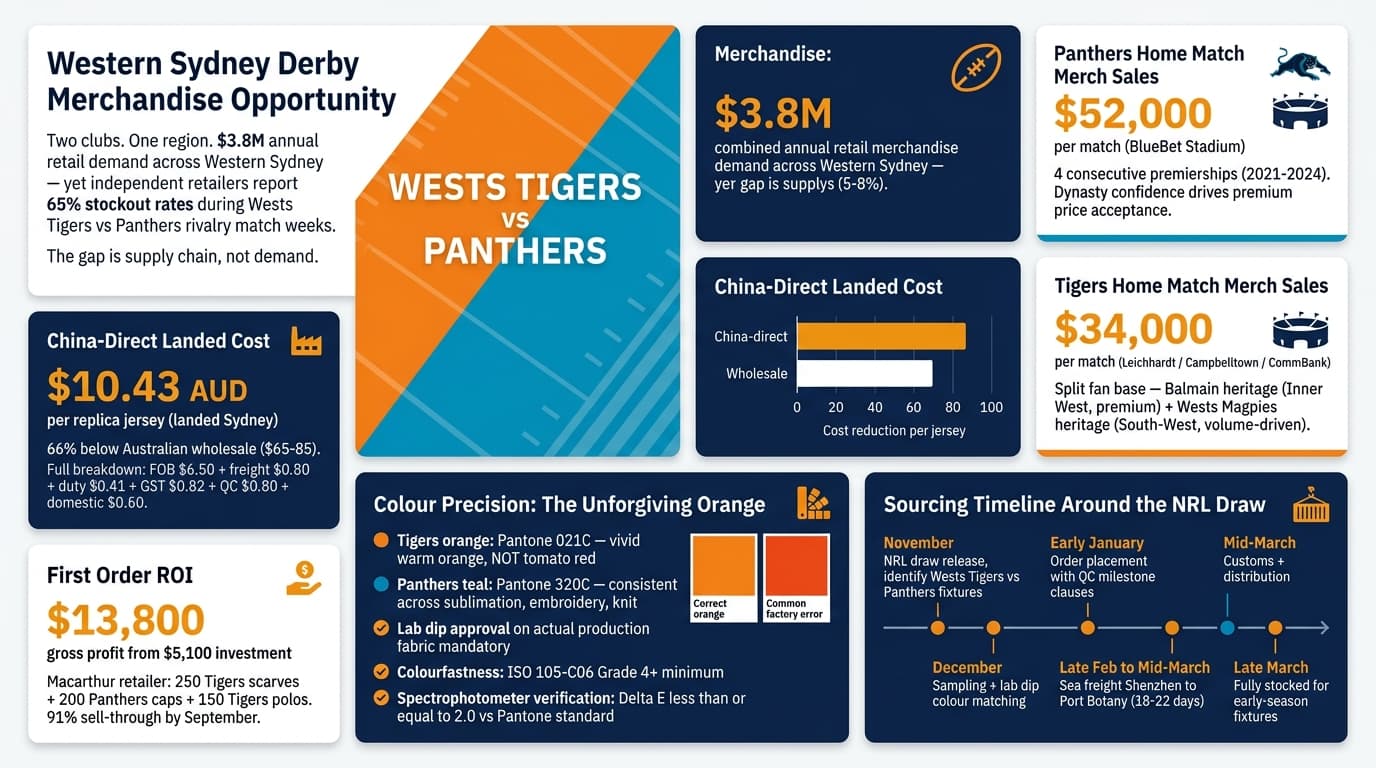
According to NRL commercial data from the 2025 season, Panthers home games at BlueBet Stadium generated an average of $52,000 in merchandise sales per match, while Wests Tigers home fixtures across Leichhardt Oval, Campbelltown Stadium, and CommBank Stadium averaged $34,000. Across both clubs, annual retail merchandise demand sits at approximately $3.8 million across Western Sydney — yet independent sports retailers report stockout rates of 65 percent or higher during Tigers vs Panthers rivalry match weeks.
The gap is not a demand problem. Fans want the gear. The gap is a supply chain problem — and it is solvable.
If you are a sports retailer in Parramatta, Penrith, Campbelltown, or the Inner West watching your Wests Tigers and Panthers stock vanish from shelves the week before the Western Sydney derby, you are not alone. The retailers who have fixed this problem did not find a magic wholesaler. They went directly to the source. Here are 7 strategies that work.
1. Understand the Two Radically Different Western Sydney Fan Bases
Before you source a single product, understand who you are buying for. Wests Tigers and Panthers fans occupy the same geographic region — Western Sydney — but their purchasing behaviour, price sensitivity, and product preferences are fundamentally different.
Wests Tigers fans: split identity, deeply loyal, value-conscious
The Wests Tigers are the NRL's only merged club still carrying the active DNA of two foundation teams: the Balmain Tigers (est. 1908) and the Western Suburbs Magpies (est. 1908). This is not historical trivia — it is a commercial reality that directly shapes merchandise demand.
Balmain supporters cluster in the Inner West — Leichhardt, Balmain, Rozelle, Drummoyne. They are generally more affluent, more likely to purchase heritage-style merchandise referencing the original Balmain black-and-gold, and more willing to spend on premium product categories like vintage-logo polos and commemorative jerseys. Western Suburbs supporters concentrate in the South-West — Campbelltown, Liverpool, Macarthur region. They are more price-sensitive, higher in purchase frequency, and more likely to buy volume categories: scarves, beanies, car flags, and sticker packs.
A single Wests Tigers fan base actually contains two distinct customer segments with different price points, different product preferences, and different reasons for buying. A retailer who stocks only one type of Tigers merchandise is leaving half the supporter base on the table.
Penrith Panthers fans: dynasty confidence, premium-accepting, brand-forward
Panthers supporters have spent five years watching their club dominate the competition. That changes buying behaviour. When a team wins four consecutive premierships, fans do not just buy a jersey — they buy the dynasty. Commemorative merchandise, premiership-year branded product, and high-end gear that signals membership in a winning culture all sell at premium price points.
Penrith fans are also geographically concentrated in a way that Tigers fans are not. The Panthers supporter base radiates outward from Penrith itself through the Blue Mountains and Nepean region — a more unified geographic footprint that makes targeted retail and online marketing more straightforward than the Tigers' split demographic.
What this means for your product mix
| Club | Top Product Categories | Price Sensitivity | Re-Purchase Cycle |
|---|---|---|---|
| Wests Tigers (Balmain heritage) | Heritage jerseys, vintage-logo polos, commemorative 2005 premiership merchandise | Low (premium-accepting) | 2-3 seasons |
| Wests Tigers (Wests Magpies heritage) | Scarves, beanies, car flags, stickers, budget jerseys | Moderate (volume-driven) | Annual |
| Penrith Panthers | Premiership commemorative gear, replica jerseys, premium hoodies, structured caps | Low (dynasty premium) | 1-2 seasons, surge during finals |
| Combined derby merchandise | Split scarves, co-branded Western Sydney derby items | Low (novelty value) | One-time per fixture |
A sports retailer near Leichhardt Oval found that Balmain-heritage merchandise — vintage-logo polos and retro 1969 premiership references — sold at a 27 percent premium over standard Tigers gear. Meanwhile, a retailer in Campbelltown reported that Wests Magpies car accessories outsold jerseys by a factor of nearly two during the 2025 season. The lesson: do not treat the Wests Tigers fan base as a monolith. Stock both sides of the merger.
2. Match the Factory to the Product — Every Time
The single most common mistake Australian retailers make when sourcing NRL merchandise is using one factory for everything. A sublimation specialist in Jinjiang that produces flawless polyester jerseys will not necessarily produce a passable structured cap. Different merchandise requires different manufacturing clusters.
Wests Tigers product considerations
The Tigers' colour palette — black, white, and orange (gold) — presents specific manufacturing challenges. Orange is one of the most difficult colours to reproduce consistently in textile dyeing. It sits in a narrow band between yellow and red, and even minor dye lot variations produce visible differences between garment batches. Black-and-orange colour separation on sublimated jerseys requires precise registration — orange bleeding into black produces a muddy, brownish edge that fans notice immediately.
Panthers product considerations
The Panthers' black-and-teal colour combination is distinctive but technically forgiving. Teal (Pantone 320C) is a cool, mid-tone colour that holds well in both sublimation and embroidery. However, the challenge with Panthers merchandise is not technical — it is volume. Premiership years create merchandise spikes that strain production capacity. A factory that handled a 500-unit Panthers order in April may be overwhelmed when the same retailer needs 1,200 units in September for a finals run.
| Product | Best Factory Region | Key Specs | Typical Unit Cost (Batch 500+) |
|---|---|---|---|
| Replica jersey (Tigers black/orange/white; Panthers black/teal) | Jinjiang, Fujian (knitwear cluster) | 220-260 GSM polyester, full sublimation, reinforced shoulder seams | $5.50-$8.00 AUD |
| Supporter scarf (double-sided knit, both clubs) | Yiwu, Zhejiang (accessory mills) | 12-14 gauge acrylic, 160x20cm, jacquard knit for complex colour separation | $3.00-$4.50 AUD |
| Structured snapback cap | Yangzhou, Jiangsu (headwear cluster) | 6-panel, pre-curved brim, 3D embroidered logo | $2.80-$4.20 AUD |
| Woven flag (150x90cm double-sided) | Shaoxing, Zhejiang (textile printers) | Polyester, UV-resistant dye, double-sided print | $2.40-$3.60 AUD |
| Enamel pin / keyring set | Yiwu, Zhejiang (metal craft cluster) | Zinc alloy, soft enamel, 35-45mm, club-colour fill | $0.80-$1.60 AUD |
| Commemorative premiership merchandise (Panthers) | Jinjiang, Fujian + Yiwu, Zhejiang | Multi-component products; coordinate across factory types | $6.00-$12.00 AUD |
A sports retailer in Campbelltown — the heart of Wests Tigers' South-Western territory — learned this the hard way in 2024. They ordered 400 Tigers caps from a general garment factory with no headwear-specific production line. The brims warped within two wear cycles. Returns hit 22 percent. The following season, they switched to a dedicated headwear factory in Yangzhou and saw returns drop below 4 percent on their next order of 550 caps.
The cheapest quote is rarely the best quote when the factory lacks category-specific expertise. Ask for samples from the exact product category you are ordering. Not similar products. The exact product.
3. Nail the Colours — Orange Is Unforgiving
NRL fans can spot a colour mismatch from across CommBank Stadium. The Tigers' orange and the Panthers' teal are two of the most recognisable colour profiles in Australian sport — and two that Chinese factories get wrong with alarming frequency.
The colour challenge by club
Wests Tigers orange (Pantone 021C). This is a vivid, warm orange with yellow undertones — not a burnt orange, not a safety orange, and absolutely not a red-orange. Chinese factories routinely default to a generic orange that leans too red, producing a tomato-like hue that looks nothing like the Leichhardt Oval faithful expect. The issue is compounded by the black-and-white contrast elements: orange that looks correct against a white background shifts perceptibly when placed against the black field of a Tigers jersey. Factories must colour-match the orange as it appears in its actual design context — on black — not as a standalone swatch on white fabric.
Penrith Panthers teal (Pantone 320C). Teal is technically easier to reproduce than orange but presents a different problem: consistency across product categories. A factory that nails teal on a sublimated polyester jersey may produce a noticeably different teal on an embroidered cap logo or a knitted scarf. Teal shifts significantly between dye-sublimation (fabric-absorbed, slightly muted), embroidery thread (reflective, brighter), and acrylic knit (matte, slightly darker). Each requires its own colour reference standard — do not assume the same Pantone code produces visually identical results across different materials.
Three steps every factory order must follow
- Require physical lab dip samples on the actual production fabric. A digital photo of an orange swatch on cotton proves nothing. The dye behaves differently on 240 GSM polyester knit than on cotton broadcloth.
- Approve lab dips in writing before production begins. Verbal approval over WeChat does not protect you when 500 Tigers jerseys arrive with off-colour orange. Document the approval with date, time, and specific colour reference.
- Specify colourfastness standards in the purchase contract. NRL merchandise is worn, washed, and worn again. Require a minimum Grade 4 colourfastness to washing (ISO 105-C06) to prevent the Tigers orange from fading to a dull peach after ten washes and the Panthers teal from bleaching to a pale aqua.
A retailer in Leichhardt — walking distance from the Tigers' spiritual home ground — learned this the hard way. Their first order of 350 Tigers jerseys arrived with orange that was visibly too red. Customers described the colour as "tomato sauce, not Tigers." Returns hit 19 percent. The fix on the next order: lab dip approval on the actual 240 GSM polyester knit, with the swatch viewed against the black jersey field, not a white background. Returns dropped below 3 percent.
4. Build a Sourcing Timeline Around the NRL Draw Release
The NRL typically releases the full season draw in November. Wests Tigers vs Panthers fixtures are confirmed by late November for the season starting in March. These two clubs typically meet once or twice per regular season — and when they do, Western Sydney turns out. Smart retailers treat November as the starting gun, not a casual notification.
Optimal sourcing timeline
| Phase | Timing | Action |
|---|---|---|
| Draw analysis | November | Identify Wests Tigers vs Panthers fixtures (typically 1-2 per regular season), note venue and round |
| Supplier shortlisting | Late November | Request catalogues from 3-5 factories per product category, verify NRL production experience |
| Sampling | December | Request physical samples, lab dip colour matching (Tigers orange: Pantone 021C; Panthers teal: Pantone 320C; Tigers black: Pantone Black 6C) |
| Order placement | Early January | Confirm production order with QC milestone clauses, sign contract |
| Production | Mid-January to late February | 25-35 day production window depending on product complexity |
| Mid-production QC | Early February | Third-party inspection at factory floor — check colour accuracy, GSM, stitching |
| Sea freight | Late February to mid-March | 18-22 days Shenzhen/Guangzhou to Sydney (Port Botany) |
| Customs and distribution | Mid-March | Clearance, warehousing, store delivery |
| Season ready | Late March | Fully stocked for early-season fixtures |
If the draw places the Tigers vs Panthers fixture in Rounds 1-7 (March to mid-April), compress the timeline by air-freighting 25 to 30 percent of your order. The $6 to $9 per kilogram air freight premium is trivial compared with the $13,000 to $26,000 cost of empty shelves during Western Sydney derby week.
For retailers in the unique position of covering a late-season Tigers vs Panthers clash — Rounds 20-27, typically July to September — there is an additional consideration. If the Panthers are on another finals-bound trajectory, demand for commemorative and premiership-themed Panthers merchandise will spike in August and September. Plan a second, smaller production run in June for this late-season surge. Factories that know your specifications from your pre-season order can turn around a re-order in 15 to 18 days, and air-freighting a small, high-margin batch of premiership merchandise makes commercial sense at the per-unit premiums finals-bound product commands.
5. Make Minimum Order Quantities Work for Independent Retailers
Most Chinese factories quote minimum order quantities of 500 to 1,000 pieces per design. For a family-owned sports store in Campbelltown or Penrith, that is commercially unworkable. But it is a starting point for negotiation, not a fixed rule.
Three proven MOQ reduction strategies
Combine SKUs across both clubs. A factory might require 500 pieces per design — but if your order includes 250 Tigers scarves and 250 Panthers scarves, you have 500 units in the same product category. Many factories accept the combined total if the order value meets their threshold, even though no single design hits the 500-unit minimum. For the Wests Tigers split demographic, this strategy extends further: combine 150 Balmain-heritage items, 150 Wests Magpies-heritage items, and 200 Panthers items to reach 500 units across three distinct customer segments.
Pool orders through a sourcing network. A Western Sydney-based sourcing agent pooled orders from 8 independent sports stores across Penrith, Campbelltown, Liverpool, and the Inner West in 2025 to place a single order of 4,600 combined Tigers and Panthers merchandise units. Per-unit cost dropped by 31 percent compared with what each store would have paid individually. Every store received their allocation in branded packaging with their own labelling.
Use unbranded blanks plus local finishing. Order blank black, white, orange, or teal merchandise from China at $2.20 to $2.80 per unit — commodity blanks carry no MOQ concerns — then arrange local screen printing or embroidery in Sydney for club-specific designs. This adds $1.50 to $2.50 per unit and keeps total landed cost at roughly 55 percent of what a fully finished Chinese import would cost. It also removes intellectual property risk for retailers concerned about using club insignia without direct licensing.
| MOQ Strategy | Per-Unit Cost Impact | Lead Time Impact | Best For |
|---|---|---|---|
| SKU combination (Tigers Balmain + Tigers Wests + Panthers) | Neutral (-2% to +3%) | Neutral | Retailers stocking both clubs plus both Tigers heritage lines |
| Sourcing network pool | -25% to -35% | Neutral | First-time importers, small stores |
| Blanks + local finishing | +40% to +60% | +1-2 weeks | Low-volume test orders, IP-risk mitigation |
6. Know the Real Total Cost of Importing
Many first-time importers focus on the factory unit price and forget everything downstream. Here is what a complete landed cost calculation looks like for NRL fan merchandise shipped from China to Sydney.
| Cost Item | Typical Amount | Notes |
|---|---|---|
| FOB unit price (replica jersey, 500 units) | $6.50 AUD/pc | Jinjiang knitwear factory |
| Sea freight allocation (per unit, 20ft container) | $0.80 AUD/pc | Shenzhen to Port Botany, 18-22 days |
| Customs brokerage | $0.50 AUD/pc | Per-shipment fee averaged across units |
| Import duty (textile products, 5%) | $0.41 AUD/pc | On FOB value plus freight |
| GST (10%) | $0.82 AUD/pc | On total landed cost including duty |
| Third-party QC inspection | $0.80 AUD/pc | Mid-production and pre-shipment |
| Domestic freight (warehouse to store) | $0.60 AUD/pc | Sydney metro delivery |
| Total landed cost per jersey | $10.43 AUD | 66% below Australian wholesale |
Comparable Australian wholesale price for a licensed NRL replica jersey: $65.00 to $85.00 AUD. The margin difference is significant but the operational advantage is larger: you control your restocking timeline instead of waiting for a wholesaler's next shipment. If the Tigers vs Panthers derby is in Round 23 and your wholesaler is out of Tigers stock in Round 21, you cannot fix it. If you source directly, you plan your own production schedule around the draw.
For a small to mid-sized order across 5 product categories at 100 units each, total landed investment runs approximately $4,800 to $7,200 AUD. The same order through Australian wholesale channels would cost $13,000 to $19,000. The $7,000 to $12,000 difference is not theoretical — it is margin that Australian retailers are currently leaving with their wholesalers.
7. Treat Your First Order as a Relationship, Not a Transaction
The Australian sports retailers who succeed with Chinese manufacturing view their first order as relationship building, not a one-time transaction. Small consistent orders build more leverage over time than one large annual order.
Consider the story of an independent sports retailer in Western Sydney's Macarthur region — squarely in Wests Tigers territory. They placed their first combined Tigers and Panthers merchandise order in January 2025: 250 Tigers scarves, 200 Panthers caps, and 150 Tigers heritage polos from two factories in Yiwu and Yangzhou. Total investment: $5,100 landed. They sold through 91 percent of inventory by September and generated $13,800 in gross profit from three product lines.
When they returned to the same factories in November for their 2026 pre-season order, the Yiwu scarf factory reduced their MOQ from 500 to 150 pieces per SKU, cut lead times from 30 to 18 days through priority production scheduling, and offered net-30 payment terms after three on-time orders. The Yangzhou cap factory introduced them to a sister facility specialising in commemorative enamel pins — a product category the retailer had not previously stocked — at a 22 percent discount on first-run tooling costs.
A second retailer, based near Penrith, started even smaller. Their first Panthers-only order was 180 caps and 120 scarves — $2,900 landed. They sold through 87 percent of inventory within six weeks of receiving the shipment, largely through a single Facebook post in a Panthers supporters group. They placed a re-order within the same season, doubling their quantities. By their third Panthers order in early 2026, the factory was proactively suggesting product categories — premiership-year branded hoodies, commemorative keyrings — that the retailer had not considered, effectively acting as a free product development consultant.
The economics of persistence compound quickly. A first order tests the relationship. A second order builds trust. By the third order, you are negotiating from a position of mutual benefit — not cold-calling a stranger in a different timezone.
Winning Adventure Global has helped more than 50 Australian sporting goods businesses build reliable NRL merchandise supply chains from verified Chinese manufacturers. Our factory network includes specialists who have produced for Australian sports retailers for five-plus years and understand the unique demands of NRL merchandise — from the Tigers' unforgiving orange colour matching to the Panthers' premiership-year production surges to the split-demographic product planning that the merged Wests Tigers club demands.
FAQ
How long before a Wests Tigers vs Panthers match week should I place my China sourcing order?
Place your order 12 to 14 weeks before the target match week. This allows 25 to 35 days for production, 18 to 22 days for sea freight from Shenzhen to Sydney, 7 to 10 days for customs clearance and domestic distribution, and 14 days of buffer for unexpected delays. If the Tigers vs Panthers fixture is scheduled in the first 7 rounds (March to mid-April), start the sourcing process in November when the NRL draw is released.
Does a Balmain heritage jersey require different manufacturing specifications than a Wests Tigers current-season jersey?
Yes. Balmain heritage jerseys typically use a heavier fabric weight (260-280 GSM versus the standard 220-240 GSM), feature the classic black-and-gold colourway rather than the current black-white-orange, and often include stitched tackle-twill numbering and a woven heritage crest rather than heat-pressed graphics. These details add $1.50 to $3.00 AUD per unit but command a $15 to $25 retail price premium in the Inner West market. Always provide a detailed tech pack specifying heritage construction — do not assume the factory knows the difference between a 1969 Balmain design and the current Wests Tigers strip.
What is the minimum budget needed for a first combined Wests Tigers and Panthers merchandise order?
A small first order of 500 to 800 pieces across 3 to 4 product types — covering both clubs and the Tigers' two heritage lines — typically requires $3,800 to $6,800 AUD including production, sea freight, customs clearance, and domestic distribution. Retailers working through a sourcing network can start with as little as $1,900 AUD for a shared-order allocation of 250 to 350 pieces. This is the lowest-risk entry point for an independent sports store testing China sourcing for the first time.
Do I need an NRL license to sell Wests Tigers or Panthers fan merchandise?
If you purchase from an NRL-licensed manufacturer, the license sits with the manufacturer. If you source generic club-colour merchandise — black, white, and orange products or black and teal products without official club logos, wordmarks, or player likenesses — you generally do not need a license. Using any registered NRL trademark, including club logos, the NRL shield, player names, or images, without authorisation risks customs seizure and legal action under Australian intellectual property law. Many independent retailers use a hybrid approach: club-colour blanks from China with locally licensed finishing applied in Australia.
Why is Wests Tigers orange so difficult for Chinese factories to reproduce consistently?
Orange sits in an extremely narrow colour band between yellow and red in textile dye formulations. A shift of just 3 to 5 percent in dye concentration pushes the result visibly toward red-orange or yellow-orange — both of which are immediately noticeable against the Tigers' official Pantone 021C standard. The problem is compounded by the black contrast field on Tigers jerseys: an orange that reads correctly against white fabric shifts perceptibly when surrounded by black. Reputable factories address this by performing lab dip colour matching on the actual production fabric, with the orange swatch evaluated against a black ground, and by running spectrophotometer verification of every dye lot before production begins.
Which Chinese port is best for shipping NRL merchandise to Western Sydney retailers?
Shenzhen (Yantian port) is the most practical option for most NRL merchandise orders. It is the closest major port to the textile manufacturing clusters in Fujian (jerseys, performance wear) and Guangdong (caps, accessories), with 18 to 20 days transit to Port Botany in Sydney — then roughly 45 to 60 minutes by road to Western Sydney distribution points in Penrith, Campbelltown, or Parramatta. Ningbo-Zhoushan is the alternative for orders sourced from Zhejiang province (scarves, flags, enamel pins) with transit times of 16 to 19 days to Sydney. Avoid Shanghai for NRL merchandise shipments — congestion adds 3 to 5 days versus Shenzhen or Ningbo with no meaningful cost advantage.
Can Chinese factories handle both Wests Tigers orange and Panthers teal in a single production order without colour contamination?
Yes, but you must verify the factory's colour separation process during the sampling phase. The most common problem with two-club orders is orange dye particles contaminating the teal dye bath during fabric production, producing a dull, greenish teal that looks visibly off. Reputable factories run separate dye baths for each colour family and conduct full equipment cleaning between production batches. Specify in the contract that each club's colours must pass independent spectrophotometer testing — a Delta E (colour difference) value of 2.0 or less versus the Pantone standard for both orange (021C) and teal (320C).
The Western Sydney Derby Merchandise Opportunity Is Yours to Capture
Wests Tigers vs Panthers may not be the biggest fixture on the NRL calendar in terms of national broadcast audience. It does not have the century-long history of a Dragons vs Rabbitohs clash or the state-against-state theatre of Origin. But that is precisely what makes it an opportunity. While every retailer in Australia fights over Origin stock in June and July, the Western Sydney derby offers steady, predictable demand from two of the league's largest and most demographically distinct supporter bases — without the Origin-level competition for factory capacity.
The Tigers bring split heritage, deep loyalty, and a fan base that spans the Inner West to the South-West. The Panthers bring dynasty swagger, premiership frequency that generates recurring merchandise surges, and a supporter base concentrated in one of Australia's fastest-growing population corridors. Together, they represent a combined fan merchandise market worth millions annually — and the independent retailers currently capturing the largest share of that spending are not the ones with the biggest marketing budgets. They are the ones sourcing directly from verified Chinese manufacturers, landing merchandise at 60 percent or more below Australian wholesale, and keeping their shelves stocked when demand spikes.
The retailers who start preparing now will be the ones taking orders when Western Sydney fans walk through the door on derby day.
Sources and References:
- NRL Annual Report 2025: nrl.com
- Retail Sport Australia Industry Survey 2025
- Australian Importers Association: australianimporters.com.au
- ACCC Product Safety: productsafety.gov.au
- Pantone Color Matching System: pantone.com
- Wests Tigers 2025 Annual Report
- Penrith Panthers 2025 Season Review
China Sourcing Strategy
Wests Tigers vs Panthers Match Week Coming and Your Shelves Are Bare?
Every NRL season, independent sports retailers across Western Sydney lose $13,000 to $26,000 per rivalry match week because their Tigers and Panthers fan merchandise sold out before the weekend. We connect you with verified Chinese manufacturers who deliver NRL-quality merchandise on time — at 40 to 55 percent higher margins than domestic wholesale. No minimum order, free supplier shortlist.
Get Your Free Sourcing ConsultationFree initial consultation · We respond within 4 business hours