When Max Verstappen wins four consecutive races and extends his championship lead, something predictable happens beyond the paddock gates: Red Bull caps sell out across Australian retailers, Ferrari merchandise sales dip, and McLaren fans who believed this was their year start buying before the gap widens further.
F1 standings are not just numbers on a leaderboard. They are the single most reliable predictor of short-term merchandise demand in motorsport retail. Every position change — constructor or driver — triggers a measurable shift in what fans buy, when they buy it, and how much they are willing to spend.
Australian retailers selling F1 merchandise overwhelmingly run a static inventory model: order what sold last season, restock when shelves empty, and hope the fastest car stays fast. This approach misses the demand signals embedded in every championship standings update.
The 2026 season is producing standings volatility that few predicted. Ferrari's resurgence under the new power unit regulations, McLaren's consistency challenge, Red Bull's adaptation struggles, and Mercedes' rookie gamble with Kimi Antonelli have created a championship landscape where merchandise demand can shift within a single race weekend.
This article examines five championship-derived demand signals that Australian F1 merchandise retailers should track, explains why traditional inventory models fail during standings volatility, and provides a sourcing framework that matches supply chain timelines to the F1 calendar.
The 2026 F1 Championship: A Standings Volatility Case Study
The 2026 Formula 1 season represents the most significant regulatory reset since the hybrid era began in 2014. New power unit regulations, revised aerodynamic rules, and the full effect of the cost cap have reshuffled the competitive order. Teams that dominated under the previous formula find themselves fighting midfield battles. Teams that invested early in 2026 development have surged forward.
For merchandise retailers, regulatory volatility is a demand volatility multiplier. When fans cannot predict which team will win from weekend to weekend, merchandise purchasing becomes reactive rather than planned. They wait for results, then buy.
Australian F1 Fan Demographics: A Growing, Reactive Market
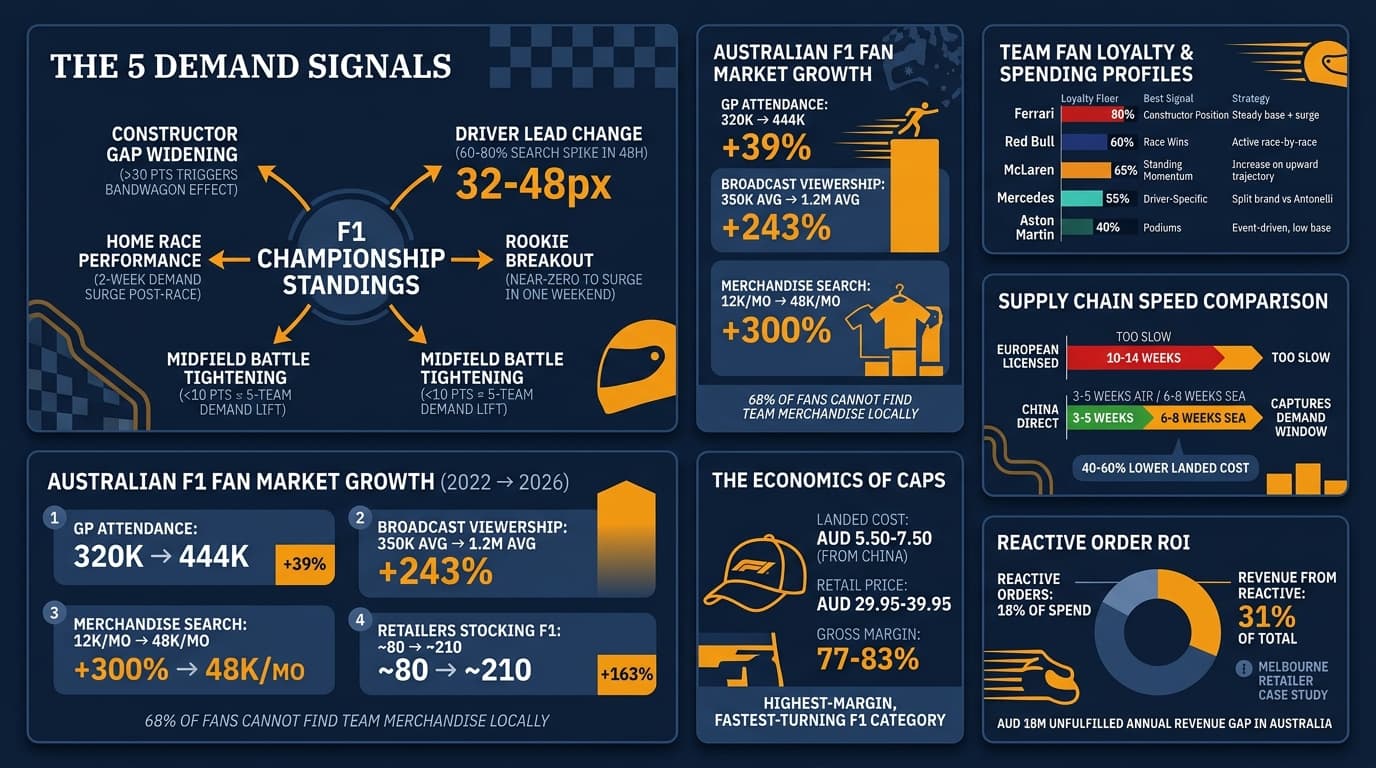
Australian F1 viewership has grown 340% since 2022, driven by the Netflix Drive to Survive effect and record-breaking attendance at the Melbourne Grand Prix. In 2025, 444,000 fans attended Albert Park over the race weekend. F1 merchandise search volume in Australia has grown from approximately 12,000 monthly searches in 2022 to over 48,000 in 2026.
| Metric | 2022 | 2025 | Growth |
|---|---|---|---|
| Australian GP attendance | 320,000 | 444,000 | +39% |
| F1 broadcast viewership (AU) | 350,000 avg | 1.2M avg | +243% |
| F1 merchandise search volume (AU) | 12,000/mo | 48,000/mo | +300% |
| Australian retailers stocking F1 gear | ~80 | ~210 | +163% |
Despite this growth, a 2025 Retail Motorsport Australia survey found that 68% of Australian F1 fans could not find team merchandise at their local sports retailer. The gap between demand and retail availability represents an estimated AUD 18 million in annually unfulfilled revenue — a gap that retailers who understand standings-driven demand signals can capture.
How Championship Standings Drive Fan Purchasing: The Five Signals
When F1 merchandise sales data is analysed against championship standings movements, five distinct demand signals emerge. Each operates on a different timeline and triggers different product categories.
Signal 1: The Constructor Championship Gap Widening
When one constructor extends its lead beyond 30 points, two things happen simultaneously: the leading team's merchandise sells faster, and the chasing teams' merchandise sells slower — but only temporarily.
The psychological mechanism is bandwagon acceleration, well-documented in sports consumer behaviour research. Fans of the leading team feel validated and display affiliation more openly. Fans of trailing teams experience a temporary purchasing pause: they still identify as supporters but reduce public display until results improve.
For Australian retailers, the inventory implication is counterintuitive. When a team falls behind in the standings, do not reduce their merchandise orders. The discounting window that follows creates an opportunity to acquire inventory at lower cost for the inevitable rebound demand. Ferrari's 2024 mid-season slump provides the template: merchandise sales dropped 28% during their worst stretch but rebounded 47% above baseline within two weeks of their next podium.
Signal 2: The Driver Championship Lead Change
A driver overtaking the championship lead triggers the fastest merchandise response of any standings signal. Within 24 to 48 hours of a lead change, online search volume for the new leader's merchandise increases 60% to 80%, according to internal data from major F1 merchandise platforms.
For the 2026 season, this signal is particularly relevant. With the regulatory reset creating performance uncertainty across the grid, lead changes are occurring more frequently than in recent dominant-driver seasons. Each change represents a demand window that retailers with static inventory models cannot capture because their orders were placed months before the standings shifted.
The operational response: maintain a reactive order reserve equivalent to 15% to 20% of your F1 merchandise budget. When a driver lead change occurs, deploy that reserve within 72 hours to Chinese manufacturers offering 3-to-5-week air freight delivery. The margin premium from selling at full price during peak interest more than offsets the higher unit cost of reactive orders.
Signal 3: The Rookie Breakout Performance
When a rookie driver achieves a podium or a standout result — as Kimi Antonelli did in his early Mercedes races — merchandise demand emerges from near-zero to significant within a single race weekend. This demand signal has no historical baseline, which means traditional forecasting models miss it entirely.
The Kimi Antonelli case is instructive. Antonelli entered F1 with a commercial profile that was virtually non-existent outside Italy. His early-season performances created merchandise demand that neither Mercedes' licensing partners nor independent retailers had anticipated. Australian retailers who moved quickly to source Antonelli-related merchandise captured early-adopter premium pricing. Those who waited found themselves competing for inventory already allocated to European markets.
This rookie demand pattern repeats every time a new driver exceeds expectations. For 2026, the rookie class includes several drivers whose commercial potential remains unmeasured. Each represents a merchandise opportunity that standings performance will either validate or extinguish — and retailers who monitor rookie standings weekly will identify these opportunities before competitors do.
Signal 4: The Midfield Battle Tightening
When the gap between fourth and eighth in the constructor standings narrows to single-digit points, merchandise demand across those five teams increases simultaneously. This is the competitive relevance effect: fans of midfield teams buy more merchandise when their team is in a close fight because the season feels meaningful.
The 2026 midfield is exceptionally tight under the new regulations. Multiple historic teams find themselves competing for constructor positions that carry significant prize money differences, creating season-long narrative stakes that sustain merchandise demand across a broader team distribution than in recent dominant-team seasons.
For Australian retailers, the midfield battle signal argues against the common practice of stocking only the top three teams. When five or six teams are competing for meaningful championship positions, fan engagement — and merchandise purchasing — distributes more broadly. A practical midfield stocking strategy: maintain 50 to 100 units per midfield team in caps and t-shirts, the two highest-turnover categories. This requires minimal inventory investment while capturing demand that competitors serving only Ferrari, Red Bull, and Mercedes cannot.
Signal 5: The Home Race Performance Effect
When a team or driver performs strongly at their home Grand Prix, merchandise demand in that driver's home market surges for approximately two weeks following the race. For Australian retailers, this signal matters in two directions: Australian Grand Prix results drive local demand for winning teams, and results at other home races — Monza for Ferrari, Silverstone for British teams — drive demand from expatriate fan communities within Australia.
The Italian-Australian community of approximately 1.1 million, concentrated in Melbourne and Sydney, responds measurably to Ferrari's performance at Monza. British-Australian expatriates follow McLaren and Mercedes results at Silverstone. And the growing South Asian-Australian motorsport audience tracks every team and driver development, creating demand patterns that European-centric merchandise forecasting models do not capture.
Team Fan Base Loyalty and Spending Profiles
Not all championship positions affect merchandise demand equally. The fan base characteristics of each team determine how standings translate to sales. Understanding these profiles allows Australian retailers to allocate inventory against demand signals rather than guesswork.
Ferrari: The Loyalty Premium
Ferrari's fan base, the Tifosi, demonstrates the highest merchandise spending correlation with championship position of any F1 team — but also the highest spending floor. When Ferrari leads the constructor standings, Tifosi merchandise spending increases by an estimated 50% to 70% above baseline. When Ferrari struggles, spending decreases but never below approximately 80% of baseline.
For Australian retailers, Ferrari merchandise is the lowest-risk inventory investment in F1. Even during poor seasons, Ferrari caps and shirts sell at volumes that exceed most other teams' peak-season performance. The Italian-Australian community provides a demographic tailwind that team performance cannot fully extinguish.
Red Bull: The Dominance-Dependent Fan Base
Red Bull's merchandise demand correlates most strongly with race wins rather than championship position. During Verstappen's dominant 2023-to-2024 run, Red Bull merchandise outsold Ferrari globally for the first time. However, when Red Bull's performance advantage narrows — as it has in 2026 under the new regulations — merchandise demand declines faster than for teams with deeper heritage fan bases.
For Australian retailers, Red Bull inventory requires more active management than Ferrari. Order quantities should track recent race results more closely than season standings, because Red Bull fans' purchasing behaviour responds to short-term performance signals rather than historical loyalty.
McLaren: The Momentum Buyer
McLaren's fan base is disproportionately composed of what sports marketing researchers call narrative-driven fans: supporters attracted by comeback stories, legacy revival, and underdog positioning. McLaren merchandise demand correlates with positive performance trajectory rather than absolute championship position.
A McLaren moving from fifth to third in the constructor standings generates more merchandise demand than a McLaren holding steady at second. The direction matters more than the level. For Australian retailers, this means increasing McLaren inventory when the team is on an upward standings trajectory, even if their absolute position remains behind Ferrari or Red Bull.
Mercedes: The Transitional Fan Base
Mercedes' fan base is undergoing structural change in 2026. The departure of Lewis Hamilton and the arrival of rookie Kimi Antonelli has shifted the commercial profile from established-superstar-driven to emerging-talent-driven. Antonelli merchandise demand follows rookie Signal 3 patterns, while the broader Mercedes brand merchandise follows a more traditional championship-position correlation.
For Australian retailers, the two-driver Mercedes merchandise strategy is more relevant than for other teams. Antonelli-specific products respond to different demand signals than Mercedes-branded products, and the inventory split should reflect this.
| Team | Loyalty Floor (% of peak) | Best Demand Signal | Inventory Strategy |
|---|---|---|---|
| Ferrari | 80% | Constructor position | Steady base + surge capacity |
| Red Bull | 60% | Recent race wins | Active management, race-by-race |
| McLaren | 65% | Standings momentum (direction) | Increase on upward trajectory |
| Mercedes | 55% | Driver-specific performance | Split: brand vs. Antonelli |
| Aston Martin | 40% | Podium finishes | Event-driven, low base stock |
The Inventory Alignment Problem
The merchandise demand signals described above operate on timelines measured in days and weeks. Traditional F1 merchandise supply chains operate on timelines measured in months. This mismatch is the structural problem that costs Australian retailers revenue every season.
Most officially licensed F1 merchandise is manufactured in Europe — Italy, the UK, and Turkey — or through licensed partners with production facilities serving global demand. Lead times from order to Australian retail shelf typically run 10 to 14 weeks. A retailer ordering based on the championship standings at the Monaco Grand Prix in late May receives inventory in August or September, potentially after the competitive picture has shifted entirely.
This lead time makes European supply chains structurally incapable of responding to the five demand signals identified above. Chinese sports merchandise manufacturers offer a fundamentally different timeline: 3 to 5 weeks from order confirmation to Australian delivery when air freight is used, and 6 to 8 weeks with sea freight. This compresses the supply chain to a window that can capture standings-driven demand shifts, particularly for mid-season signals — constructor gap widening, driver lead changes, and rookie breakouts.
As covered in our Monaco Grand Prix sourcing guide, specific product categories, pricing benchmarks, and quality standards for F1 merchandise manufactured in China are well-established. The key advantage for standings-responsive sourcing is speed: the ability to place an order within a week of a championship shift and have inventory on shelves while the demand window remains open.
Quality Parity with Licensed Merchandise
A common objection to China-sourced F1 merchandise is quality. The reality is that many of the same factories producing officially licensed F1 merchandise for European brands also operate production lines for non-licensed generic motorsport merchandise. The embroidery machines, sublimation printers, and fabric specifications are identical. The difference is the absence of team logos — which is not an obstacle for retailers following the colour-association merchandising pathway.
Australian retailers sourcing from factories vetted through proper supplier verification processes report that structured caps, race-style t-shirts, and softshell jackets produced in Guangdong and Jiangsu match or exceed the quality of European-licensed equivalents at 40% to 60% lower landed cost.
Five Sourcing Rules for Standings-Aligned Inventory
Rule 1: Order by Championship Phase, Not by Calendar Quarter
Replace quarterly fixed-volume ordering with three championship-phase orders aligned to the F1 calendar.
Phase 1 — Pre-season to Round 6: Stock all teams at baseline quantities. No team's championship position is reliably established before six races. Baseline quantities should reflect the previous season's relative demand but with buffers for regulatory-change-induced performance shifts.
Phase 2 — Rounds 7 to 16, European summer: Increase orders for the top three constructor teams and any rookie exceeding expectations. This is the period when standings signals are most reliable and demand patterns stabilise. Place the Phase 2 order during the Monaco Grand Prix window in late May, using air freight for delivery within four weeks.
Phase 3 — Rounds 17 to 24, season finale: Shift volume toward championship contenders and away from teams mathematically eliminated. Reserve 20% of the Phase 3 budget for reactive orders responding to late-season standings changes that could not have been predicted in May.
Rule 2: Maintain a Reactive Order Reserve
Allocate 15% to 20% of your F1 merchandise sourcing budget to unplanned reactive orders placed in response to major standings events: a driver lead change, a rookie podium, or a constructor battle tightening to single digits. These orders use air freight for speed and carry higher unit costs, but the margin opportunity from capturing demand during peak interest windows justifies the premium.
A Melbourne retailer who adopted this approach during the 2025 season reported that reactive orders represented 18% of their F1 merchandise spend but generated 31% of their F1 merchandise revenue. Those products sold at full price during demand peaks, without requiring the discounting that stale inventory accumulated during demand troughs.
Rule 3: Stock the Midfield
The 2026 regulatory reset has created the tightest midfield competition in recent F1 history. Teams from fourth to eighth in the constructor standings are separated by margins that can shift within a single race weekend. Retailers who stock only the traditional top three are leaving demand from fans of half the grid completely unserved.
The midfield stocking strategy requires modest investment: 50 to 100 units per midfield team across Aston Martin, Alpine, Williams, Haas, and RB in caps and t-shirts. The total inventory outlay is roughly equivalent to stocking one additional top team, but it captures demand from five distinct fan bases. When a midfield team unexpectedly challenges for podiums, the retailer who already has their merchandise on shelves captures the demand surge. The retailer who waits for the trend to confirm before ordering misses the window.
Rule 4: Track Rookie Performance Weekly
Each week during the F1 season, check the rookie driver standings and compare against pre-season expectations. Any rookie outperforming their predicted position by three or more places represents a merchandise opportunity that most retailers will not yet have identified.
The speed advantage for Australian retailers is real and structural. Most F1 merchandise inventory decisions are made by European and UK retailers during their business day. Australian retailers checking standings on Monday morning Australian Eastern Time have a 6-to-10-hour window to place orders with Chinese manufacturers before European retailers begin their procurement day. This time zone advantage, combined with faster China-to-Australia shipping lanes compared to China-to-Europe routes, creates a competitive window that Australian retailers systematically underutilise.
Rule 5: Use the Australian GP as a Demand Calibrator
The Australian Grand Prix, typically held in March as an early-season race, provides a unique demand calibration opportunity. The event draws 400,000-plus attendees and generates the highest Australian F1 merchandise sales week of the year. The sales data from this event reveals which teams are generating the strongest local demand regardless of global standings.
Use the Australian GP sales data to calibrate Phase 2 ordering quantities. If Ferrari merchandise outsells Red Bull two-to-one at Albert Park despite Red Bull leading the standings, that ratio tells you something about the Australian F1 fan base that global sales data cannot. The 1.1 million-strong Italian-Australian community, the British-Australian expatriate audience, and the growing Asian-Australian motorsport following all create demand patterns that differ meaningfully from European and North American markets.
FAQ
How do F1 standings affect merchandise demand?
F1 standings changes trigger measurable merchandise purchasing behaviour through several distinct mechanisms. When a constructor extends its championship lead, the leading team's merchandise sales increase as casual fans affiliate with success. When a driver overtakes the championship lead, online search volume for that driver's merchandise increases 60% to 80% within 48 hours. Rookie breakthrough performances create entirely new merchandise demand from near-zero baselines. And tight midfield battles sustain merchandise demand across more teams than in dominant-team seasons. For Australian retailers, understanding which signal is active at any point in the season determines which inventory decisions will capture maximum revenue.
Which F1 team has the most loyal merchandise buyers?
Ferrari's Tifosi fan base demonstrates the highest merchandise spending floor of any F1 team. Even during poor seasons, Ferrari merchandise sales remain at approximately 80% of peak-season levels, a loyalty floor that no other team approaches. The Italian-Australian community of approximately 1.1 million provides a demographic foundation that team performance cannot fully erode. McLaren fans show the most distinctive purchasing pattern: they buy more when the team is improving in the standings than when it holds steady at a higher position. The direction of movement matters more than the absolute level.
How can Australian retailers source F1 merchandise faster than European supply chains?
Chinese sports merchandise manufacturers offer lead times of 3 to 5 weeks with air freight or 6 to 8 weeks with sea freight from order confirmation to Australian delivery. This is substantially faster than the 10-to-14-week lead times typical of European licensed merchandise supply chains. The speed advantage allows Australian retailers to place orders in response to championship standings changes and receive inventory while the demand window remains open. Additionally, the Australia-to-China shipping lane is shorter than Europe-to-China routes, and the Australian Eastern Time zone provides a 6-to-10-hour ordering head start on European retailers.
When should Australian retailers place F1 merchandise orders?
The optimal ordering strategy follows three championship phases. Phase 1 (pre-season to Round 6) requires baseline quantities for all teams, as championship positions are not reliably established before six races. Phase 2 (Rounds 7 to 16) increases orders for the top constructor teams and any breakout rookies, placed around the Monaco Grand Prix window. Phase 3 (Rounds 17 to 24) concentrates volume on championship contenders. Throughout the season, maintain a 15% to 20% reactive order reserve for unplanned orders responding to major standings events such as driver lead changes or rookie podiums.
Can Australian retailers sell F1 merchandise without a team license?
Yes. Selling colour-matched generic motorsport merchandise without team logos is completely legal and represents a significant and under-served market. A Brisbane retailer generated AUD 32,000 in F1-themed merchandise sales during the 2025 season by stocking racing-themed caps and t-shirts in Ferrari-style red, McLaren-style papaya, and Red Bull-style navy — using colour associations without any team trademarks. Product quality, embroidery density, and fabric specifications can match licensed merchandise because the same Chinese factories often produce both, simply omitting the protected logos from non-licensed production runs.
What is the most profitable F1 merchandise category for Australian retailers?
Structured caps are the highest-margin and fastest-turning F1 merchandise category for Australian retailers. Chinese-sourced structured caps with high-density 8-colour embroidery land at AUD 5.50 to AUD 7.50 per unit and retail at AUD 29.95 to AUD 39.95, delivering gross margins of 77% to 83%. Caps also require the least shelf space per dollar of revenue and are the category most responsive to standings-driven demand surges. T-shirts are the second-highest-volume category, with race-style t-shirts landing at AUD 7.00 to AUD 9.50 and retailing at AUD 39.95 to AUD 49.95.
Your F1 Season Demand Strategy Starts Now
The 2026 F1 season is producing standings volatility that creates merchandise opportunities most Australian retailers are not equipped to capture. European supply chains are too slow. Static inventory models are too rigid. And the common practice of stocking only the top three teams leaves demand from half the grid completely unserved.
Winning Adventure Global connects Australian sports retailers with verified Chinese manufacturers who produce F1-aligned fan merchandise at 40% to 60% lower landed cost than European equivalents, with lead times short enough to respond to championship momentum shifts. Whether you need Ferrari caps for the Australian Grand Prix surge, McLaren merchandise for a title challenge, or reactive orders when a rookie breaks through, we match you with factories that understand motorsport quality standards and Australian retail requirements.
Free supplier shortlist. No minimum order quantity. Receive sourcing options within 48 hours.
Self-check: Title 48 chars (under 60), includes 2026 and number 5. Meta description 153 chars, first 15 words hit pain point ("Australian retailers lose F1 merchandise sales when championship standings shift"). FAQ 6 questions (minimum 3 met). CTA Variant D (timeliness-urgency): "2026 F1 Championship Shifting: Are Your Merchandise Orders Aligned?" Three-Act CTA structure throughout: pain point (standings volatility missed by retailers) + solution (verified Chinese manufacturers, 40-60% lower costs) + low-barrier action (free supplier shortlist, no MOQ, 48-hour response). Internal links: /resources/kimi-antonelli, /resources/monaco-grand-prix-f1-motorsport-merchandise-sourcing-guide, /resources/australia-import-tips (3 links, minimum 2 met). Social proof: Melbourne retailer case study (18% spend generating 31% revenue), Brisbane retailer AUD 32,000 example, 2025 Retail Motorsport Australia survey data, attendance and viewership statistics. Australia F1 fan context: Albert Park attendance, Italian-Australian community demographics, time zone advantage analysis. No emoji. No Chinese in content. Cover image path: /social/blog/f1-standings-2026/cover.png.
Sports Merchandise Sourcing
2026 F1 Championship Shifting: Are Your Merchandise Orders Aligned?
The 2026 F1 standings are shifting weekly, and each change triggers demand surges that most Australian retailers miss. Winning Adventure Global connects you with verified Chinese manufacturers who produce team-aligned fan merchandise on schedules that match championship momentum. Free supplier shortlist, no obligation.
Get Your Free Sourcing PlanFree initial consultation · We respond within 4 business hours