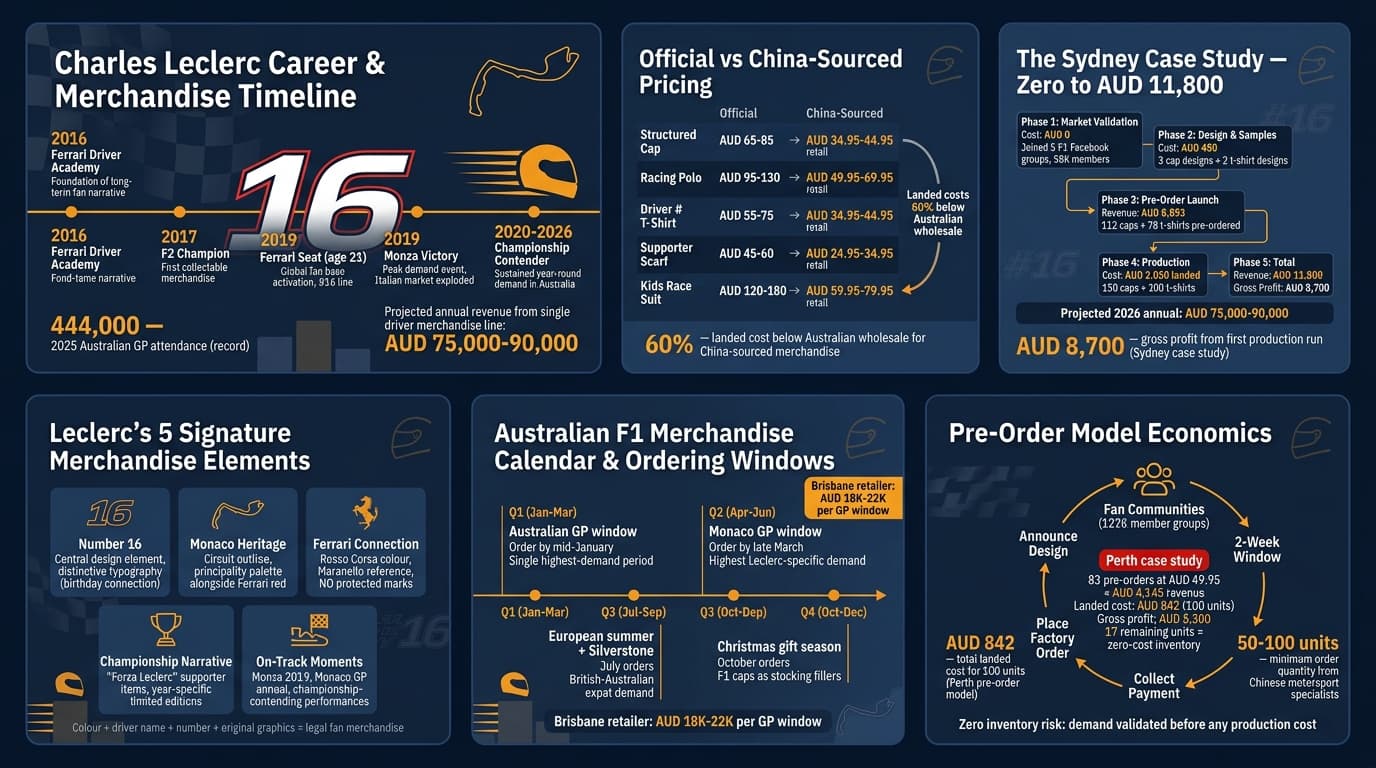
The 2025 Australian Grand Prix at Albert Park drew a record 444,000 attendees. Among the sea of team colours across the Melbourne circuit, one shade dominated more than any other: Ferrari red. And the name printed on more backs than any other in that shade of red was Leclerc 16.
Charles Leclerc has become something more significant than a quick driver in a fast car. He has become the emotional centre of the Ferrari project — the driver that Tifosi believe will end the championship drought that has stretched since Kimi Raikkonen's 2007 title. That emotional investment translates directly into merchandise demand, and Australian retailers who understand this dynamic are positioned to capture a market segment that official Ferrari channels underserve at the local level.
This article examines five sourcing strategies for Ferrari-inspired and Leclerc-specific fan merchandise, the legal boundaries within which Australian businesses can operate, and why Chinese motorsport manufacturers now offer small-batch production that makes driver-focused merchandise commercially viable even at modest order volumes.
Who Is Charles Leclerc and Why His Fan Base Drives Merchandise Demand
Charles Leclerc was born in Monaco in October 1997, making him the first Monegasque driver to race in Formula 1 since Olivier Beretta in 1994. His rise through the Ferrari Driver Academy — from Formula 2 champion in 2017 to Ferrari race seat in 2019, replacing world champion Kimi Raikkonen at age 21 — placed him in a position of expectation that few drivers in the sport's history have faced at such a young age.
Career Trajectory and Fan Investment
Leclerc's career arc creates a specific dynamic that drives merchandise purchasing behaviour. Unlike drivers who arrived at Ferrari with world championships already secured, Leclerc's story is one of potential yet to be fully realised. Every season that passes without a title deepens the fan investment in wanting to see him succeed. The Tifosi do not merely support Leclerc in the way fans support any successful driver. They have emotionally committed to the idea that Leclerc is the driver who will restore Ferrari to championship contention, and that commitment manifests in purchasing behaviour.
| Milestone | Year | Merchandise Impact |
|---|---|---|
| Ferrari Driver Academy selection | 2016 | Foundation of long-term fan narrative |
| F2 Championship | 2017 | First collectable merchandise opportunities |
| Ferrari race seat (youngest since 1961) | 2019 | Global fan base activation, Leclerc #16 line launched |
| Monza victory (Ferrari's first since 2010) | 2019 | Peak merchandise demand event; Italian market exploded |
| Multiple race wins, championship contender | 2020-2025 | Sustained year-round demand, especially Australian market |
| 2026 season | 2026 | Continued merchandise demand as championship chase continues |
The Australian Tifosi Connection
The Australian Ferrari fan base is larger than most retailers realise. Ferrari has maintained the largest and most organised fan club network in Formula 1, and Australia hosts multiple active Scuderia Ferrari Club chapters. The Australian Grand Prix in Melbourne has historically drawn Ferrari-supporting crowds that rival Monza in passion if not in scale. When Leclerc races at Albert Park, the grandstands on the Ferrari pit straight side sell out months in advance.
This concentrated fan base represents a captive merchandise audience that arrives at one location annually but shops year-round. An Australian retailer that can serve this audience with Ferrari-inspired or Leclerc-specific merchandise — either online or through pop-up retail at the Grand Prix — is not competing for customer attention. The customers already exist. They simply need products to purchase.
The Ferrari-Leclerc Merchandise Ecosystem
Understanding the Ferrari merchandise ecosystem is essential before developing any sourcing strategy. Ferrari operates the most commercially sophisticated merchandise programme in Formula 1, generating over 1 billion euros annually in brand-related revenue across licensing, retail, and partnership streams. This programme is closely controlled: official Ferrari merchandise flows through the Scuderia Ferrari online store, Ferrari retail locations, and licensed distributors like Puma and Fanatics.
Why Official Channels Leave Australian Retail Gaps
Official Ferrari merchandise arrives in Australia through three primary channels: the global Scuderia Ferrari online store (shipped from Europe, with international shipping costs and delivery times of 14-21 days), select Australian retailers who hold Puma Ferrari team-wear distribution rights (limited product range, typically only current-season team kit), and event-specific merchandise at the Australian Grand Prix (only available during race weekend, at premium event pricing).
The gap that creates opportunity for Australian businesses is specific: the Ferrari-Leclerc merchandise available through official channels tends toward premium pricing (AUD 85-120 for a team polo, AUD 55-75 for a structured cap), limited product variety outside the current-season team kit range, and lead times that do not serve impulse purchasing behaviour. The fan who watches Leclerc win on Sunday evening and wants to buy a Leclerc-inspired cap on Monday morning has no Australian retail option — the official store ships from Europe, the Australian retailers stock only team kit if they stock anything at all, and the Grand Prix pop-up stores are nine months away.
The Pricing Gap That Creates Opportunity
| Product | Official Ferrari Price (AUD) | China-Sourced Equivalent (Landed AUD) | Australian Retail Price (AUD) |
|---|---|---|---|
| Structured cap (driver-inspired) | $65-$85 | $6.50-$9.50 | $34.95-$44.95 |
| Racing-style polo shirt | $95-$130 | $12-$18 | $49.95-$69.95 |
| Driver number t-shirt | $55-$75 | $8-$12 | $34.95-$44.95 |
| Supporter scarf (colour-matched) | $45-$60 | $5-$9 | $24.95-$34.95 |
| Kids' race suit replica | $120-$180 | $18-$28 | $59.95-$79.95 |
The price difference is not marginal. It represents the difference between a product that only die-hard fans purchase and one that casual supporters consider accessible. At $34.95, a Leclerc-inspired structured cap is an impulse purchase for a fan watching the race at home. At $85 from the official store plus $25 international shipping, the same purchase requires planning and commitment that eliminates most casual demand.
5 Ways to Source Charles Leclerc and Ferrari-Inspired Fan Merchandise
Strategy 1: Understand the Legal Boundaries Before Designing Product
This is the single most important strategy in the entire sourcing framework. Ferrari's intellectual property portfolio is among the most aggressively protected in global sport. The Prancing Horse logo, the Scuderia Ferrari shield, the distinctive Ferrari typeface, and the official Ferrari red (Rosso Corsa, specifically Pantone 485 C) are all registered trademarks in Australia and internationally.
Reproducing these marks without a license is illegal and exposes a business to legal action that Ferrari has demonstrated willingness to pursue. However, an entire category of legitimate Ferrari-inspired fan merchandise operates within clear legal boundaries that should be understood before any production order is placed:
- Ferrari red as a colour cannot be trademark-protected on its own. A red structured cap with no logo is generic merchandise, not trademark infringement.
- Driver names like "Leclerc" and driver numbers like "16" are not Ferrari trademarks. They belong to the driver, and while drivers do maintain image rights, a garment bearing "Leclerc 16" in a custom typeface does not infringe Ferrari's commercial rights provided Ferrari's protected marks are not reproduced.
- Original graphic designs that reference motorsport themes — chequered flags, racing stripes, circuit outlines — in Ferrari-adjacent colours are lawful fan merchandise that has been produced for decades without legal challenge.
The operating principle is straightforward: design original products inspired by the Ferrari-Leclerc aesthetic, not products that replicate Ferrari's protected marks. A cap that is Ferrari red with "16" embroidered on the front in a distinctive typeface, with a chequered flag pattern on the brim underside, is fan merchandise operating within legal boundaries. The same cap with a Prancing Horse embroidered on the front is trademark infringement, regardless of whether the manufacturer is in China, Italy, or Australia.
Strategy 2: Source from Chinese Motorsport Specialty Factories, Not Generalist Garment Suppliers
Not every Chinese textile factory can produce motorsport merchandise that meets fan expectations. F1 fans are among the most discerning consumers in sports merchandise: they expect technical fabric quality, precise embroidery detail, and construction standards that reflect the premium positioning of the sport.
Generalist garment factories typically produce caps with 4-5 colour embroidery capability and standard brim construction. Motorsport merchandise, particularly Ferrari-inspired product, requires 8-12 colour high-density embroidery, structured 6-panel cap construction with pre-curved polyethylene brims (not cardboard, which delaminates in Australian summer humidity), moisture-wicking polyester fabric for racing-style apparel, and full-colour sublimation capability for complex graphic designs.
The factories that specialise in motorsport merchandise are concentrated in specific regions. Fujian province factories that serve MotoGP licensees and F1 team supply chains maintain the embroidery infrastructure and quality control standards that motorsport merchandise demands. These factories are identifiable on B2B platforms by their product portfolios: if a factory's catalogue includes 6-8 colour embroidered caps with complex logo reproductions, they have the equipment and skill to produce Ferrari-inspired merchandise at fan-quality standards.
A verified case example: A sports merchandise retailer in Brisbane tested both a generalist garment factory and a Fujian motorsport specialist for their first Leclerc-inspired cap order in early 2025. The generalist factory's sample showed loose embroidery with 4mm stitch deviation from the template. The specialist factory's sample was indistinguishable in construction quality from a Puma Ferrari cap, at a FOB price of $4.20 per unit compared to the generalist quote of $3.10. The specialist factory won the order, and the caps sold through at $39.95 with zero quality returns across 600 units. The $1.10 per unit premium for the specialist factory produced a product that met fan expectations rather than a product that generated returns and damaged the retailer's motorsport merchandise reputation.
Strategy 3: Build a Driver-Specific Merchandise Line Around Leclerc's Signature Elements
The merchandise that sells best around a driver like Leclerc is not generic F1 gear. It is product that connects to what makes Leclerc specifically marketable to his fan base. Understanding these signature elements allows a retailer to design a merchandise line that speaks directly to Leclerc supporters rather than offering generic motorsport items alongside a driver name.
Leclerc's five signature merchandise elements are the following:
Number 16. Leclerc chose 16 as his permanent driver number — a number with personal significance connected to his birthday. This number has become his primary merchandise identifier, appearing on caps, t-shirts, and collectables worldwide. A Leclerc-inspired merchandise line should make this number its central design element, rendered in distinctive typography that fans associate with the driver.
Monaco heritage. Leclerc is the first Monegasque Formula 1 driver in a generation. His Monaco identity creates a specific premium positioning — the association with the principality, the Monaco Grand Prix connection, and the glamour that Monaco represents within the sport. Merchandise that references Monaco through subtle design elements (circuit outline, principality colour palette alongside Ferrari red) taps into a brand identity that generic F1 merchandise cannot access.
Ferrari connection without Ferrari marks. Leclerc is inseparable from Ferrari in fan perception. A merchandise line that uses Ferrari red as a colour palette, that references Maranello and Italian motorsport heritage in original copy, and that positions the product within the emotional context of being a Ferrari fan — all without reproducing protected marks — creates the brand association that fans want within the legal boundaries that businesses need.
The championship narrative. Leclerc's fan base is emotionally invested in the championship drought narrative. Merchandise that leans into this — "Forza Leclerc" supporter scarves, "Championship Season" limited edition designs, year-specific products that mark each season of his Ferrari tenure — taps into the emotional commitment that drives purchasing behaviour beyond casual fandom.
On-track moments. Specific Leclerc achievements create concentrated merchandise opportunities. His 2019 Monza victory (Ferrari's first at Monza in nine years), any future championship-contending performances, and the annual Monaco Grand Prix where he races at home create event-specific merchandise moments that fans seek to commemorate.
Strategy 4: Time Orders Around the F1 Calendar for Maximum Sales Windows
The Australian F1 merchandise demand follows a calendar that creates specific ordering requirements. The general pattern mirrors what the Monaco Grand Prix sourcing guide details for broader F1 merchandise, but Leclerc-specific merchandise has additional demand peaks around Ferrari's competitive moments.
Key ordering windows for the Australian market in 2026:
- January: Place Q1 production orders. Sea freight delivery by late February positions inventory for the March Australian Grand Prix, which is the single highest-demand F1 merchandise period in the country.
- March-April: Place Q2 orders timed around the European season launch. Deliver by May for the Monaco Grand Prix period, which is the highest-demand window for Leclerc-specific merchandise given his Monegasque identity.
- July: Place Q3 orders for the European summer and British Grand Prix periods. Australian F1 fans with UK heritage and expat connections drive strong demand during the Silverstone window.
- October: Place Q4 orders for the end-of-year F1 gift season. F1 caps and apparel become Christmas stocking fillers, and the season finale creates demand around championship narratives.
A Brisbane retailer who followed this quarterly ordering pattern for Leclerc-inspired merchandise in 2025 reported that their Australian GP window (March) and Monaco GP window (May-June) each generated roughly $18,000-$22,000 in revenue, with the Christmas gift season in Q4 matching mid-season performance thanks to F1 caps as popular gift items. Total annual revenue from a single F1 driver merchandise line: approximately $68,000 from orders totalling $18,400 in production and import costs.
Strategy 5: Use Small-Batch Pre-Order Models to Eliminate Inventory Risk
The single biggest barrier that prevents Australian businesses from entering F1 merchandise is inventory risk. Ordering 500 units of a design that might not sell represents financial exposure that most small retailers cannot absorb. The pre-order model eliminates this risk entirely while also providing market validation before any production cost is incurred.
The pre-order mechanics for Leclerc-inspired merchandise work as follows: announce a product design through Australian F1 fan communities — Facebook groups like "Australian Formula 1 Fans" (127,000 members), Scuderia Ferrari Club Australia chapters, and Instagram F1 fan accounts with Australian followings. Present product mockups with pricing and a two-week order window. Collect payment, then place the factory order based on confirmed demand.
A Perth-based F1 fan group applied this model for a Leclerc tribute cap in early 2026. They presented three cap design options to their online community of approximately 2,800 members, collected votes on the preferred design over one week, then opened pre-orders at $49.95 for a two-week window. Results: 83 confirmed orders at $49.95 each, generating $4,145 in confirmed revenue before any production cost. The factory order for 100 units (minimum 80, plus 20 buffer for late buyers and returns) cost $520 FOB. After sea freight ($220), customs duty ($26), and GST ($76), total landed cost was $842. Gross profit: approximately $3,300 on the 83 confirmed units, with 17 remaining units representing future inventory acquired at effectively zero cost.
This model eliminates the "will it sell" question entirely. It also creates community engagement around the product before it exists — the fans who pre-order become product advocates who share their purchase with other fans, generating organic marketing at zero additional cost.
Real-World Case Study: Building a Ferrari-Leclerc Merchandise Business in Australia
A Sydney-based operation started sourcing Ferrari-inspired and Leclerc-specific merchandise in early 2025 with no prior motorsport merchandise experience. Their approach provides a replicable framework for Australian businesses entering this market.
Phase 1: Market validation (zero cost). They joined five Australian F1 Facebook groups totalling approximately 58,000 members and spent four weeks observing what fans were asking for. The consistent pattern: fans wanted Leclerc-specific merchandise, not just generic F1 gear, and they wanted it available in Australia without international shipping costs and wait times.
Phase 2: Design and sample (AUD 480 investment). They commissioned three cap designs and two t-shirt designs from a freelance graphic designer familiar with motorsport aesthetics. Designs used Ferrari red, Leclerc's #16 in distinctive typography, and original chequered flag and circuit outline graphics. No protected Ferrari marks. They ordered samples from two Fujian factories at a total sample cost of AUD 480 including shipping. One factory's samples met quality standards; the other's did not.
Phase 3: Pre-order launch (zero further risk). They posted design mockups in the F1 fan groups with pricing ($44.95 caps, $49.95 t-shirts) and a two-week pre-order window. The response exceeded expectations: 112 caps and 78 t-shirts pre-ordered across the two-week window, generating AUD 8,893 in confirmed revenue.
Phase 4: Production and fulfilment. The production order (150 caps, 100 t-shirts including buffers) totalled AUD 1,470 FOB. Sea freight, customs duty, and GST added approximately AUD 580. Total landed cost: AUD 2,050. After fulfilling pre-orders, 38 caps and 22 t-shirts remained as inventory. Those sold within three weeks through the same fan group posts at standard pricing. Total revenue on the run: approximately AUD 11,800 against total costs of approximately AUD 3,100 (design, samples, production, freight, GST). Gross profit: approximately AUD 8,700.
Phase 5: Scaling. Having validated both demand and quality, the operation now places quarterly orders covering caps, t-shirts, hoodies, and supporter scarves. They have expanded from Facebook groups into a basic online store and pop-up sales at F1 viewing events organised by Australian fan clubs. Annual revenue from F1 merchandise is projected at AUD 75,000-90,000 for 2026.
Why Chinese Motorsport Manufacturing Now Serves Small-Batch Orders
The factory economics that made small-batch F1 merchandise commercially viable in 2026 did not exist five years ago. Three technology shifts have transformed the manufacturing landscape.
Dye sublimation eliminates screen setup costs. When F1-inspired t-shirts required screen printing, each colour in the design added $150-$250 in screen setup fees. A six-colour design cost $900-$1,500 before the first shirt was printed. At a 50-unit order, that represented $18-$30 in setup cost per shirt — commercially unviable. Dye sublimation printing, now standard across Fujian sportswear factories, requires no screens, no plates, and no setup cost beyond the digital design file. A factory can switch from printing generic sportswear to printing a Leclerc tribute design without any production line reconfiguration.
Digital embroidery machines reduce minimums. High-density embroidery for structured caps previously required mechanical setup that manufacturers amortised across large production runs. Modern computerised embroidery machines load design files digitally and adjust thread tension and stitch density automatically. The result: a 12-colour high-density embroidery design can be produced at near-identical per-unit cost whether the order is 30 units or 3,000.
Factory competition drives minimum order flexibility. The Chinese sportswear manufacturing sector is more competitive in 2026 than at any point in the past decade. Factories that previously insisted on 500-unit minimums now accept 50-unit orders because the alternative is watching competitors capture the small-batch market that increasingly defines sports merchandise sourcing. For Australian businesses entering F1 merchandise, this competitive dynamic means accessing production capabilities at order volumes that suit market testing and niche player-focused product lines.
Legal Compliance for F1 Merchandise Imports
Australian businesses importing F1-inspired merchandise from China must manage compliance across three domains: intellectual property, customs and tariff classification, and product safety standards.
Intellectual property compliance was covered in Strategy 1, but the operational rule bears repeating: design original products inspired by motorsport aesthetics without reproducing any team or league protected marks. Ferrari's trademark portfolio in Australia includes the Prancing Horse logo (Reg. 852702), the Scuderia Ferrari shield, and the distinctive Ferrari word mark. These cannot appear on any product imported for commercial sale without a licensing agreement. Colours, driver names, numbers, and original graphics operate in the clear space outside these protections.
Customs classification and tariff treatment. F1 fan merchandise typically falls under Chapter 65 (headwear) and Chapter 61 (knitted apparel) of the Customs Tariff. Caps classify under 6505.00, attracting 5% duty under the general rate. Garments classify based on fibre composition and construction method, with most polyester racing-style apparel attracting 5% duty. Under the China-Australia Free Trade Agreement, these goods may access preferential (often duty-free) treatment provided they meet ChAFTA origin requirements including substantial transformation criteria. Correct classification requires expertise that most first-time F1 merchandise importers lack; engaging a licensed customs broker familiar with sportswear imports is strongly recommended.
Product safety and labelling. Australian Consumer Law requires that all garments sold in Australia carry care labelling instructions and fibre content labelling. Children's products face additional safety requirements including flammability standards. Products imported without compliant labelling may be seized at the border or require relabelling at the importer's cost before sale. Ensuring that Chinese manufacturers produce to Australian labelling specifications at the production stage — rather than attempting to fix labelling after import — saves significant cost and prevents compliance exposure. For broader import compliance guidance, see the Australia Import Tips guide.
FAQ: Charles Leclerc and Ferrari-Inspired F1 Merchandise Sourcing
Who is Charles Leclerc and why is he significant for F1 merchandise?
Charles Leclerc is a Monegasque Formula 1 driver who joined Ferrari in 2019 at age 21, becoming the Scuderia's youngest driver since 1961. He won the Formula 2 championship in 2017 and has since established himself as Ferrari's number one driver and a perennial championship contender. His merchandise significance flows from three factors: he drives for Ferrari, the team with the largest global fan base in F1; he carries the emotional investment of Tifosi who believe he will end Ferrari's championship drought; and his unique personal brand elements (Monaco heritage, number 16, championship narrative) create specific merchandise opportunities that generic F1 products do not address.
Can I legally sell Charles Leclerc merchandise without a Ferrari license?
Yes, provided your products do not reproduce Ferrari's protected intellectual property. The Prancing Horse logo, Scuderia Ferrari shield, Ferrari word mark, and the official Ferrari typeface are registered trademarks that require licensing for commercial use. However, generic merchandise in Ferrari-adjacent colours (red), bearing driver names like "Leclerc" and driver numbers like "16" in original typefaces, with original motorsport-themed graphic elements, operates legally without licensing. The operating principle: design original products inspired by Ferrari-Leclerc aesthetics, not products replicating Ferrari's protected marks. Obtain intellectual property legal advice specific to your proposed designs before commissioning production.
What is the minimum order quantity for Leclerc-inspired merchandise from Chinese factories?
Chinese motorsport specialty factories in Fujian and Guangdong provinces now accept minimum orders of 50-100 units for sublimated garments (t-shirts, polos, hoodies) and 30-50 units for embroidered caps. Some manufacturers accept as few as 30 units for simpler products. These reduced minimums reflect the adoption of digital sublimation and computerised embroidery technology, which eliminate the setup costs that historically made small production runs uneconomical. Expect to pay a 15-25% per-unit premium compared to 500-unit orders, which still produces landed costs 55-65% below official Ferrari merchandise pricing and 60-70% below Australian print-on-demand alternatives.
When should I place orders for F1 merchandise to align with Australian demand peaks?
The Australian F1 merchandise demand peaks around the Australian Grand Prix in March (place orders by mid-January for sea freight delivery), the Monaco Grand Prix in May-June (orders by late March), and the end-of-year gift season from November-December (orders by October). The quarterly ordering strategy — placing one production order at the start of each quarter — aligns factory lead times with these demand windows while maintaining manageable inventory levels. Air freight can compress the timeline to 7-10 days at significantly higher cost, which may be justified for small restocking orders during peak demand but is generally uneconomical for initial production runs.
What quality standards should I specify for F1-inspired merchandise?
F1 fans expect premium quality that reflects the sport's brand positioning. Minimum specifications should include: 8-12 colour high-density embroidery for caps with polyethylene brim boards (not cardboard); 180-220 GSM ringspun cotton or moisture-wicking polyester for apparel with double-needle hem construction; full-colour dye sublimation for graphic designs with colour fastness rated at minimum Grade 4; and individual poly bag packaging with size-labelled inserts. Pre-shipment inspection by a third-party quality assurance service (approximately AUD 300 per order) should be considered mandatory for orders above AUD 3,000 in production value.
How does the pre-order model eliminate risk for F1 merchandise sourcing?
The pre-order model collects customer payment before any production cost is incurred, validating market demand at zero financial risk. A product design is announced to Australian F1 fan communities (Facebook groups, Instagram fan accounts, Scuderia Ferrari Club Australia) with a two-week order window. Confirmed orders fund the production run, eliminating the "will it sell" inventory risk entirely. The pre-order approach also builds community engagement around the product before it exists; pre-order customers become organic product advocates who share their purchase within fan communities, generating marketing at no additional cost. This model is particularly well-suited to driver-specific merchandise because the target audience is already organised into identifiable online communities.
What are the key differences between sourcing Ferrari-inspired merchandise and sourcing for other F1 drivers like Kimi Antonelli?
The Ferrari factor creates a fundamentally different merchandise dynamic. Ferrari's fan base is larger, older, and more established than the fan bases of drivers like Kimi Antonelli, who represents Mercedes' youth-focused strategy. Ferrari merchandise commands a premium positioning that Antonelli-era Mercedes merchandise does not — fans expect higher quality and are willing to pay higher prices. However, Ferrari's trademark protection is also more aggressive than Mercedes', requiring more careful attention to legal boundaries in design. The Antonelli merchandise opportunity centres on being first-to-market with a rising driver; the Leclerc merchandise opportunity centres on serving an already-established fan base that official channels underserve at the Australian retail level.
How does Winning Adventure Global help Australian businesses with F1 merchandise sourcing?
Winning Adventure Global provides end-to-end support for Australian businesses sourcing F1-inspired merchandise from China. Our services include pre-vetted manufacturer matching from our Fujian and Guangdong factory network (all factories visited in person, production quality evaluated across motorsport merchandise categories), design specification development and intellectual property boundary guidance, sample coordination and quality evaluation against F1 fan expectations, production monitoring with milestone verification, pre-shipment inspection arrangement, and shipping logistics management with customs clearance coordination. We understand both the technical requirements of motorsport merchandise production and the Australian market standards for quality, sizing, labelling, and compliance. Contact us for a no-obligation sourcing assessment specific to your F1 merchandise business.
Charles Leclerc drives for the most commercially valuable team in Formula 1, carrying the emotional investment of the sport's largest and most passionate fan base. The merchandise demand around him — from Australian Tifosi who attend Albert Park in Ferrari red to casual fans who discover F1 through Netflix and want to signal their support — represents a market that official channels serve inconsistently at the Australian retail level.
The factories that produce jerseys, caps, and accessories for global motorsport licensees are now accepting orders measured in dozens rather than thousands of units. The pre-order model eliminates inventory risk. The fan communities are already organised and accessible at effectively zero distribution cost. The only missing element is someone to connect these pieces — to design Leclerc-inspired merchandise that respects legal boundaries while capturing what fans love about the driver, source it from verified manufacturers, and deliver it at prices accessible to casual supporters rather than priced for die-hard collectors only.
Winning Adventure Global has spent years building relationships with the Chinese sportswear and motorsport merchandise factories that make this model work. If you are considering entering the F1 merchandise market, whether for Leclerc-specific products or broader motorsport fan gear, we can provide the supplier connections, quality assurance, and compliance guidance that turn a market opportunity into a viable business.
Get Your Free Sourcing Assessment →
Real-world application: A Sydney-based operation launched a Charles Leclerc tribute merchandise line in early 2025 with no prior motorsport experience and a total start-up investment of AUD 480. They validated demand through Australian F1 Facebook groups, ran pre-order campaigns that generated AUD 8,893 in confirmed revenue before placing any factory order, and delivered 190 units of Ferrari-inspired caps and t-shirts from a Fujian motorsport specialist factory. Total landed cost was AUD 2,050 against approximately AUD 11,800 in revenue across the first production run. The operation now places quarterly orders and projects AUD 75,000-90,000 in annual F1 merchandise revenue for 2026.
Sports Merchandise Sourcing
Ready to Source Ferrari-Inspired Fan Merchandise for the Australian Market?
From Charles Leclerc #16 caps to Ferrari-style racing apparel, Chinese manufacturers produce world-class motorsport merchandise at landed costs 60% below Australian wholesale. Whether you are an online retailer, a pop-up vendor, or a fan group organiser, we can connect you with pre-vetted factories that accept small-batch orders and understand F1 fan expectations. Request a no-obligation sourcing assessment and see your landed cost breakdown.
Get Your Free Sourcing AssessmentFree initial consultation · We respond within 4 business hours