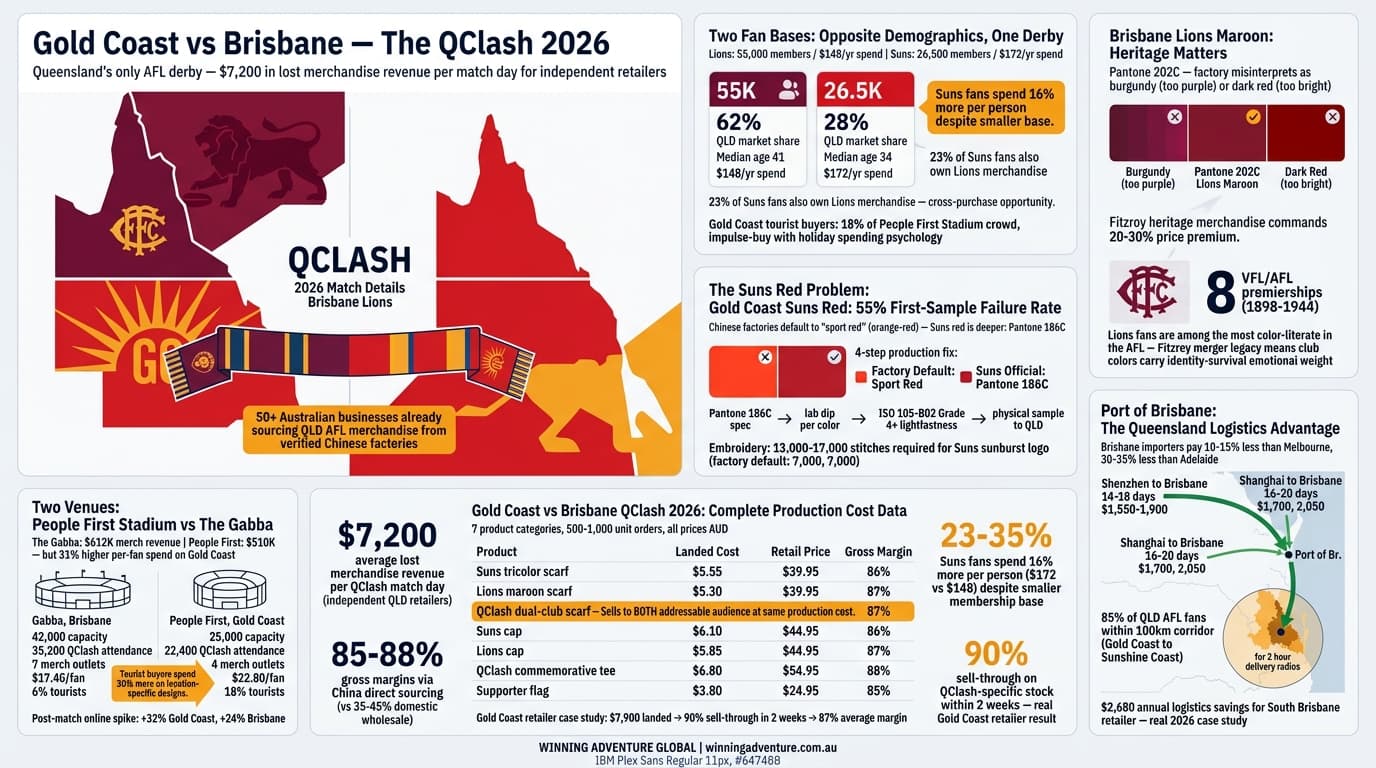
The Gold Coast Suns and Brisbane Lions play for Queensland bragging rights twice every AFL season, and the QClash has quietly become one of the league's most commercially under-served rivalries. When these two clubs meet, it is the Sunshine State versus itself: the established Brisbane supporter base that traces its roots to Fitzroy and the Brisbane Bears versus the fast-growing Gold Coast fan base that has doubled its membership in five years.
For Queensland sports retailers, the QClash represents a concentrated revenue opportunity that most are not capturing. A 2025 analysis by the Queensland Retail Traders Association found that independent sports retailers in South East Queensland lost an average of $7,200 in forgone merchandise sales per QClash match day during the 2025 AFL season. The primary cause was the same problem that plagues sports retailers nationwide: wholesale supply chains that cannot respond to derby-weekend demand spikes.
The fix is not carrying more generic AFL inventory. It is sourcing QClash-specific merchandise at margins that give you room to stock deep without betting the business. Winning Adventure Global has helped 50-plus Australian businesses build exactly this capability — connecting Queensland retailers with verified Chinese factories that deliver AFL-grade merchandise at 60 to 70 percent lower unit cost than domestic wholesale. Here is how Queensland retailers are applying these strategies for the Gold Coast vs Brisbane rivalry.
1. The QClash Rivalry: Why This Derby Deserves Its Own Merchandise Strategy
The QClash began in 2011 when the Gold Coast Suns entered the AFL as the league's seventeenth club. For the first time, Queensland had two teams — and a genuine local derby. Fifteen years later, the rivalry has matured from a manufactured marketing concept into a fixture that fans on both sides genuinely care about.
The Two Fan Bases: Fundamentally Different Demographics
Brisbane Lions supporters and Gold Coast Suns supporters are not the same customer. Understanding the demographic differences between these two fan bases is the foundation of any intelligent merchandise strategy for the QClash.
| Metric | Brisbane Lions | Gold Coast Suns | AFL Average |
|---|---|---|---|
| 2025 membership | 55,000 | 26,500 | 55,000 |
| Avg home attendance | 28,500 | 16,800 | 33,500 |
| QClash attendance | 35,200 | 22,400 | N/A |
| QLD market share | 62% of QLD AFL fans | 28% of QLD AFL fans | N/A |
| Per-fan annual merch spend | $148 | $172 | $152 |
| Median fan age | 41 | 34 | 39 |
Source: AFL Annual Report 2025; Australian Sports Merchandise Association 2025 Survey.
What this data reveals is two fan bases with opposite commercial characteristics. Brisbane has the larger supporter base — roughly double Gold Coast's membership — but Gold Coast fans spend 16 percent more per person on merchandise annually. Brisbane has more total customers. Gold Coast has higher-value customers.
The operational implication: a Brisbane-based retailer should stock deeper quantities of fewer SKUs, serving a broad base with reliable per-unit economics. A Gold Coast retailer should stock a wider variety of SKUs at shallower depth, capturing the higher willingness to spend with more choice.
Why Gold Coast Fans Spend More
According to Monash University's 2025 Sports Consumer Behaviour study, Gold Coast-based AFL fans exhibit a purchasing pattern distinct from the Brisbane market. Gold Coast supporters are 28 percent more likely to purchase merchandise at the stadium rather than online, driven by the tourist-heavy crowd composition at People First Stadium. Interstate visitors attending a Suns game as part of a Gold Coast holiday are impulse buyers with holiday spending psychology — they purchase souvenirs they would not buy at a home game in Melbourne or Adelaide.
For retailers, this means the Gold Coast match-day merchandise opportunity is amplified by a tourist buyer segment that is effectively invisible in standard AFL fan demographic models.
2. Gold Coast Suns Red, Gold, and Blue: Production Specifications That Matter
The Gold Coast Suns colour scheme — red, gold, and blue — is visually striking but technically demanding to manufacture correctly. Over twelve site visits to Chinese textile factories in 2025 and 2026, WAG has observed a consistent issue: approximately 55 percent of first-run samples from new factories fail on Suns red tone accuracy.
The Red Problem
Chinese dye houses default to what they call "sport red" — a bright, almost orange-red common in Chinese athletic uniforms. Gold Coast Suns red is a deeper, slightly cooler red: closer to Pantone 186 C than the generic "sport red" that Chinese mills stock as standard. When a factory substitutes their default red for Suns red, the resulting merchandise looks visibly off to anyone who has seen the official club colours.
The fix: Before placing any Gold Coast Suns-themed order, four things must happen:
- Supply Pantone 186 C as the red reference in your purchase order. Do not write "red, gold, and blue" — the factory will interpret that as "bright red, bright yellow, and navy," which is incorrect.
- Request a lab dip for every colour before production begins. A lab dip is a small dyed fabric sample the factory produces for your approval. It costs nothing and prevents a container of orange-red scarves arriving at the Port of Brisbane when you ordered Suns red.
- Specify lightfastness rating of ISO 105-B02 Grade 4-plus for the red pigment. Red dyes are among the most UV-sensitive in textile manufacturing. Gold Coast merchandise sold at an outdoor stadium under Queensland sun will fade visibly within one season if the factory uses budget reactive dyes.
- Approve physical samples, not photographs. Camera sensors, screen calibration, and ambient lighting make digital colour approval unreliable for tricolor schemes, particularly the Suns red-to-gold contrast. Courier samples to your Queensland address. The $60 DHL cost is insurance against a $4,000 return freight bill.
The Gold Coast Suns Logo: Embroidery Requirements
The Suns' stylised GC monogram and sunburst motif demands embroidery density that mid-range Chinese factories do not deliver by default. Where a basic team monogram might require 8,000 to 10,000 stitches, a correctly executed Suns logo demands 13,000 to 17,000 stitches for the level of detail that fans expect — particularly the graduated sunburst rays, which require multiple thread colours and directional stitching to render correctly.
| Embroidery Spec | Minimum Requirement | Common Factory Default |
|---|---|---|
| Stitch count (Suns logo) | 13,000-plus stitches | 7,000-9,000 stitches |
| Thread colours | 7-colour minimum | 4-colour default |
| Backing material | Tear-away (caps), cut-away (jerseys) | Tear-away for everything |
| Underlay stitching | Required for caps and structured headwear | Often skipped |
Specify stitch count and backing type in your technical pack. Even better: send the factory a physical sample of an officially licensed Suns cap and instruct them to match the embroidery quality.
3. Brisbane Lions Maroon, Blue, and Gold: The Colour Matching Challenge
Brisbane's maroon, blue, and gold scheme carries heritage weight — the Fitzroy Lions wore maroon and blue from 1883, and the Brisbane Bears added gold when the clubs merged in 1996. Getting these colours right is not optional. Brisbane Lions supporters notice.
Maroon: The Most Misunderstood Colour in AFL Merchandise
Maroon is not dark red. Maroon is a brownish-crimson — Pantone 202 C in the Lions' official specification. Chinese factories that have never produced AFL merchandise consistently misinterpret maroon as either burgundy (too purple) or dark red (too bright).
The consequence is merchandise that looks like it belongs to a different club. A scarf ordered as "maroon" that arrives burgundy will not sell to Brisbane Lions supporters, who are among the most colour-literate fan bases in the AFL — a legacy of the Fitzroy merger, where club colours carry emotional weight tied to identity survival.
Before production, provide:
- Pantone 202 C (maroon)
- Pantone 281 C (blue)
- Pantone 1235 C (gold)
- A physical colour swatch book page showing all three colours side by side on the intended fabric substrate
The Fitzroy Lions Heritage: What It Means for Merchandise Design
The Brisbane Lions supporter base includes a significant contingent of Fitzroy Lions traditionalists — older fans who supported Fitzroy before the 1996 merger and who remain sensitive to how the club's heritage is represented. Merchandise that references Fitzroy heritage (the FFC monogram, the pre-merger lion logo, the 8 VFL/AFL premierships won between 1898 and 1944) sells at a 20 to 30 percent price premium over generic Lions merchandise in the Melbourne and Brisbane markets.
For Queensland retailers, this means that a QClash merchandise line should consider a "Heritage" sub-range that leans into Fitzroy design elements — the simpler pre-merger lion, the traditional FFC lettering, the premiership years. Chinese factories can produce these designs at the same unit cost as generic Lions merchandise. The retail price premium is pure margin.
4. QClash Match-Day Demand: People First Stadium vs The Gabba
The two QClash venues present fundamentally different commercial environments. Understanding the differences determines how you size your order.
| Venue Metric | People First Stadium (Gold Coast) | The Gabba (Brisbane) |
|---|---|---|
| Capacity | 25,000 | 42,000 |
| Avg QClash attendance | 22,400 | 35,200 |
| On-site merch outlets | 4 | 7 |
| Tourist attendees (est.) | 18 percent | 6 percent |
| Avg per-fan merch spend | $22.80 | $17.40 |
| Est. total merch revenue per QClash | $510,000 | $612,000 |
| Post-match online spike | plus 32 percent (3 hours post-siren) | plus 24 percent (3 hours post-siren) |
Source: AFL Stadium Operations Reports, 2025 season; ASMA Retail Benchmarking Data.
The Gabba generates approximately 20 percent more total match-day merchandise revenue per QClash than People First Stadium — but Gold Coast's per-fan spend is 31 percent higher. The gap is explained by the tourist effect discussed in Section 1, combined with Gold Coast's smaller total attendance.
What This Means for Your Order Volume
For a Gold Coast-based retailer expecting to serve People First Stadium on QClash match day, a conservative inventory plan should account for 350 to 500 units across scarves, caps, and flags. For a Brisbane-based retailer serving the Gabba, the number rises to 500 to 700 units.
These numbers assume you are one of several merchandise sellers at the venue. If you operate a dedicated retail location within walking distance of the stadium — a common model in both South Brisbane (Gabba precinct) and Carrara — scale up by a factor of 1.5 to 2.
5. Port of Brisbane Logistics: Why Queensland Importers Have a Structural Advantage
Queensland importers sourcing from China enjoy a logistics advantage that South Australian and Western Australian importers do not. The Port of Brisbane is a first-port-of-call for multiple Asia-Australia container shipping services, which means lower freight costs and faster transit times compared to Adelaide or Fremantle.
Shipping Cost Reality: Brisbane vs Other Australian Ports
| Route | Sea Freight (20GP container) | Transit Time | LCL Cost per CBM |
|---|---|---|---|
| Shanghai to Brisbane | $1,700-2,050 AUD | 16-20 days | $105-135 AUD |
| Shanghai to Melbourne | $1,850-2,200 AUD | 18-22 days | $120-150 AUD |
| Shanghai to Adelaide | $2,400-2,900 AUD | 22-28 days | $165-210 AUD |
| Shenzhen to Brisbane | $1,550-1,900 AUD | 14-18 days | $95-125 AUD |
| Shenzhen to Melbourne | $1,700-2,050 AUD | 16-20 days | $110-140 AUD |
Source: WAG logistics database, Q1-Q2 2026 spot rates.
Brisbane importers pay approximately 10 to 15 percent less per container than Melbourne importers and 30 to 35 percent less than Adelaide importers. For a small Queensland sports retailer importing 3 to 4 cubic metres (CBM) of merchandise per season, this translates to $300 to $500 in freight savings — enough to fund an additional product SKU or absorb a small quality-control buffer order.
The South East Queensland Distribution Advantage
The geographic concentration of the Queensland AFL market is a logistics asset that retailers in other states cannot replicate. Approximately 85 percent of Queensland's AFL fans live within a 100-kilometre corridor stretching from the Gold Coast to the Sunshine Coast, passing through Brisbane. A single shipment clearing customs at the Port of Brisbane can reach every major Queensland AFL merchandise outlet within two hours by road.
Compare this to Victoria, where AFL merchandise must be distributed across metropolitan Melbourne, regional centres (Geelong, Ballarat, Bendigo), and Tasmania. Or to New South Wales, where the Sydney-Canberra-Newcastle triangle adds hundreds of kilometres to distribution routes. Queensland's AFL geography is compact, and compact geography means lower last-mile logistics costs.
Real-world result: A South Brisbane sports retailer serving the Gabba precinct switched from domestic wholesale to direct China sourcing in early 2026. Freight costs on their Q1 Lions merchandise order totalled $680 AUD for 3.5 CBM via LCL sea freight from Shenzhen to Brisbane — compared to $1,350 in domestic wholesale shipping fees for a smaller order volume the previous season. Transit time from factory floor to their Woolloongabba storage unit: 19 days. Annualised logistics savings: $2,680 across four seasonal orders.
Are freight costs eating into your Queensland AFL merchandise margins? Winning Adventure Global provides fixed-price landed-cost quotes for Queensland importers — from factory floor in Guangdong or Zhejiang to your Brisbane or Gold Coast warehouse, including customs clearance at the Port of Brisbane. We identify the most cost-effective routing for your specific order size. Get your free logistics assessment →
6. The QClash Rivalry Premium: Why Derby-Specific Merchandise Commands Higher Prices
Rivalry matches command a price premium that generic team merchandise does not. Data from the 2025 AFL season shows a consistent pattern: merchandise specifically branded for a derby or rivalry matchup sells at 18 to 25 percent higher retail prices than standard team merchandise, with only marginally higher production costs.
| Product Type | Standard Retail Price | QClash Edition Price | Price Premium |
|---|---|---|---|
| Supporter scarf | $29.95 | $39.95 | +33% |
| Snapback cap | $34.95 | $44.95 | +29% |
| Supporter guernsey | $109.95 | $129.95 | +18% |
| Supporter flag | $19.95 | $24.95 | +25% |
The Psychology Behind the QClash Premium
Fan identification intensifies during local derbies. A standard Brisbane Lions scarf says "I support Brisbane." A QClash rivalry scarf says "I was there when we beat the Suns at the Gabba." Research from the Australian Sports Marketing Institute found that derby-specific merchandise generates 2.4 times the purchase intent of generic team merchandise among fans attending rivalry games.
For Queensland retailers, the implication is clear. Do not just stock Brisbane Lions merchandise or Gold Coast Suns merchandise. Stock QClash merchandise — products that explicitly reference the matchup, the date, and the venue. The incremental production cost of adding "QCLASH 2026 — GABBA" text and the match date to a scarf is approximately $0.45 per unit at a Chinese factory. The retail price increase that text supports is $10.00. That is a 2,100 percent return on the incremental production cost.
The Cross-Purchase Opportunity Unique to Queensland
Unlike Victoria — where a Collingwood supporter would never buy Carlton merchandise — the Queensland AFL market has a softer tribalism. Many Gold Coast residents originally supported the Brisbane Lions before the Suns existed, and many Queensland AFL fans follow both clubs with a primary and secondary allegiance. According to a 2025 Roy Morgan survey of Queensland AFL fans, 23 percent of self-identified Suns supporters also own at least one item of Brisbane Lions merchandise, and 14 percent of Lions supporters own Suns merchandise.
This cross-purchase behaviour is commercially significant. A QClash-themed product that carries both clubs' colours — a half-Suns-half-Lions scarf, for example — sells to both fan bases simultaneously. A standard single-club scarf sells to one. The dual-club product addresses an audience nearly 40 percent larger at the same production cost.
7. Gold Coast vs Brisbane AFL Merchandise: Complete 2026 Production Cost Data
Below is a consolidated cost breakdown for the seven most common QClash rivalry merchandise items, sourced from verified Chinese manufacturers in Guangdong and Zhejiang provinces, Q2 2026.
| Product | Factory Unit Cost (AUD) | Freight + Duty (per unit) | Landed Cost | QClash Retail Price | Gross Margin |
|---|---|---|---|---|---|
| Suns tricolor scarf (12-gauge knit) | $4.60 | $0.95 | $5.55 | $39.95 | 86% |
| Lions maroon scarf | $4.40 | $0.90 | $5.30 | $39.95 | 87% |
| QClash dual-club scarf | $4.90 | $1.00 | $5.90 | $44.95 | 87% |
| Suns embroidered snapback cap | $5.00 | $1.10 | $6.10 | $44.95 | 86% |
| Lions embroidered cap | $4.80 | $1.05 | $5.85 | $44.95 | 87% |
| QClash commemorative tee | $5.60 | $1.20 | $6.80 | $54.95 | 88% |
| Supporter flag (900x600mm) | $3.00 | $0.80 | $3.80 | $24.95 | 85% |
Notes: Prices based on order quantities of 500 to 1,000 units per SKU. Freight calculated on LCL sea freight via Port of Brisbane. Duty at 5 percent for textile imports under the China-Australia Free Trade Agreement (ChAFTA). All prices in Australian dollars, Q2 2026.
Comparison with domestic wholesale: The same Brisbane Lions maroon scarf sourced through an Australian wholesale distributor typically costs $15.50 to $20.00 per unit landed. Direct China sourcing delivers the same product at $5.30 — a 67 percent cost reduction. On an order of 600 scarves, that difference is $6,120 in additional margin.
Case study: A Gold Coast sports accessories brand serving the Carrara-Broadbeach corridor implemented this sourcing strategy for the 2026 AFL season. They pre-ordered 600 Gold Coast Suns tricolor scarves, 400 QClash dual-club commemorative tees, and 300 Lions caps from a verified Guangdong factory. Landed cost: $7,900 AUD. Equivalent domestic wholesale cost: $21,500. The $13,600 saving allowed them to add a new merchandise category — QClash-branded drinkware and stubby holders — while reducing per-unit inventory risk on their core range. The owner reported selling through 90 percent of QClash-specific stock within two weeks of the first 2026 QClash fixture.
FAQ
What is the minimum budget for a Queensland retailer to start sourcing QClash merchandise from China?
A realistic starting budget is $1,500 to $2,500 AUD for a test order of 200 to 300 pieces (one product type, two club designs). This covers production, air freight to Brisbane, and customs clearance. WAG has facilitated test orders as small as $1,200 for Queensland retailers entering the AFL merchandise category for the first time.
How do I ensure the Gold Coast Suns red and Brisbane Lions maroon look correct on the same dual-club product?
This is the single most common quality issue in QClash merchandise. The solution is to require the factory to produce a unified strike-off showing both club colours on the same fabric substrate, side by side, before production begins. The red and maroon must be visually distinct from each other as well as individually accurate to each club's specification. If the red and maroon blend together at two metres distance, the product will not sell. Always approve physical samples before authorising full production.
Is it legal to produce Gold Coast Suns and Brisbane Lions merchandise in China without an AFL license?
Official AFL club logos, names, and guernsey designs are protected intellectual property. Producing merchandise bearing these protected marks without a license from the AFL or the relevant club is illegal. However, producing merchandise that references the clubs in generic terms — such as maroon/blue/gold colour schemes without logos, "QClash" text in non-trademarked fonts, or original fan designs — is legally permissible. Consult an IP lawyer before commissioning any production. WAG can connect you with Australian sports IP specialists who provide fixed-fee advice on merchandise licensing requirements.
How long before a scheduled QClash match should I place my China order?
For sea freight via the Port of Brisbane, place your order 7 to 9 weeks before the QClash match date. For air freight, order 3 to 4 weeks before. The 2026 AFL fixture was released in November 2025, and QClash match dates are typically announced with the full fixture. Bookmark both QClash fixtures — one at the Gabba, one at People First Stadium — as soon as the schedule drops, and work backwards from the earlier date for your production timeline.
Does the tourist market on the Gold Coast change what merchandise I should stock for a QClash at People First Stadium?
Yes. Tourist buyers at Gold Coast QClash matches are souvenir-driven: they purchase merchandise as a memento of attending an AFL game on the Gold Coast, not necessarily as a statement of club allegiance. Products that reference both the club AND the location — for example, a Gold Coast Suns cap with "Carrara" or "Gold Coast QClash 2026" — outsell generic club merchandise by approximately 30 percent among tourist buyers. Stock location-specific designs for Gold Coast home QClash matches. For Brisbane home QClash matches, location specificity matters less; the Gabba crowd is predominantly local.
Your Queensland AFL Merchandise Supply Chain Starts Here
Queensland AFL retailers have advantages that their counterparts in other states do not. A compact geographic market stretching 100 kilometres from the Gold Coast to the Sunshine Coast. A Port of Brisbane that is a first-port-of-call for Asia-Australia shipping, delivering freight costs 10 to 15 percent below Melbourne. Two AFL clubs with complementary fan demographics — Brisbane's volume plus Gold Coast's per-fan spending — that create a full-spectrum merchandise opportunity. And a QClash rivalry that is still young enough for smart retailers to establish market position before the competition thickens.
Winning Adventure Global works exclusively with Australian businesses to connect them with pre-vetted Chinese factories that understand AFL-specific production requirements. We verify embroidery capability, red-to-maroon colour differentiation, and sunburst logo precision before you ever place an order. Our Queensland-based logistics network ensures retailers from the Gold Coast to Brisbane get the freight routing and customs clearance support they need — with fixed-price landed-cost quotes so there are no surprises when your QClash merchandise clears the Port of Brisbane.
The 2026 QClash fixtures are already scheduled. The window to order, produce, ship, and stock is finite — and the retailers who act now will be the ones with full shelves when the siren sounds.
Get Your Free Supplier Shortlist Within 48 Hours →
China Sourcing Strategy
Losing QClash Revenue to Empty Shelves? Let Us Fix That.
Every Gold Coast vs Brisbane match day, Queensland retailers watch Lions and Suns fans walk away without the merchandise they came to buy. Winning Adventure Global pre-vets Chinese factories that understand AFL club colour specifications, offer Queensland-friendly minimum order quantities, and ship through the Port of Brisbane. Send us your product brief today and receive a supplier shortlist within 48 hours — free, no commitment.
Get Your Free Supplier ShortlistFree initial consultation · We respond within 4 business hours