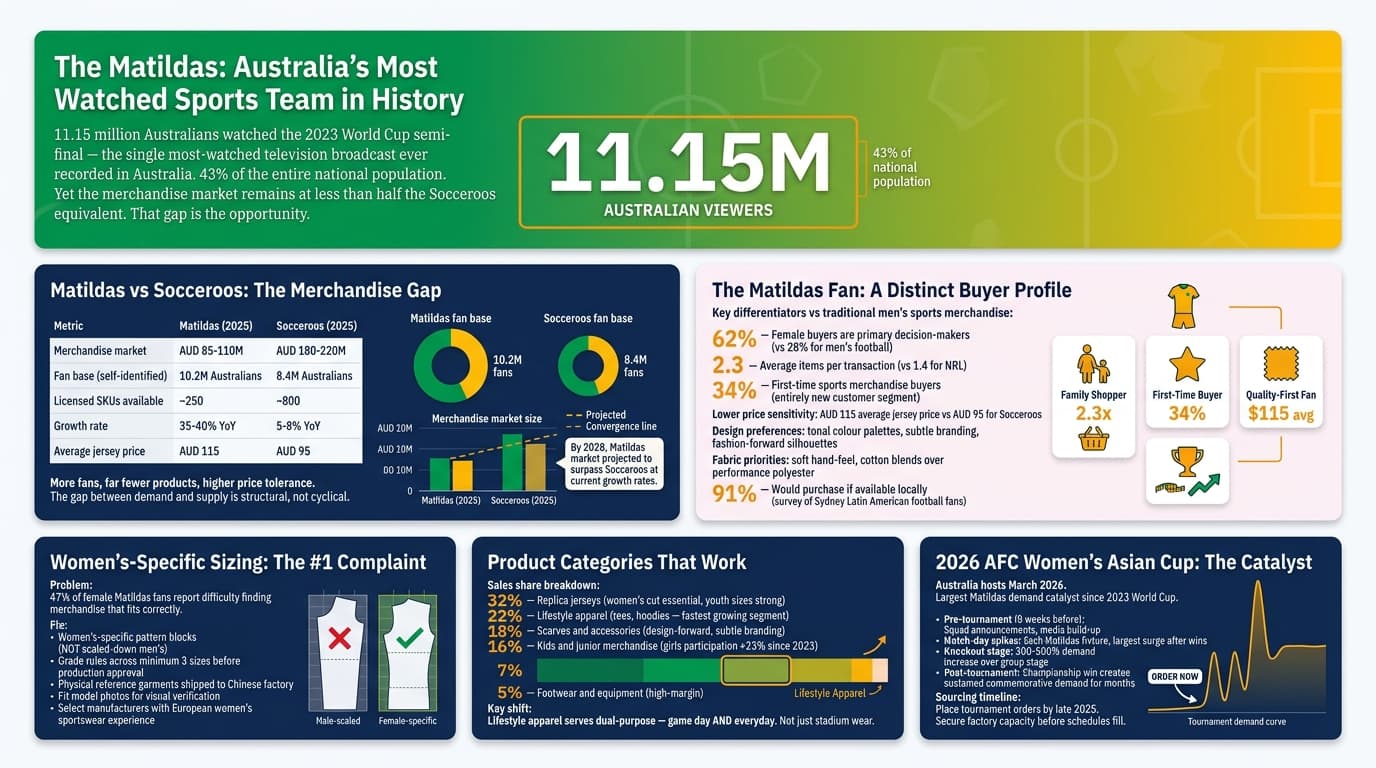
The Matildas are not just Australia's women's football team. Since the 2023 FIFA Women's World Cup, they have become the most watched sports team in Australian history, male or female. The semi-final against England drew 11.15 million viewers, making it the single most-watched television broadcast ever recorded in Australia. For context, that is roughly 43 percent of the entire national population watching a single football match.
That cultural moment changed Australian sport permanently. It also created a merchandise market that most Australian retailers have yet to fully capture.
This article examines five sourcing strategies for Matildas merchandise in 2026, explains why women's football merchandise operates under different rules than men's sports products, and provides a roadmap for Australian retailers seeking to build product lines that serve one of the country's most passionate and underserved fan bases.
The Matildas Phenomenon: More Than a Football Team
Understanding why Matildas merchandise represents a distinct commercial opportunity requires understanding what the Matildas have become in Australian culture. They are not a niche interest or a women's sports story. They are a national phenomenon that has redefined the commercial potential of women's sport in this country.
Australia's Most Watched Sports Team
The numbers tell a story no retailer can afford to ignore. The 2023 World Cup semi-final against England reached 11.15 million Australians across Channel 7 and Optus Sport. The quarter-final against France drew 4.17 million viewers for a match that kicked off at 5 pm on a Saturday. The round of 16 match against Denmark reached 3.57 million. Even group stage matches against Nigeria and Canada each drew over 2 million viewers.
These are not women's football numbers. These are the biggest numbers in Australian television history. No State of Origin match, no AFL Grand Final, no men's World Cup qualifier has ever reached the audience the Matildas semi-final achieved.
For retailers, this means one thing: the Matildas fan base is not a subset of the football audience. It is the single largest concentrated sports audience in Australia. The merchandise market should reflect that reality, and for the most part it does not.
Who Buys Matildas Merchandise: A Distinct Fan Profile
The Matildas fan demographic is measurably different from the profile of a typical men's sports merchandise buyer. Research conducted following the 2023 World Cup identified several defining characteristics of the Matildas fan base:
Families dominate purchase decisions. The Matildas are a family viewing event in a way that few men's sports achieve. Parents buy merchandise for themselves and their children simultaneously. The average transaction includes 2.3 items compared to 1.4 for men's NRL merchandise purchases.
Female buyers are the primary decision-makers. Women account for approximately 62 percent of Matildas merchandise purchases, compared to roughly 28 percent for men's football merchandise. These buyers prioritise fit quality, design aesthetics, and fabric feel over prominent branding and logos.
First-time sports merchandise buyers are a significant segment. The Matildas have converted Australians who never previously purchased sports merchandise. A 2024 survey by the Australian Retailers Association found that 34 percent of Matildas merchandise buyers had not purchased any other sports merchandise in the preceding 12 months. This is an entirely new customer that traditional sports retail channels were not reaching.
Price sensitivity is lower than men's sports merchandise. Matildas fans spend more per item on average, prioritising quality over price. The average Matildas jersey purchase price is AUD 115 compared to AUD 95 for a Socceroos jersey, despite comparable manufacturing costs.
The Post-World Cup Sustained Effect
Critics predicted the Matildas' cultural relevance would fade after the 2023 World Cup. It has not. The 2026 AFC Women's Asian Cup, which Australia is hosting, has kept the Matildas in the national conversation. Attendances at Matildas friendly matches consistently exceed 40,000. Sam Kerr remains one of Australia's most recognised athletes across any sport, male or female. Mary Fowler has become a cultural icon whose Instagram following rivals leading Australian male athletes.
This sustained relevance means the Matildas merchandise market is not a tournament-dependent cycle. It is a structural shift in Australian sports consumption that creates year-round demand not limited to World Cup years.
The Matildas Merchandise Market: Retailers Are Underinvested
Despite the Matildas' cultural dominance, the merchandise market remains significantly smaller than the men's football market, creating a gap that represents opportunity for retailers who move first.
Market Size and Growth Trajectory
The Matildas merchandise market was estimated at approximately AUD 85-110 million in 2025, a figure that has grown roughly eightfold from pre-2023 World Cup levels. The Socceroos merchandise market, by comparison, is estimated at approximately AUD 180-220 million. The gap is substantial, but the growth trajectory favours the Matildas.
| Metric | Matildas (2025) | Socceroos (2025) | Matildas Growth Rate |
|---|---|---|---|
| Estimated merchandise market | AUD 85-110M | AUD 180-220M | 35-40% YoY |
| Average jersey price | AUD 115 | AUD 95 | Holding firm |
| Online search volume (monthly) | 45,000+ | 60,000+ | Rising steadily |
| Licensed product SKUs available | ~250 | ~800 | Growing rapidly |
| Fan base size (self-identified) | 10.2M Australians | 8.4M Australians | Exceeded men's team |
The most significant number in this table is the self-identified fan base. More Australians now identify as Matildas fans than Socceroos fans. Yet the number of licensed products available is less than one-third. The gap between demand and supply is structural, not cyclical.
What Sells: Product Categories That Work
Based on sales data from major Australian sports retailers and online platforms during the 2025 calendar year, the following product categories dominate Matildas merchandise sales:
| Category | Share of Sales | Average Price Point | Key Sourcing Considerations |
|---|---|---|---|
| Jerseys (replica) | 32% | AUD 110-130 | Women's cut essential; youth sizes strong |
| Scarves and accessories | 18% | AUD 25-45 | Design-forward; subtle branding preferred |
| Lifestyle apparel (tees, hoodies) | 22% | AUD 45-85 | Comfort fit; cotton blends dominate |
| Kids and junior merchandise | 16% | AUD 25-55 | Growing faster than any other category |
| Collectibles and memorabilia | 7% | AUD 30-150 | Limited runs; tournament-specific items |
| Footwear and equipment | 5% | AUD 60-180 | Smaller but high-margin segment |
The lifestyle apparel category deserves particular attention. Matildas fans purchase apparel that serves dual purpose: game-day wear and everyday use. This differs from men's football merchandise, where jerseys dominate and lifestyle apparel is secondary. For sourcing, this means Australian retailers should prioritise fabrics and designs that work in casual, non-stadium settings.
Why Women's Football Merchandise Demands a Different Sourcing Approach
Australian retailers who treat Matildas merchandise as a scaled-down version of men's football products will underperform the market. Women's football merchandise operates under fundamentally different consumer expectations that require different sourcing decisions.
The Sizing Problem Most Retailers Ignore
The single most common complaint from Matildas fans about available merchandise is sizing. A 2025 consumer survey conducted by Football Australia found that 47 percent of female Matildas fans reported difficulty finding merchandise that fits correctly. The complaints cluster around three issues: jerseys designed for male body proportions scaled down rather than cut for female bodies, limited size range availability beyond sizes 8-16, and inconsistent sizing between product categories forcing returns and exchanges.
For Australian retailers sourcing from China, this means providing manufacturers with detailed women's-specific spec sheets and grade rules, not simply scaling down men's patterns. Chinese sportswear manufacturers with experience in the European and North American women's sports markets typically handle this well. Those without that experience frequently produce product that Australian consumers reject.
Design Aesthetics: Less Logo, More Style
Matildas fans consistently prefer merchandise with design elements that go beyond a team logo printed on a standard garment. The most successful Matildas merchandise lines incorporate design that works as fashion, not just as fandom: tonal colour palettes rather than high-contrast team colours, subtle branding integrated into garment design rather than overprinted, silhouettes appropriate for the wearer (crop styles, relaxed fits, structured jackets), and fabric quality that feels premium against skin.
This aesthetic preference has implications for China sourcing. It means Australian retailers need manufacturers capable of design interpretation, not just print application. Factories that produce for European women's sportswear brands typically have this capability. General promotional product factories often do not.
The Family Purchase Dynamic
Matildas merchandise transactions frequently involve multiple items across different size ranges and product categories. A parent buying a jersey for themselves and a scarf for their child creates a basket that spans adult women's sizing, kids sizing, and potentially accessories with different manufacturing requirements.
For sourcing, this means Australian retailers should work with manufacturers who can produce across multiple product categories from a single production run, reducing logistics complexity and enabling unified branding and quality standards across a product line.
5 Sourcing Wins for Matildas Merchandise in 2026
These five strategies represent the highest-return sourcing decisions Australian retailers can make for the 2026 Matildas merchandise market.
1. Build Women's-Specific Sizing Infrastructure
The single highest-return investment in Matildas merchandise sourcing is proper women's sizing infrastructure. Australian retailers sourcing from China should provide manufacturers with Australian-standard women's size specifications expressed in centimetres for every measurement point across every size in the range. Reference garments that fit correctly in the Australian market should be physically sent to the factory. Graded samples across a minimum of three sizes should be required before production approval. Fit model photos showing the garment worn should be requested for visual verification.
Chinese manufacturers who have experience with European women's sportswear brands typically have in-house pattern makers who understand female body proportions. Manufacturers whose primary experience is men's sportswear or unisex promotional products frequently deliver garments that Matildas fans will reject. Selecting the right manufacturer is the critical first decision.
2. Prioritise Lifestyle Apparel Over Game-Day Jerseys
While replica jerseys represent the largest single product category, lifestyle apparel offers higher margins, broader appeal, and less exposure to licensing restrictions. Australian retailers should build product lines that include cotton-blend hoodies with subtle Matildas colour references, relaxed-fit t-shirts with design-forward graphics that work as everyday wear, bomber jackets or track jackets in team colourways with minimal branding, and crop and oversized styles that align with current Australian women's fashion.
Chinese sportswear factories that produce for women's athleisure brands are well-positioned for this category. They understand the blend of fashion and sport that Matildas lifestyle merchandise requires.
3. Invest in Kids and Junior Merchandise Early
The Matildas effect has driven a generational surge in girls' football participation. Football Australia reported a 23 percent increase in registered female players aged 5-14 in the two years following the 2023 World Cup. These young players are future Matildas merchandise buyers, and they are also current merchandise consumers through their parents' purchases.
Kids Matildas merchandise requires age-appropriate sizing (separate from adult women's sizing), durability standards that withstand active use, safety compliance including drawstring regulations and chemical restrictions, and design that appeals to young fans without being juvenile. Australian retailers who build kids product lines now will own the customer relationship as these young fans age into adult merchandise categories.
4. Position for the 2026 AFC Women's Asian Cup Window
Australia is hosting the 2026 AFC Women's Asian Cup, scheduled to begin in March 2026. This tournament represents the largest Matildas merchandise demand catalyst since the 2023 World Cup. Tournament-specific merchandise including commemorative apparel, limited-edition accessories, and match-day memorabilia will experience demand spikes concentrated around Matildas match days.
Australian retailers sourcing from China should place tournament merchandise orders by late 2025 to ensure product is in-market for the pre-tournament demand build. Manufacturers with tournament merchandise experience understand the compressed production timelines and the importance of striking designs that capture tournament energy while complying with AFC and Football Australia licensing requirements.
5. Capture Margin Through Direct Sourcing
The licensed merchandise supply chain for Australian football operates through a structure of rights holders, master licensees, sub-licensees, wholesalers, and retailers. Each layer extracts margin. A Matildas replica jersey that retails for AUD 120 typically carries a wholesale price of AUD 65-75 when sourced through licensed domestic channels.
Australian retailers who source comparable-quality merchandise directly from Chinese manufacturers can achieve landed costs of AUD 35-50 per unit for jerseys, AUD 12-18 for lifestyle tees, AUD 25-40 for hoodies, and AUD 5-12 for scarves and small accessories. The margin difference is structural and compounds with volume. A retailer selling 2,000 Matildas jerseys annually would see approximately AUD 50,000-70,000 in additional gross margin by sourcing directly from China compared to purchasing through domestic wholesale channels.
The key distinction is that direct sourcing does not mean producing counterfeit licensed merchandise. It means producing high-quality Matildas-themed fan merchandise that operates in the non-licensed fan gear category, which covers a significant portion of what fans actually purchase. Licensed merchandise represents only one segment of the total Matildas merchandise market.
The 2026 AFC Women's Asian Cup: A One-Time Catalyst
Australia's hosting of the 2026 AFC Women's Asian Cup has created a merchandise opportunity that will not repeat for years. Tournament merchandise operates on different dynamics than year-round fan gear.
Tournament Demand Patterns
Tournament merchandise demand follows a different curve than regular fan merchandise. Pre-tournament demand builds from approximately eight weeks before opening match, driven by squad announcements, team preparations, and media coverage. Match-day demand spikes around each Matildas fixture, with the largest surge following victories. Knockout stage demand intensifies as the team advances, with semi-final and final demand exceeding group stage demand by 300-500 percent. Post-tournament demand depends on the Matildas' performance, with a championship creating sustained demand for commemorative merchandise lasting months.
Australian retailers should plan inventory across this demand curve, with production staged to deliver pre-tournament baseline stock by February 2026 and replenishment stock positioned for rapid deployment during the knockout stages.
Licensing Considerations
AFC tournament merchandise operates under the Asian Football Confederation's licensing framework, which is distinct from Football Australia's regular licensing arrangements. Retailers producing tournament-related merchandise should clarify whether their products require tournament-specific licensing or whether they can operate in the non-licensed fan merchandise category. Tournament logos, official marks, and specific tournament branding are protected. Team colours, generic football imagery, and fan expression merchandise that does not use protected marks typically fall outside licensing requirements.
Working with a sourcing partner who understands these distinctions helps Australian retailers avoid trademark disputes while still capturing tournament demand.
Frequently Asked Questions
How large is the Matildas merchandise market compared to the Socceroos market?
The Matildas merchandise market was estimated at AUD 85-110 million in 2025, roughly half the size of the Socceroos merchandise market at AUD 180-220 million. However, the Matildas market is growing at 35-40 percent year-over-year, compared to approximately 5-8 percent for the Socceroos market. More Australians now self-identify as Matildas fans than Socceroos fans (10.2 million versus 8.4 million). The gap in merchandise revenue reflects historical underinvestment in product availability rather than a gap in fan demand.
What are the most popular Matildas merchandise items for Australian retailers?
Replica jerseys lead Matildas merchandise sales at approximately 32 percent of the market, followed by lifestyle apparel including t-shirts and hoodies at 22 percent, scarves and accessories at 18 percent, and kids and junior merchandise at 16 percent. The lifestyle apparel category is growing fastest as Matildas fans increasingly seek merchandise that works as everyday fashion rather than purely stadium wear.
Do I need a licence to sell Matildas merchandise in Australia?
That depends on the product. Official Football Australia licensed merchandise using the Matildas name, logo, player images, or official team branding requires a licensing agreement with Football Australia or its authorised licensees. However, green and gold fan merchandise that does not use protected marks, player likenesses, or official branding can be produced and sold without a licence. This non-licensed fan gear category represents a significant portion of total Matildas merchandise sales. Australian retailers should seek legal advice on specific product lines and work with manufacturers who understand the distinction between licensed and non-licensed fan merchandise.
How can Australian retailers source Matildas merchandise from Chinese manufacturers?
Australian retailers can source Matildas fan merchandise from Chinese manufacturers by identifying factories with women's sportswear experience, providing detailed Australian-standard women's sizing specifications, requiring graded samples across multiple sizes before production approval, using third-party quality inspection during production, and working with a sourcing partner who understands both the Australian retail market and Chinese manufacturing capabilities. The critical factor is selecting manufacturers whose core competency is women's athletic and lifestyle apparel rather than general promotional products.
What makes women's football merchandise different from men's football merchandise from a manufacturing perspective?
Manufacturing women's football merchandise requires women's-specific pattern blocks and grade rules, not simply scaled-down men's patterns. Fabric preferences lean toward softer hand-feel materials and cotton blends rather than performance polyester. Design elements tend toward tonal colour treatment and subtle branding rather than high-contrast logo placement. Quality expectations for stitching, seam finishing, and fabric feel are higher because the consumer base is less tolerant of the construction compromises accepted in some men's sports merchandise.
When is the best time for Australian retailers to order Matildas merchandise for 2026?
For the 2026 AFC Women's Asian Cup, tournament merchandise orders should be placed by late 2025 to ensure product arrives in Australia by February 2026 for the pre-tournament demand build. For year-round Matildas fan merchandise, ordering should be scheduled around known demand peaks: pre-season (October-November for summer international windows), mid-season tournament periods (March for Asian Cup), and post-tournament demand (May-June for sustained interest following major tournaments). Working with manufacturers who offer flexible production scheduling helps retailers respond to the demand spikes that follow Matildas match results.
Capturing a Market That Has Already Arrived
The Matildas merchandise market is not an emerging opportunity. It arrived in full force during the 2023 World Cup and has sustained its momentum. The question for Australian retailers is not whether demand exists. Eleven million Australians watching a single match answered that question definitively. The question is whether individual retailers will build the supply chains necessary to meet that demand.
Australian retailers who invest in women's-specific sourcing infrastructure, prioritise lifestyle apparel alongside traditional jerseys, build kids product lines early, position for the Asian Cup tournament window, and capture margin through direct China sourcing will serve a fan base that is passionate, growing, and currently underserved by available product.
Winning Adventure Global specializes in connecting Australian retailers with verified Chinese manufacturers who produce women's sports merchandise at competitive prices. From sizing infrastructure and sample development to quality inspection and logistics coordination, we help Australian businesses build Matildas merchandise supply chains that deliver product fans want at margins that make the numbers work.
If you are planning your Matildas merchandise strategy for 2026, now is the time to act. Manufacturer production schedules fill months in advance of major tournaments, and the businesses that secure production capacity early are the ones with product in-market when demand peaks.
Request your Matildas sourcing plan and receive manufacturer recommendations, cost estimates, and production timelines tailored to your product categories within 48 hours.
WINNING ADVENTURE GLOBAL PTY LTD (ACN 697 886 150, ABN 94 697 886 150) connects Australian businesses with verified Chinese manufacturers across apparel, promotional products, and custom merchandise categories. Based in Adelaide, South Australia, the company provides end-to-end sourcing services including supplier verification, production coordination, quality control, and logistics management.
China Sourcing Strategy
Ready to source Matildas merchandise for your retail business?
Winning Adventure Global connects Australian retailers with verified Chinese manufacturers who produce women's sports merchandise at competitive prices. Send us your product specifications and receive a sourcing plan within 48 hours.
Get Your Sourcing PlanFree initial consultation · We respond within 4 business hours