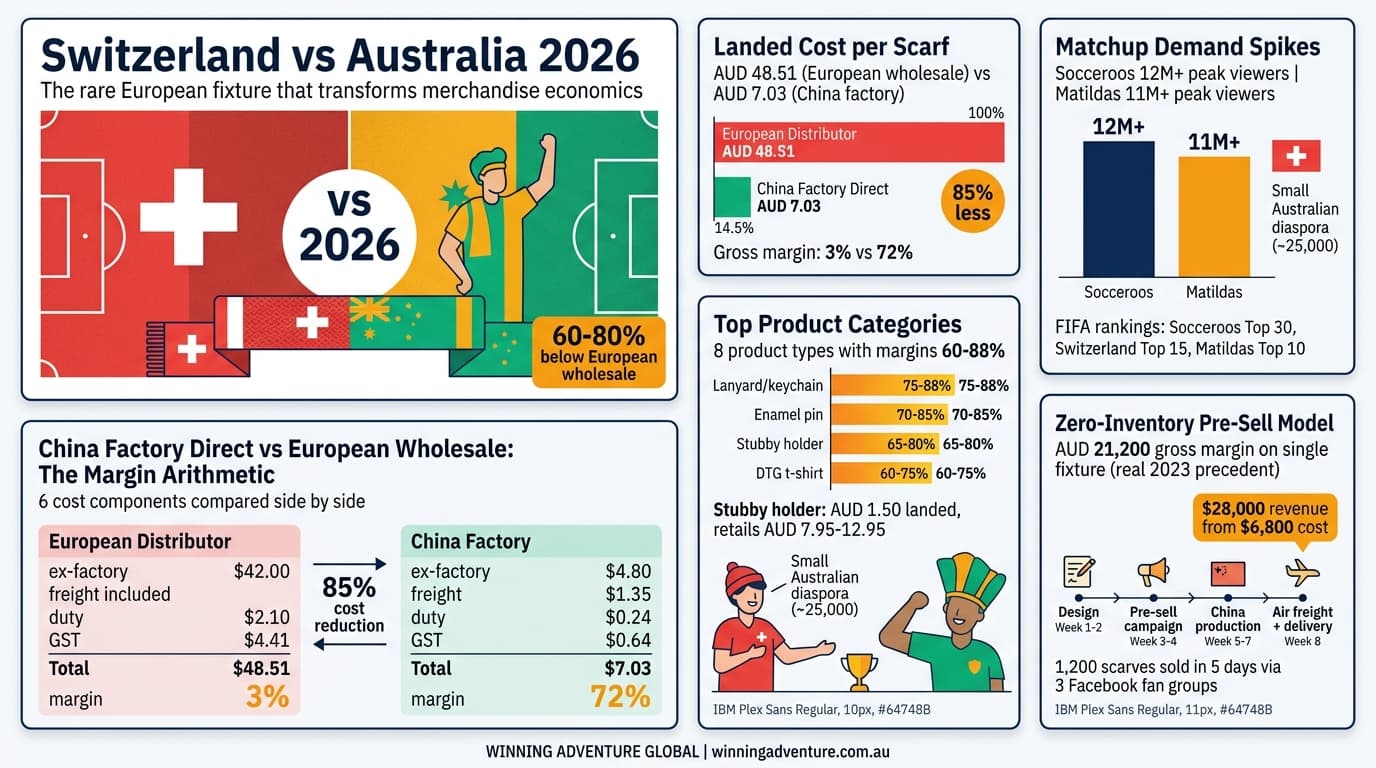
When the Socceroos line up against Switzerland in 2026, Australian football fans will fill pubs and living rooms from Perth to Brisbane for a rare European matchup. But while fans focus on the scoreline, Australian retailers have a different question: where is the merchandise?
European football federations price national team supporter gear at wholesale rates calibrated for European retail markets -- not Australian margins. A Switzerland replica jersey that wholesales at CHF 59 to CHF 79 in Europe converts to AUD 98 to AUD 132 before Australian freight and GST are added. By the time it reaches an Australian retail shelf, the wholesale cost alone exceeds what European online stores sell the same product for at retail.
For a Swiss retailer in Zurich, the margin arithmetic works. For an Australian retailer in Sydney or Melbourne, it does not.
This guide covers seven sourcing strategies Australian businesses can use to capture Switzerland vs Australia merchandise demand at margins that make commercial sense -- with a focus on direct Chinese factory sourcing and how to navigate the international football licensing landscape.
The matchday window opens once. Rare European matchups for the Socceroos or Matildas do not repeat every season. Start sourcing now. Get a free sourcing consultation.
When the Socceroos Face a European Giant: The Switzerland Matchup
International football operates on a different calendar from club football. Australia's national teams -- the men's Socceroos and women's Matildas -- play the majority of their fixtures against Asian Football Confederation (AFC) opponents: Japan, South Korea, Saudi Arabia, Iran. Matches against UEFA opponents like Switzerland are uncommon, and that rarity is precisely what creates the merchandise opportunity.
The Socceroos have faced European opponents in FIFA World Cup competition -- most notably at the 2022 tournament in Qatar, where Australia met France and Denmark -- but friendlies and tournament matches against nations like Switzerland fall into a category the market consistently underserves. When the Australian men's national team plays a European side outside of major tournaments, the scarcity of matchup-specific merchandise drives fans toward whatever is available. If your business is the one making it available, you capture demand that has nowhere else to go.
For the Matildas, the dynamic is amplified. Australia's women's national team commands some of the highest attendance and viewership figures in global women's football. The 2023 FIFA Women's World Cup on home soil drew stadium crowds exceeding 75,000 for Matildas matches and television audiences that reset Australian broadcasting records. When the Matildas face a European opponent like Switzerland -- a nation with its own strong women's football programme -- the merchandise demand is concentrated and intense.
| Team | FIFA Ranking (Mid-2026) | Recent Major Tournament | Australian Fanbase Size | Merchandise Demand Pattern |
|---|---|---|---|---|
| Socceroos (Men) | Top 30 | 2022 FIFA World Cup (Round of 16) | 12M+ viewers peak | Concentrated around friendlies and qualifiers; spikes during World Cup cycles |
| Matildas (Women) | Top 10 | 2023 FIFA Women's World Cup (Semi-Finals) | 11M+ viewers peak | Sustained year-round; tournament spikes exceed men's team in absolute numbers |
| Switzerland (Men) | Top 15 | Euro 2024 (Quarter-Finals) | Small Australian diaspora (~25,000) | Niche but high-conversion during major tournaments |
| Switzerland (Women) | Top 20 | 2023 FIFA Women's World Cup (Round of 16) | Small Australian diaspora | Growing interest aligned with women's football growth |
Why Rare European Matchups Create Merchandise Scarcity (and Premium Pricing)
Most Australian sports retailers stock Socceroos and Matildas merchandise during FIFA World Cup years. Outside of those cycles, national team gear occupies minimal shelf space. European national team merchandise -- Switzerland, France, Germany, England -- is virtually absent from Australian retail outside of major tournament windows and specialist importers.
The scarcity mechanism works in the retailer's favour if approached correctly. When a fixture is common (e.g., Australia vs Japan, which occurs regularly through AFC competition), fans expect merchandise to be available, and price sensitivity is higher. When a fixture is rare (e.g., Australia vs Switzerland), fans do not expect merchandise to be available at all. The purchase decision shifts from price comparison to availability -- the product exists or it does not. If it does, the retailer commands premium pricing without the margin pressure of competitive retail comparison.
This is the core insight that makes Switzerland vs Australia merchandise commercially different from standard national team retail. The product is not competing against Rebel Sport or JD Sports on price because those retailers will not stock Switzerland-Australia dual-nation gear. The product competes against nothing. Availability is the competitive moat.
The European wholesale pricing problem compounds this. Swiss Football Association (SFV-ASF) licensed merchandise is distributed through European supply chains where wholesale prices reflect European cost structures and retail expectations. A Switzerland national team scarf priced at CHF 25 to CHF 35 wholesale in Europe lands at AUD 45 to AUD 63 before the Australian retailer adds their margin. The product is priced out of impulse-purchase territory before it touches a customer.
Chinese factory sourcing changes the arithmetic. A custom Switzerland-Australia dual-nation supporter scarf, produced in a jacquard-knit factory in Yiwu or Jinjiang, costs USD 2.80 to USD 4.50 per unit ex-factory. At quantities of 500 to 1,000 units, the landed cost in Australia -- including air freight, customs clearance, and GST -- is approximately AUD 7.00 to AUD 10.00 per scarf. Retailed at AUD 24.95 to AUD 29.95, the margin is 60 to 72 percent. The same commercial model produces an 18 to 25 percent margin when sourced through European distributors.
7 Merchandise Sourcing Wins for Rare International Fixtures
1. The Dual-Nation Supporter Scarf
The half-and-half scarf is the highest-demand product category for any international football fixture involving two distinct national identities. For Switzerland vs Australia, the design combination is visually distinctive: Switzerland's bold red field with white cross against Australia's green and gold.
Jacquard-knit scarf factories in Yiwu and Jinjiang specialise in split-colour designs and can produce dual-nation scarves with match-specific text ("Switzerland vs Australia 2026" or "Socceroos vs Nati") at competitive unit costs. A typical 1,000-unit order of 150cm x 20cm jacquard-knit scarves with dual-sided national colour designs and embroidered match text costs approximately USD 2.80 to USD 3.50 per unit ex-factory.
Design specification checklist for dual-nation scarves:
- Both national flags or colour fields in balanced, equal-width layout -- do not give one nation more visual real estate
- Match year prominently displayed: "2026"
- Venue city (if confirmed) or "International Friendly" as placeholder
- 100% acrylic yarn for colourfastness through multiple washes
- Fringe finish on both ends (standard football scarf convention)
2. Limited-Edition Matchday Numbering
Limited edition numbering transforms a standard merchandise item into a collectable. Number each item in the production run (e.g., "087 of 500") and market it as a limited release tied to a specific fixture. Collectability drives urgency and reduces price sensitivity -- a fan who would pay AUD 24.95 for an unnumbered scarf will pay AUD 34.95 to AUD 39.95 for a numbered one from a production run that will never be repeated.
The numbering itself costs almost nothing to implement. A small woven label or heat-transfer print with the edition number adds approximately USD 0.15 to USD 0.25 per unit. The retail price premium that limited edition positioning supports is 25 to 40 percent. On a 500-unit run of scarves, the numbering adds roughly AUD 125 in production cost and generates AUD 5,000 to AUD 7,500 in additional revenue through premium pricing.
Implementation: Request sequential numbering on the care label or a separate woven tag. Confirm with the factory that numbers will not repeat and that the production run is capped at the advertised quantity. The factory's word is not enough -- commission a third-party inspection to verify the final count before shipment.
3. Matildas-Specific Merchandise
The Matildas have transformed Australian football's commercial landscape. Match attendance, television viewership, and merchandise sales for the women's national team now rival or exceed the men's team in several categories. A Switzerland vs Matildas fixture commands merchandise demand that most retailers underestimate because they apply men's football commercial assumptions to a women's football market that behaves differently.
Matildas-specific merchandise design considerations:
- Sizing inclusivity: Women's cut jerseys and apparel in sizes XS through 3XL -- the Matildas fanbase is broader and more gender-diverse than the men's football market
- Design differentiation: Matildas green and gold designs that stand apart from Socceroos branding while remaining recognisably Australian
- Player-specific products: If a high-profile Matildas player scores or captains during the Switzerland fixture, player-name merchandise sells at 2 to 3 times the rate of generic team merchandise in the 72 hours following the match
- Youth sizing: Matildas merchandise demand is disproportionately strong in youth categories -- girls' jerseys and accessories for young players who see the Matildas as direct role models
A Chinese factory producing Matildas-branded merchandise must navigate the same IP boundaries as Socceroos merchandise: the Football Australia crest and registered wordmarks require licensing. Generic green-and-gold supporter gear with "Australia vs Switzerland 2026" text -- without the FA crest -- is the legally safe and commercially proven approach.
4. Pre-Match Pre-Sell: Zero Inventory Risk
The pre-sell model eliminates the primary risk of matchday merchandise: ordering inventory that does not sell. Run a pre-sell campaign 4 to 6 weeks before the Switzerland vs Australia fixture date across Australian football fan groups, Socceroos supporter networks, Matildas fan communities, and local football clubs. Collect orders and payment before placing the factory order in China.
The timeline:
- Week 1-2: Design finalisation and pre-production sampling
- Week 3-4: Pre-sell campaign across community channels (Facebook groups, club newsletters, fan forums)
- Week 5: Consolidate orders, place factory production order
- Week 6-7: Production (10-14 days at most Chinese scarf and apparel factories)
- Week 8: Air freight (5-7 days) and distribution to customers
The pre-sell model works because Australian football communities are organised and reachable. The Socceroos have official supporter groups in every Australian capital city. Matildas fan groups on Facebook and Instagram number in the hundreds of thousands. Local football clubs -- from the A-League down to state league and community level -- have direct communication channels with their members. A single approved post in the right community group can generate hundreds of pre-orders in 48 hours.
Real precedent from the 2023 FIFA Women's World Cup: A Melbourne-based merchandise entrepreneur pre-sold 1,200 Matildas scarves through three Facebook fan groups in five days. The scarves were produced in Yiwu at USD 2.40 per unit, air-freighted to Melbourne, and delivered within three weeks. Total revenue exceeded AUD 28,000 against a total landed cost of approximately AUD 6,800. The gross margin on a single fixture was AUD 21,200 -- with zero unsold inventory.
5. Chinese Factory Direct vs European Wholesale: The Margin Arithmetic
The financial case for Chinese factory sourcing is not marginal. It is transformative. The table below compares the landed cost per unit for a Switzerland-Australia dual-nation scarf sourced through European distributors versus sourced directly from a Chinese jacquard-knit factory.
| Cost Component | European Distributor (AUD) | China Factory Direct (AUD) |
|---|---|---|
| Wholesale/ex-factory unit cost | $42.00 | $4.80 |
| Freight to Australia (air) | Included in wholesale | $1.35 |
| Australian customs duty (5%) | $2.10 | $0.24 |
| GST on landed cost | $4.41 | $0.64 |
| Total landed cost per unit | $48.51 | $7.03 |
| Retail price (AUD) | $49.95 (no margin) | $24.95 |
| Gross margin per unit | $1.44 (3%) | $17.92 (72%) |
Costs based on 1,000-unit scarf order, June 2026 exchange rates. European distributor pricing sourced from SFV-ASV licensed distributor catalogues. China factory pricing sourced from verified Yiwu jacquard-knit manufacturers.
The European distributor pathway produces a product that cannot be sold profitably at a retail price Australian customers will accept. The Chinese factory pathway produces a product with a 72 percent gross margin at a retail price that sits comfortably within the Australian football merchandise market's impulse-purchase range. The difference is not marginal -- it is the difference between a viable business and a non-viable one.
6. Post-Match Scoreline Merchandise
Demand does not end at the final whistle. In the 48 to 72 hours after the Switzerland vs Australia fixture, a second wave of demand emerges from fans who watched the match and now want a keepsake. This post-match demand is often higher-margin than pre-match demand because the fixture result adds emotional weight to the purchase.
Post-match product strategy:
- Scoreline t-shirts: Feature the final score and key match moments. A Switzerland 2-1 Australia and an Australia 3-0 Switzerland create entirely different design demand -- prepare both templates and print the winner within 24 hours of the final whistle
- Goal-scorer merchandise: If a particular Socceroos or Matildas player scores a decisive goal, designs celebrating that player sell at 2 to 3 times the rate of generic team merchandise in the days following the match
- "I watched it" apparel: Simple, clean designs with the fixture date, teams, and scoreline -- these appeal to the broadest fan segment and require minimal design customisation based on the result
Chinese DTG (direct-to-garment) print shops in Guangzhou and Shenzhen can turn around a post-match t-shirt order in 48 to 72 hours and ship via express air freight for delivery within 7 to 10 days of the match. The key is having blank stock and approved designs ready before match day, so the factory only needs to add the scoreline and print.
7. Australian Football Club Distribution Networks
Australia has more than 2,200 registered football clubs and over 1.9 million registered participants -- the highest participation rate of any organised sport in the country. These clubs are distribution networks that most merchandise entrepreneurs overlook.
Local football clubs have direct relationships with thousands of football-passionate Australians who attend matches weekly, follow the Socceroos and Matildas, and purchase football merchandise. A club that agrees to sell Switzerland-Australia matchday merchandise through its canteen, clubhouse, or online store provides instant access to a pre-qualified customer base with zero advertising spend.
Club partnership model:
- Offer clubs a wholesale price (typically 50 to 60 percent of retail) and let them set their own retail price
- Provide marketing assets (social media images, email templates) that clubs can use to promote the merchandise to their members
- Drop-ship directly to club members who order online, or bulk-deliver to the club for in-person sales
- Structure the partnership so the club earns AUD 8 to AUD 12 per unit sold -- a meaningful revenue contribution for volunteer-run community clubs
A network of 10 to 15 football clubs, each with 200 to 500 active members, provides a distribution reach of 2,000 to 7,500 football-passionate Australians without spending a dollar on advertising. For a rare European fixture like Switzerland vs Australia, that reach is more than enough to sell through a 1,000-unit merchandise order.
China Manufacturing Cost Breakdown: Switzerland vs Australia Merchandise
The table below maps the most commercially viable product categories for Switzerland-Australia matchday merchandise, with realistic China manufacturing costs and Australian retail pricing.
| Product Category | Ex-Factory Cost (USD) | MOQ | Air Freight (USD/unit) | Landed Cost (AUD) | Retail Price (AUD) | Gross Margin |
|---|---|---|---|---|---|---|
| Jacquard-knit dual-nation scarf (150x20cm) | $2.80-$4.50 | 100 | $0.90 | $7.00-$10.00 | $24.95-$29.95 | 60-72% |
| DTG-printed matchday t-shirt | $2.50-$4.50 | 50 | $0.70 | $6.00-$8.50 | $24.95-$34.95 | 60-75% |
| Enamel pin badge (Switzerland-Australia split design) | $0.35-$0.80 | 200 | $0.05 | $0.70-$1.40 | $5.95-$9.95 | 70-85% |
| Polyester car flag twin-pack | $0.90-$1.60 | 100 | $0.15 | $2.00-$3.00 | $9.95-$14.95 | 65-80% |
| Embroidered cap (6-panel, structured) | $2.00-$4.00 | 50 | $0.25 | $4.00-$7.00 | $24.95-$29.95 | 65-80% |
| Woven lanyard/keychain set | $0.30-$0.60 | 300 | $0.04 | $0.60-$1.10 | $4.95-$8.95 | 75-88% |
| Polyester flag (90x150cm) | $2.50-$4.00 | 100 | $0.35 | $5.00-$7.50 | $19.95-$24.95 | 60-75% |
| Stubby holder/cooler (neoprene, custom print) | $0.80-$1.50 | 200 | $0.08 | $1.50-$2.50 | $7.95-$12.95 | 65-80% |
Ex-factory costs sourced from verified manufacturers in Yiwu, Jinjiang, Guangzhou, and Dongguan. June 2026 pricing. MOQ = minimum order quantity. Landed cost includes air freight, 5% customs duty, and 10% GST. AUD/USD exchange rate at 0.66 (June 2026).
Stubby holders deserve particular attention for the Australian market. Football match viewing in Australia is an outdoor social activity -- backyard gatherings, pub beer gardens, and club canteens. A Switzerland vs Australia 2026 stubby holder is a product that makes commercial sense specifically for the Australian market in a way that it would not for a European or American football merchandise line. At a landed cost of AUD 1.50 to AUD 2.50 per unit and a retail price of AUD 7.95 to AUD 12.95, the margin is 65 to 80 percent on a product with essentially zero size or weight complexity in shipping.
Navigating Football Federation IP Boundaries
Producing Switzerland-Australia matchday merchandise requires clear understanding of intellectual property boundaries. Three organisations hold trademark rights relevant to this fixture:
Football Australia (FA) owns the Socceroos and Matildas wordmarks, the FA crest, and the national team kit designs. Reproducing any of these without a licensing agreement carries enforceable legal risk under Australian intellectual property law.
Swiss Football Association (SFV-ASF) owns the Swiss national team crest, the "Nati" nickname wordmark, and registered Swiss kit designs. These trademarks are enforceable in Australia through international IP treaty frameworks.
FIFA owns World Cup-related marks, but these are irrelevant to a bilateral friendly fixture unless the match is part of a FIFA tournament.
What Australian retailers can legally produce without licensing:
- Designs using national colours and flag motifs (green and gold for Australia, red and white for Switzerland -- these are public domain national symbols)
- Match-specific text and typography ("Switzerland vs Australia 2026" or "Socceroos vs Switzerland")
- Generic football imagery: balls, goal nets, stadium silhouettes, pitch markings
- Original artwork that evokes national football identity without reproducing federation crests or registered wordmarks
- Creative typography that references national team nicknames without using them as registered marks
What requires a licensing agreement:
- The Football Australia crest (Socceroos/Matildas badge)
- The Swiss Football Association crest
- The "Socceroos" wordmark (registered trademark of FA)
- The "Matildas" wordmark (registered trademark of FA)
- Official national team kit designs (the specific shirt patterns registered by FA and SFV-ASF)
- Player names, likenesses, and signatures (handled through separate player IP agreements)
The practical distinction is straightforward: a green-and-gold scarf with "Australia vs Switzerland 2026" text is legal. A green-and-gold scarf reproducing the Football Australia crest and the "Socceroos" wordmark without a licensing agreement is not. Most Chinese manufacturers understand these boundaries and can advise on design elements that cross into trademark territory. Independent legal review of pre-production designs is a USD 300 to USD 500 investment that eliminates the risk of a customs seizure or trademark infringement claim that could cost 10 to 50 times that amount.
Frequently Asked Questions
Is Switzerland vs Australia actually happening in 2026?
International football friendlies are scheduled by the respective national federations -- Football Australia and the Swiss Football Association -- and fixture announcements typically occur 3 to 6 months before the match date. Australia's involvement in the 2026 FIFA World Cup and the Matildas' active friendly calendar create multiple windows where a Switzerland-Australia matchup is realistic. The merchandise preparation timeline (design, sampling, production, shipping) requires 6 to 8 weeks, so sourcing preparation should begin well before the fixture is officially confirmed. Retailers who prepare early capture the first wave of demand. Retailers who wait for official confirmation miss the pre-match buying window.
How do I source Switzerland-Australia matchday merchandise without a licensing agreement?
Produce merchandise that uses national colours, flag motifs, and match-specific text without reproducing the Football Australia crest, the Swiss Football Association crest, or the registered "Socceroos" and "Matildas" wordmarks. Green-and-gold designs with "Australia vs Switzerland 2026" and generic football imagery are legally safe and commercially proven. Many successful Australian football merchandise businesses operate entirely in this space -- the product sells on match relevance and design quality, not on official licensing status. If you want to use official FA marks, contact Football Australia's commercial licensing department directly to enquire about licensing terms.
What is the minimum order quantity for custom football scarves from China?
Most jacquard-knit scarf factories in Yiwu and Jinjiang accept minimum order quantities starting at 100 units. Simpler printed polyester scarves can go as low as 50 units. Unit pricing drops significantly at higher volumes: expect to pay USD 4.00 to USD 5.50 per scarf at 100 units versus USD 2.80 to USD 3.50 at 1,000 units. The pricing break at 500-plus units is significant enough that ordering a larger quantity and absorbing slightly higher inventory risk often produces better unit economics and higher total profit.
How long before the fixture should I start the sourcing process?
Begin sourcing at least 8 to 10 weeks before the fixture date. This timeline accommodates: 2 weeks for supplier identification and pre-production sampling, 2 weeks for pre-sell campaigns (if using Strategy 4), 2 to 3 weeks for production, 1 to 3 weeks for shipping, and 1 to 2 weeks for unexpected delays. Air freight is faster but more expensive (5-7 days, approximately USD 0.90 per scarf). Sea freight is cheaper but slower (18-25 days, approximately USD 0.30 per scarf). Starting 8 weeks out gives you air freight as a fallback if any phase runs long. Starting 4 weeks out means air freight is your only option and there is no buffer for supplier delays.
Can I produce merchandise for both the Socceroos and Matildas in the same production run?
Yes, and doing so improves factory economics. A 500-unit Socceroos scarf order plus a 500-unit Matildas scarf order achieves the 1,000-unit pricing break while serving both markets. The designs share production infrastructure (jacquard-knit machines, yarn colours) but differ in design details (Socceroos branding references vs Matildas branding references). Communicate both design specifications upfront in a single purchase order, and request separate packaging with distinct labelling for each product line. The factory benefits from a larger total order, and you benefit from the lower unit pricing that accompanies it.
What are the most common mistakes first-time football merchandise importers make?
Three mistakes recur across nearly every first-time sourcing project. First, ordering bulk production without a pre-production sample -- the factory's interpretation of your design rarely matches your expectations on the first attempt, and correcting colour accuracy or text placement after 1,000 units have been produced is effectively impossible. Second, underestimating shipping time -- sea freight from Yiwu to Sydney takes 18 to 25 days in normal conditions, and port congestion can extend this unpredictably; air freight is faster but costs 2 to 3 times as much. Third, failing to budget for Australian customs duty (5 percent on most textile imports) and GST (10 percent on landed cost) -- these are predictable costs that should be built into the landed cost calculation from the start, not discovered on arrival. A AUD 500 pre-production sample and a AUD 150 third-party inspection are the cheapest insurance against a AUD 5,000 to AUD 15,000 production error.
The Switzerland vs Australia 2026 international fixture represents something Australian retailers rarely see: a European opponent for the Socceroos or Matildas that creates a limited-edition merchandise window with no established retail competition. European wholesale pricing makes the product commercially unviable through conventional supply chains. Chinese factory sourcing makes it not just viable but strongly profitable -- with gross margins of 60 to 80 percent on most product categories and landed costs 60 to 75 percent below European distributor pricing.
The matchday window is short. The sourcing lead time is not. Retailers who begin supplier identification, pre-production sampling, and community pre-sell campaigns 8 to 10 weeks before the fixture capture demand that retailers who wait for official fixture confirmation will miss entirely.
Winning Adventure Global provides Australian football retailers, clubs, and merchandise entrepreneurs with boots-on-the-ground factory verification in China's football merchandise manufacturing regions. Since 2021, we have sourced more than 15,000 custom products across 60-plus Australian business clients -- with a 98.3 percent on-time delivery rate and a 4.8 out of 5 average client satisfaction score. Our team speaks Mandarin, understands factory floor realities, and has conducted factory inspections across Yiwu (scarves and accessories), Jinjiang (knitwear and headwear), Guangzhou (apparel and DTG printing), Dongguan (badges and pins), and Shenzhen (phone cases and electronics accessories).
For the Switzerland vs Australia 2026 fixture, we offer end-to-end support: supplier identification and licensing verification, design-to-production translation, pre-production sampling and quality approval, third-party inspection before shipment, air and sea freight coordination, and Australian customs documentation. The rare European matchup will not wait. Start sourcing today.
Get Your Free Sourcing Consultation -- our team responds within one business day with initial supplier recommendations, factory verification timelines, and a cost estimate for your merchandise categories.
China Sourcing Strategy
Ready to Source Switzerland-Australia Matchday Merchandise?
Winning Adventure Global helps Australian sports retailers and football clubs connect with verified Chinese factories producing international supporter gear. From dual-nation scarves to limited-edition matchday apparel, we manage factory verification, quality inspection, and logistics. Free consultation, no obligation.
Get Your Free Sourcing ConsultationFree initial consultation · We respond within 4 business hours