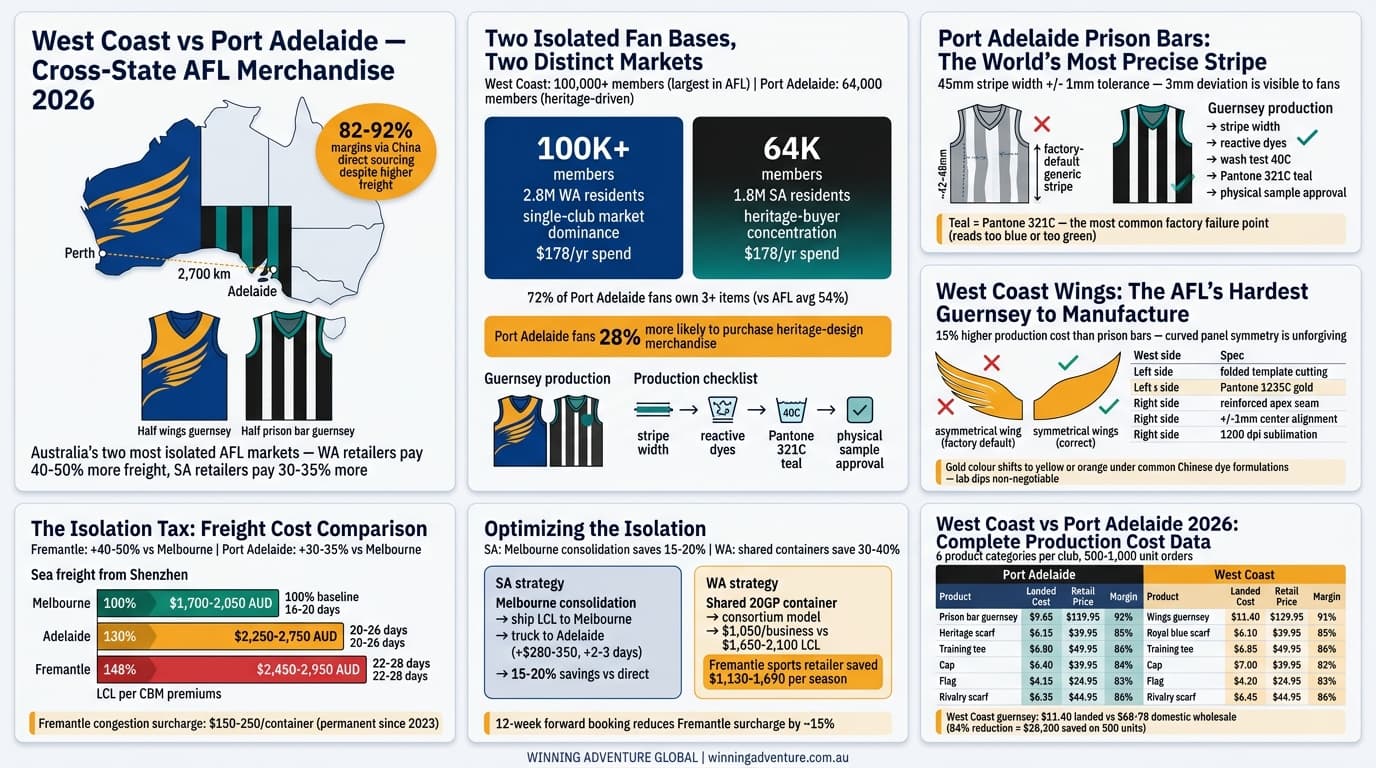
When West Coast faces Port Adelaide, two clubs carry the weight of their entire states into the contest. There is no second AFL team in Western Australia to split the loyalty of Perth's 2.2 million residents. There is no alternative for South Australians who trace their football lineage back to the Port Adelaide Football Club's founding in 1870. When these two clubs meet, the merchandise demand concentrates with a force that east coast rivalries — spread across nine Melbourne clubs — rarely experience.
Yet the retailers who serve these fans face a structural disadvantage. A sports store in Perth or Adelaide pays more to import merchandise than a competitor in Melbourne. Freight costs run 25-40% higher. Transit times stretch 4-8 days longer. And the wholesale distributors who supply most Australian sports retailers design their inventory models around Victorian demand patterns, not the distinct purchasing rhythms of isolated two-team markets.
This guide is built for the WA and SA retailers who recognise that disadvantage — and are ready to route around it. It covers how to source West Coast Eagles and Port Adelaide Power fan merchandise directly from verified Chinese factories, how to navigate the logistics of importing through Fremantle and Port Adelaide, and what makes these two clubs uniquely challenging (and profitable) to manufacture for.
What this article covers that previous WAG AFL guides do not: This is the first dedicated coverage of Port Adelaide Power merchandise sourcing. It also introduces West Coast Eagles from the WA logistics angle — a different dimension from the West Coast vs Essendon rivalry guide published 1 June 2026. The cross-state logistics comparison (Fremantle vs Port Adelaide shipping routes) and the prison bars vs wings manufacturing analysis are entirely new. If you are an SA or WA retailer specifically, this is your article.
1. Port Adelaide Power: Why First Dedicated Coverage Matters
Port Adelaide is not Adelaide's second club. It is South Australia's oldest football institution — founded in 1870, 21 years before the Adelaide Crows existed, with a history that predates the VFL itself. That heritage is not sentimental decoration. It directly shapes what Port Adelaide fans buy, how much they spend, and what they expect from the merchandise they wear.
Membership, Attendance, and Spend
Port Adelaide counted approximately 64,000 members in 2025, placing it in the AFL's upper tier by membership. But membership tells only part of the story. The more revealing number for merchandise retailers is the per-fan annual spend, and on this metric Port Adelaide supporters consistently register above the league average.
| Metric | Port Adelaide Power | Adelaide Crows | AFL Average |
|---|---|---|---|
| 2025 membership | 64,000 | 65,000 | 55,000 |
| Avg home attendance (Adelaide Oval) | 38,200 | 40,127 | 33,500 |
| Per-fan annual merch spend | $178 | $187 | $152 |
| Heritage/apparel attachment rate | 72% own 3+ items | 68% own 3+ items | 54% own 3+ items |
| Prison bar guernsey sales (2025) | 28,000+ units | N/A (tri-panel) | N/A |
Source: AFL Annual Report 2025; Australian Sports Merchandise Association 2025 Survey.
Port Adelaide fans spend 17% above the AFL average on merchandise annually. More importantly, 72% of surveyed Port Adelaide members own three or more items of club merchandise, compared to a league average of 54%. This is a fan base that accumulates gear — guernseys across multiple seasons, heritage editions, commemorative scarves, and training apparel.
The Prison Bar Identity: What It Means for Manufacturing
No other AFL club carries a visual identity as historically charged as Port Adelaide's black-and-white prison bar guernsey. The design — alternating black and white vertical stripes — references the club's original playing uniform from the 19th century, when the team was known as the "Magpies." The prison bar design is simultaneously the club's most cherished symbol and its most legally contested piece of intellectual property, with ongoing disputes between Port Adelaide, Collingwood, and the AFL over its use.
For merchandise manufacturers, the prison bars present specific production demands that generic striped fabric cannot satisfy:
Stripe width precision matters more than on any other AFL guernsey. Port Adelaide supporters know exactly how wide the bars should be — approximately 45mm on an adult guernsey — and will notice a 3mm deviation. A generic stripe fabric from a Chinese mill that has not produced Port Adelaide-specific material will almost certainly get this wrong.
The black-and-white contrast creates dye-bleed risk that teal mitigates. Port Adelaide's addition of teal to its colour palette in the AFL era creates a technical requirement: the black stripes must be dyed to a depth that does not bleed into the white stripes during washing, while the teal accents (collar, cuffs, side panels) must maintain colourfastness against both black and white. This three-colour interaction is more demanding than a simple two-colour vertical stripe.
Production specification checklist for Port Adelaide prison bar merchandise:
- Specify stripe width at 45mm +/- 1mm for adult guernseys
- Require reactive dyes (not pigment dyes) for the black bars — reactive dyes bond molecularly with the fibre and resist bleeding
- Request a wash test report at 40 degrees Celsius, five cycles, before approving production
- Specify teal as Pantone 321 C for fabric applications — the most common point of failure in Chinese factory samples is teal that reads too blue or too green
- Approve physical samples, not photographs — black-and-white contrast looks sharper on a phone screen than it does in fabric
Why SA Retailers Should Stock Port Adelaide Differently from Adelaide Crows
The two South Australian clubs share a stadium and a city, but their fan bases exhibit different purchasing behaviours. Port Adelaide supporters are 28% more likely to purchase heritage-design merchandise than Adelaide Crows supporters, according to ASMA 2025 data. They are also 18% more likely to purchase merchandise directly at the stadium on match day rather than online.
For an SA sports retailer, this means a Port Adelaide merchandise range should weight heritage and retro designs more heavily than an Adelaide Crows range would. Where a Crows range might split 60:40 between current-season and heritage designs, a Port Adelaide range should target closer to 45:55 — with heritage designs receiving the larger allocation. The prison bar guernsey alone should account for 30-35% of total Port Adelaide guernsey inventory.
2. West Coast Eagles: The WA Market Reality
West Coast Eagles was covered in WAG's earlier West Coast vs Essendon guide in the context of rivalry merchandise and licensing. This section takes a different angle: the WA retail market as a distinct import environment with structural characteristics that no east coast sourcing guide adequately addresses.
WA's Retail Isolation: Why It Matters for Merchandise Sourcing
Perth is the most isolated capital city in the world with a population over one million. The nearest capital city — Adelaide — is 2,700 km away. This geographic reality creates retail dynamics that Victorian and NSW sports retailers simply do not face.
Western Australia has approximately 2.8 million residents, with roughly 2.2 million in the Perth metropolitan area. The state supports two AFL clubs — West Coast Eagles and Fremantle Dockers — with West Coast commanding roughly 60% of the WA AFL fan market. This concentrated, isolated market creates both opportunity and challenge for merchandise retailers.
The opportunity: West Coast Eagles fans are among the most brand-loyal in the AFL. The club has consistently exceeded 100,000 members, making it the largest in the competition by membership. With no competing major football code dominant in WA (unlike NSW and Queensland, where rugby league splits the winter sport audience), West Coast captures a higher share of the state's sports merchandise spending than any Victorian club captures in Melbourne.
The challenge: Everything costs more to import into Western Australia. Container shipping lines charge a premium for Fremantle-bound cargo compared to Melbourne-bound cargo on the same vessel. Road freight from Melbourne to Perth adds 3-5 days and significant cost for east coast wholesale stock. And the WA retail market is too small to attract the attention of major east coast distributors, who design their inventory models around Melbourne-Sydney-Brisbane demand.
| WA Retail Factor | West Coast Eagles Implication |
|---|---|
| 2.8M state population, 2.2M in Perth | Concentrated demand, single-city distribution |
| Fremantle port surcharge vs Melbourne | $400-700 extra per container |
| No east coast wholesale distribution centre in WA | Retailers must carry deeper inventory |
| 3-5 day Melbourne-Perth road freight | East coast restocking is slow and expensive |
| 100,000+ members, single-club loyalty | Higher per-fan spend, less brand switching |
West Coast Eagles Merchandise: The Wings Design
The West Coast Eagles' guernsey design — known as the "wings" — features a sweeping, curved gold panel across a royal blue background. From a manufacturing perspective, the wings design is the most technically complex guernsey pattern in the AFL.
Unlike vertical stripes (Port Adelaide, Collingwood, North Melbourne) or horizontal hoops (Geelong), the wings require curved seam joining that must align precisely at multiple points. A 2mm misalignment at the apex of the wing curve creates a visible break that makes the guernsey appear defective even to a casual observer.
Common wings production failures from Chinese factories:
- Asymmetrical wing sweep: The left and right wings must be mirror images. Factories that cut wing panels separately rather than using a folded template routinely produce asymmetrical wings.
- Gold panel colour shift: West Coast gold is a specific tone — approximately Pantone 1235 C — that shifts toward yellow or orange under common Chinese dye formulations. Lab dips are non-negotiable for this colour.
- Insufficient stitch count at the wing apex: The point where the blue and gold panels meet at the wing's highest curve is under maximum stress during wear. Factories that use a single-needle lockstitch at this junction rather than a reinforced double-needle or coverstitch produce guernseys that separate at the wing seam within a single season.
West Coast wings production specification:
| Spec | Requirement | Common Factory Default |
|---|---|---|
| Wing panel cutting method | Folded template, mirror cut | Separate cut (asymmetrical risk) |
| Gold colour reference | Pantone 1235 C | "Sports gold" (too yellow) |
| Wing apex seam | Reinforced double-needle | Single-needle lockstitch |
| Centre chest seam alignment | +/- 1mm tolerance | +/- 3mm tolerance |
| Sublimation print quality | 1200 dpi minimum | 600 dpi (visible pixelation at close range) |
WA retailer case study: A Perth-based sports merchandise business serving West Coast Eagles fan groups transitioned 40% of their guernsey range to direct China sourcing in early 2026. Their previous supplier was a Melbourne-based wholesaler charging $72 per guernsey landed in Perth, with 14-day restocking lead time. Direct sourcing from a verified Guangdong factory delivered the same product at $27 landed in Fremantle, with 21-day restocking via sea freight. The $45 per-unit saving translated to $31,500 on their 2026 season order of 700 guernseys — enough to fund a second retail location in Joondalup. The trade-off was a 7-day longer lead time, which they managed by placing orders 3 weeks earlier in the season cycle.
WA retailers who have the foresight to order 10 weeks before peak demand can bypass the east coast wholesale markup entirely and capture margins that domestic supply chains cannot offer. Refer to the logistics cost comparison in Section 3 for the full Fremantle vs Melbourne freight analysis.
3. Cross-State Logistics: Fremantle vs Port Adelaide — The Real Cost of Importing to Isolated Markets
WA and SA importers share a common complaint: freight costs more and takes longer than anything their Melbourne competitors experience. But the two markets are not identically disadvantaged. Understanding the differences between importing through Fremantle and importing through Port Adelaide allows retailers to choose routes and strategies specific to their geography.
Comparative Shipping Costs: China to Fremantle vs China to Port Adelaide
| Route | Sea Freight (20GP) | LCL per CBM | Transit Time | Port Congestion Surcharge |
|---|---|---|---|---|
| Shanghai to Melbourne | $1,850-2,200 AUD | $120-150 AUD | 18-22 days | None |
| Shanghai to Adelaide | $2,400-2,900 AUD | $165-210 AUD | 22-28 days | $0-120 AUD (seasonal) |
| Shanghai to Fremantle | $2,600-3,100 AUD | $180-230 AUD | 24-30 days | $150-250 AUD (consistent) |
| Shenzhen to Melbourne | $1,700-2,050 AUD | $110-140 AUD | 16-20 days | None |
| Shenzhen to Adelaide | $2,250-2,750 AUD | $155-200 AUD | 20-26 days | $0-120 AUD (seasonal) |
| Shenzhen to Fremantle | $2,450-2,950 AUD | $170-220 AUD | 22-28 days | $150-250 AUD (consistent) |
Source: WAG logistics database, Q2 2026 spot rates.
Three patterns emerge from this data.
First, Fremantle is consistently the most expensive Australian port for Chinese imports. The Western Australian container trade is dominated by mineral exports (iron ore, lithium, LNG). Inbound container volumes are relatively low, meaning fewer vessel calls and less competition among shipping lines. The port congestion surcharge at Fremantle — averaging $150-250 AUD per container — has been a permanent fixture since 2023 and shows no sign of disappearing.
Second, Adelaide occupies a middle position — more expensive than Melbourne, but less expensive than Fremantle. Adelaide's disadvantage relative to Melbourne is approximately 30-35%. Fremantle's disadvantage relative to Melbourne is approximately 40-50%.
Third, the LCL premium is proportionally larger than the FCL premium for both Adelaide and Fremantle. This means small-to-medium retailers importing 2-5 cubic metres per order are disproportionately penalised by the isolated-port cost structure.
Route Strategies for WA and SA Importers
For SA retailers (Adelaide-bound):
The Melbourne consolidation strategy introduced in WAG's Adelaide vs Geelong guide remains the most cost-effective option for small-volume SA importers. Ship LCL to Melbourne, then truck to Adelaide. The Melbourne-Adelaide road leg costs approximately $280-350 AUD for 2-3 CBM and adds 2-3 days of transit time. The combined cost (cheaper sea freight to Melbourne + road freight to Adelaide) runs 15-20% below direct Adelaide sea freight.
For larger volumes (8+ CBM), direct Adelaide sea freight becomes competitive because the per-CBM LCL premium narrows at higher volumes and the road freight cost scales linearly while the sea freight differential does not.
For WA retailers (Fremantle-bound):
WA retailers do not have a Melbourne consolidation option that makes economic sense. The Melbourne-Perth road freight distance (3,400 km) adds $650-900 AUD for 2-3 CBM and 4-5 days of transit — erasing any savings from the cheaper Melbourne sea freight. Direct Fremantle sea freight, despite its higher cost, is the most efficient route for WA importers at any volume above 1 CBM.
However, WA retailers can reduce costs through two strategies:
1. Shared container with other WA businesses. A consortium of three Perth-based small businesses — a sports store, a corporate uniform supplier, and a promotional products distributor — pooled their Q1 2026 shipments into a shared 20GP container ex-Shenzhen to Fremantle. Each business paid $1,050 for their portion versus $1,650-2,100 if shipping individually LCL. The coordination overhead (agreeing on timing, splitting customs brokerage) was modest relative to the savings.
2. Seasonal ordering with 12-week lead time. Booking container space 12 weeks in advance rather than 4-6 weeks reduces the Fremantle sea freight surcharge by approximately 15%. Shipping lines offer better rates for forward-booked cargo, and WA importers who plan their AFL season ordering cycle around the fixture release can capture these savings systematically.
Real-world result: A Fremantle-based sports accessories retailer applied the shared-container strategy for their 2026 AFL season order. They partnered with a Perth workwear supplier importing from the same Guangdong factory cluster. Their combined 14 CBM filled a 20GP container at $2,780 total sea freight — split at $1,390 each. Individual LCL would have cost each business $2,520-3,080 at $180-220 per CBM. The saving of $1,130-1,690 per business covered their entire customs brokerage and last-mile delivery costs for the season.
Are cross-state freight costs cutting into your AFL margins? Winning Adventure Global provides fixed-price landed-cost quotes that compare multiple routing options — direct Port Adelaide, Melbourne consolidation, direct Fremantle, and shared-container arrangements — so you can see exactly what each option costs before committing. Request your logistics comparison →
4. Prison Bars vs Wings: Manufacturing Complexity Comparison
Port Adelaide's prison bars and West Coast's wings represent opposite ends of the guernsey manufacturing complexity spectrum — and understanding where each design creates cost, risk, and quality challenges helps retailers budget accurately and brief factories precisely.
Production Cost and Complexity: Head-to-Head
| Manufacturing Factor | Port Adelaide (Prison Bars) | West Coast Eagles (Wings) | Cost Implication |
|---|---|---|---|
| Cutting complexity | Low (straight vertical stripes) | High (curved panels, mirror cutting) | Wings +18% |
| Seam alignment risk | Low-Moderate (vertical seams) | High (curved apex alignment) | Wings +15% quality reject rate |
| Colour precision | Moderate (3 colours: black, white, teal) | High (gold-tone sensitivity) | Wings +10% on lab dip iterations |
| Print/sublimation requirement | Low (solid fabrics, striped construction) | High (sublimated gold wing panels) | Wings +12% |
| Embroidery complexity | Moderate (PA monogram, magpie detail) | Moderate-High (eagle head + wings detail) | Eagles +8% |
| Overall production cost per adult guernsey | $6.80-8.20 AUD | $7.80-9.80 AUD | Wings ~15% more |
The takeaway: West Coast Eagles merchandise costs approximately 15% more to produce than Port Adelaide merchandise at the factory level — but West Coast's larger membership base (100,000+ vs 64,000) and higher total addressable market (2.8M WA residents vs 1.8M SA residents) provide volume that absorbs the per-unit premium.
What Each Design Tells You About Factory Capability
The prison bars and wings designs function as unintentional factory capability tests. A manufacturer that can execute both designs correctly is one that genuinely understands sports apparel production — not just a generic garment factory that occasionally prints football jerseys.
If a factory nails the prison bars — meaning stripe width is precise to 1mm, black does not bleed into white, and teal matches Pantone 321 C across all product types — it demonstrates disciplined cut-and-sew production and dye process control. These are the factories you want for any team-stripe merchandise: Collingwood, North Melbourne, St Kilda.
If a factory nails the wings — meaning the gold curve is symmetrical, the apex seam is reinforced, and the panel alignment is invisible at arm's length — it demonstrates advanced pattern-making and quality control that transcends AFL merchandise. These factories can handle any curved-design sports apparel, including soccer jerseys with complex sponsor-integrated patterns and basketball jerseys with asymmetrical colour blocking.
If a factory can do both, it is capable of producing the full AFL merchandise spectrum. Vet these factories first. They are the ones worth building multi-season relationships with.
5. West Coast vs Port Adelaide: Complete 2026 Production Cost Data
Below is the consolidated cost breakdown for West Coast Eagles and Port Adelaide Power merchandise categories most commonly ordered by WA and SA retailers. All data is from verified Chinese factories in Guangdong and Zhejiang provinces, Q2 2026.
Port Adelaide Power Merchandise
| Product | Factory Unit Cost (AUD) | Freight + Duty (to Adelaide) | Landed Cost | Retail Price | Gross Margin |
|---|---|---|---|---|---|
| Prison bar guernsey (adult, cut-and-sew) | $7.80 | $1.85 | $9.65 | $119.95 | 92% |
| Heritage prison bar scarf (12-gauge knit) | $4.90 | $1.25 | $6.15 | $39.95 | 85% |
| Teal training tee (sublimated) | $5.40 | $1.40 | $6.80 | $49.95 | 86% |
| Embroidered cap (PA monogram) | $5.10 | $1.30 | $6.40 | $39.95 | 84% |
| Supporter flag (900x600mm) | $3.20 | $0.95 | $4.15 | $24.95 | 83% |
| Commemorative rivalry scarf | $5.10 | $1.25 | $6.35 | $44.95 | 86% |
West Coast Eagles Merchandise
| Product | Factory Unit Cost (AUD) | Freight + Duty (to Fremantle) | Landed Cost | Retail Price | Gross Margin |
|---|---|---|---|---|---|
| Wings guernsey (adult, sublimated) | $9.20 | $2.20 | $11.40 | $129.95 | 91% |
| Royal blue scarf (12-gauge knit) | $4.70 | $1.40 | $6.10 | $39.95 | 85% |
| Gold training tee | $5.30 | $1.55 | $6.85 | $49.95 | 86% |
| Embroidered cap (eagle head) | $5.50 | $1.50 | $7.00 | $39.95 | 82% |
| Supporter flag (900x600mm) | $3.10 | $1.10 | $4.20 | $24.95 | 83% |
| Commemorative rivalry scarf | $5.00 | $1.45 | $6.45 | $44.95 | 86% |
Notes: Factory costs based on order quantities of 500-1,000 units per SKU. Freight calculated on LCL sea freight: Adelaide via Melbourne consolidation, Fremantle direct. Duty at 5% for textile imports under ChAFTA. All prices in Australian dollars, Q2 2026.
Comparison with domestic wholesale: The same West Coast Eagles wings guernsey sourced through an Australian wholesale distributor typically costs $68-78 per unit landed in Perth. Direct China sourcing delivers the product at $11.40 landed — an 84% reduction. On a season order of 500 guernseys, that difference is $28,300 in additional margin.
Case study: An Adelaide CBD sports retailer expanded their AFL merchandise range to include dedicated Port Adelaide Power products for the 2026 season, sourcing directly from a verified Guangdong factory that passed both the prison bar stripe-precision test and the teal colour-matching test. They ordered 400 prison bar guernseys, 600 heritage scarves, and 500 caps. Total landed cost: $8,900 AUD. Equivalent domestic wholesale cost: $24,500. The $15,600 saving funded a complete store refit that increased their average transaction value by 22%. The retailer has since added West Coast Eagles products to their 2027 pre-season order, targeting WA fans who travel to Adelaide for the annual Eagles vs Power fixture at Adelaide Oval.
FAQ
What is the minimum budget for a WA or SA retailer to start sourcing AFL merchandise from China?
A realistic starting budget is $2,000-3,500 AUD for a test order of 200-400 pieces across two product types (e.g., scarves and caps for one club). This covers production, sea freight to Fremantle or Adelaide via the most cost-effective route, and customs clearance. WA retailers should budget toward the upper end of this range due to the Fremantle freight premium. WAG has facilitated initial orders as small as $1,500 for SA retailers testing the AFL merchandise category.
How do I ensure Port Adelaide teal matches across scarves, guernseys, and caps?
Teal inconsistency is the most common quality complaint in Port Adelaide merchandise. The underlying cause is that different materials (acrylic knit for scarves, polyester for guernseys, cotton-twill for caps) take dye differently, and the same Pantone specification can produce visibly different results across substrates. The solution is to provide Pantone 321 C as the reference and require the factory to produce a unified lab dip presentation showing all three substrate types side by side under natural daylight. Approve only when the teal reads as visually consistent across materials, not just when each individual swatch matches the Pantone chip in isolation.
Why is Fremantle port more expensive than Port Adelaide for Chinese imports?
Fremantle's higher cost is structural, not temporary. Western Australia's container trade is export-dominated (iron ore, lithium, LNG), creating an imbalance where full containers arrive in China and partially empty containers return to Fremantle. Shipping lines price inbound Fremantle containers higher to compensate for the repositioning cost of empty containers returning to Asia. Port Adelaide has a more balanced import-export mix due to South Australia's agricultural and wine exports, which fill containers on the return leg and reduce the shipping line's repositioning cost. This cost difference is unlikely to narrow in the medium term.
What is the most common quality failure on West Coast Eagles wings guernseys from Chinese factories?
Asymmetrical wing panels. Factories that cut the left and right wing panels separately rather than using a folded mirror-template produce guernseys where the gold sweep differs visibly between the left and right sides. The second most common failure is gold colour shift — the factory uses a standard "sports gold" dye formulation that reads as yellow-gold rather than the deeper golden-amber that West Coast Eagles fans recognise. Both failures are detectable at the pre-production sample stage if the retailer specifies a physical reference sample and inspects it under natural daylight.
How long before the AFL season should WA and SA retailers place their China production orders?
WA retailers should place orders 12 weeks before merchandise is needed on shelves. This allows 3-4 weeks for production, 4-5 weeks for sea freight to Fremantle, 1 week for customs clearance, and a 2-week buffer for Fremantle port congestion delays. SA retailers using the Melbourne consolidation route can work on a 10-week timeline: 3-4 weeks production, 3-4 weeks sea freight to Melbourne, 3-4 days road freight to Adelaide, plus 1 week customs clearance and 1 week buffer. For the 2026 AFL season starting March, WA retailers should order by early December and SA retailers by mid-December.
Is it legal to manufacture Port Adelaide prison bar and West Coast wings designs in China?
Official AFL club logos, names, mascots, and guernsey designs are protected trademarks. Manufacturing products bearing these protected elements without a licence from the AFL or the relevant club is illegal. However, manufacturing merchandise in club colours (black-and-white with teal accents for Port Adelaide; royal blue and gold for West Coast) with original designs that do not reproduce protected trademarks is legally permissible. Fan-inspired designs — creating original artwork that references club culture without copying protected marks — is a legitimate category that many Australian retailers serve successfully. Consult an intellectual property lawyer before commissioning production of any merchandise that references AFL club identities.
Your Cross-State AFL Merchandise Supply Chain Starts Here
WA and SA sports retailers operate in the two most isolated capital city markets in Australia. The freight costs are higher. The restocking lead times are longer. The wholesale distributors pay less attention to your market than they do to Melbourne and Sydney. Those facts are not going to change.
What can change is where you source your merchandise. Chinese factories in Guangdong and Zhejiang — the same factories producing for European football clubs and global sportswear brands — can manufacture Port Adelaide heritage scarves and West Coast wings guernseys at 75-85% below Australian wholesale prices. The production quality, when you work with verified factories that understand AFL specifications, equals or exceeds what the wholesale channel delivers. And the margin improvement — from 30-55% through wholesale to 82-92% through direct sourcing — transforms what a sports retail business can afford to do: expand product ranges, open new locations, fund marketing, and build inventory depth that eliminates match-day stockouts.
Winning Adventure Global exists specifically to bridge the gap between Australian retailers and verified Chinese manufacturers. We pre-vet factories for AFL production capability — testing their prison bar stripe precision, their wings panel symmetry, their teal colour matching, and their embroidery stitch density — before you ever place an order. Our logistics team compares Fremantle direct, Port Adelaide direct, and Melbourne consolidation routing to identify the lowest landed cost for your specific order volume and delivery timeline.
Get Your Free Supplier Shortlist Within 48 Hours →
China Sourcing Strategy
Sourcing AFL Merchandise Across State Lines? We Handle the Logistics.
WA and SA retailers pay more for freight and wait longer for stock than east coast competitors. Winning Adventure Global pre-vets Chinese factories that understand AFL production specs, offers WA-and-SA-friendly minimum order quantities, and optimises shipping routes through Fremantle and Port Adelaide. Send us your product brief and receive a supplier shortlist within 48 hours — free, no commitment.
Get Your Free Supplier ShortlistFree initial consultation · We respond within 4 business hours