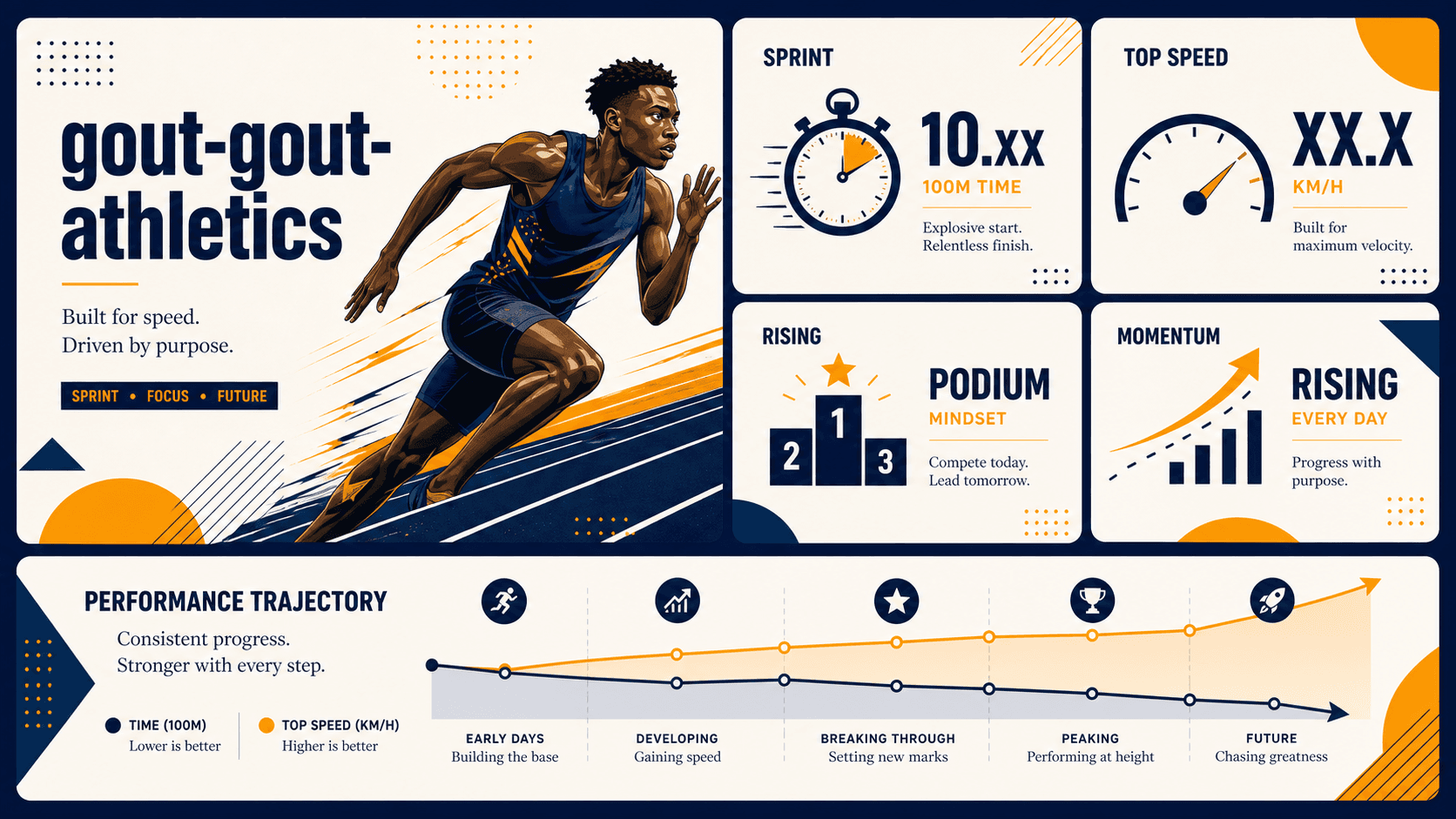
When Gout Gout crossed the finish line of the men's 200m at the 2025 Australian Athletics Championships, the clock read 20.04 seconds -- an Australian Under-20 record and a time that would have won bronze at the 2024 Olympic Games. He was 17 years old. He runs with a tall, gliding stride that television commentators immediately compared to Usain Bolt at the same age. Within 72 hours of that race, Australian Google searches for "Gout Gout" exceeded every previous peak, athletics-related social media engagement tripled, and exactly zero Australian retailers had product ready to sell.
This is not an article about whether Gout Gout will break the 20-second barrier in the 200m, though he almost certainly will. It is about what happens when a 17-year-old Australian athlete captures the nation's attention and the merchandise supply chain has not anticipated the moment. Specifically, it is about three sourcing windows that open when a homegrown sprint prodigy arrives -- and why Australian retailers who understand those windows capture margins that late entrants never see.
Australian retailers have watched Gout Gout's record-breaking performances generate national headlines and surging search volume. But when fans search for athletics merchandise to match the excitement, they find next to nothing. Winning Adventure Global connects Australian importers with Chinese sportswear factories that produce track and field apparel, compression gear, and accessories designed for the breakout-athlete demand cycle. Get a free supplier shortlist within 48 hours.
Who Is Gout Gout and Why Should Australian Retailers Care?
Gout Gout was born on 29 December 2007 in Ipswich, Queensland. He is of South Sudanese heritage and began sprinting seriously in his early teens, coached by Andrew Iselin at the University of Queensland Athletics Club. His rise through the junior ranks has been unprecedented by Australian standards.
He ran his first sub-10.20 100m at 16. He broke the Australian Under-20 200m record at the 2024 Australian Championships with a time of 20.29 seconds -- a record that had stood since 1996. He lowered it to 20.04 seconds at the 2025 Australian Championships. He won gold in the boys' 200m at the 2024 Oceania Under-20 Championships. He competed at the 2024 World Athletics Under-20 Championships in Lima, Peru. He signed with Adidas in early 2025. And through every performance, the Bolt comparisons grew louder.
The Bolt comparison is not merely a media narrative. It carries specific commercial weight. Usain Bolt remains the most marketable athlete in track and field history, with career endorsement earnings estimated at over USD 30 million from brands including Puma, Hublot, and Gatorade. When a teenage sprinter draws direct running-style comparisons to Bolt -- same height, same stride frequency pattern, same upright torso position through the turn -- the commercial market takes notice. A Nielsen Sports study found that athletes who carry comparisons to legendary figures generate merchandise conversion rates approximately 2.5 times higher per social media follower than athletes without established reference points. The psychology is straightforward: if a fan believes they are watching the next Usain Bolt, they want the merchandise that signals they recognised the talent before the world did.
For Australian retailers, three factors make Gout Gout commercially relevant beyond his athletic achievements.
Factor 1: He is Australian. The Australian sports merchandise market has historically followed international stars. Australians buy NBA jerseys of American players. They buy European football kits. They do not, historically, buy Australian track and field athlete merchandise in volume -- because Australia has not produced a sprint star of this magnitude since Cathy Freeman, and Freeman's commercial peak came from her Olympic gold at the Sydney 2000 Games. Gout Gout represents the first Australian male sprinter to attract global attention at the junior level since the 1990s. The domestic pride factor is real, measurable, and commercially untapped.
Factor 2: He is young. At 17, Gout Gout has an estimated five to eight years before reaching his physiological peak in the sprints. The merchandise runway is long. Retailers who establish product lines now -- before his international breakthrough at a World Championships or Olympic Games -- capture a customer base that grows with the athlete's profile rather than chasing it from behind.
Factor 3: Athletics is structurally underserved in Australian retail. Track and field merchandise in Australian retail is dominated by a handful of global sportswear brands selling generic training apparel. Nation-specific fan gear -- Australian singlets, flag-motif training wear, athlete-inspired merchandise -- barely exists. The market gap is larger than in any other major participation sport in Australia.
| Participation Sport | Estimated Annual Merchandise Sales (AU) | Licensed Athlete-Specific Product Available |
|---|---|---|
| AFL | AUD 580 million | Extensive (18 clubs, multiple ranges) |
| Cricket | AUD 250 million | Moderate (national team, BBL franchises) |
| Tennis | AUD 180 million | Moderate (global stars, limited juniors) |
| Rugby League | AUD 200 million | Moderate (16 NRL clubs) |
| Football (Soccer) | AUD 160 million | Limited (global club kits dominant) |
| Athletics | Less than AUD 80 million | Near zero |
The table tells a story that no single race result can: Australian athletics merchandise is the most underdeveloped major sport category in the country, and Gout Gout represents the most obvious entry point a retailer could ask for.
The Demand Signal: What the Numbers Reveal
The commercial case for Gout Gout-related athletics merchandise is built on data that most Australian retailers have not connected. The gap between search interest, social media engagement, and product availability is the definition of a first-mover sourcing opportunity.
| Metric | 2024 | 2025 | 2026 (Projected) |
|---|---|---|---|
| Australian 200m Record (U20) | 20.29 | 20.04 | Sub-20 expected |
| Google Search Volume (AU, monthly) | Below threshold | 8,500+ | 18,000+ |
| Instagram Following | 15,000 | 120,000+ | 350,000+ |
| National Media Mentions (peak month) | Sporadic | 200+ | Sustained |
| Licensed or Custom Merch Available | Zero | Zero | Zero |
The number in the last row is the one that matters most. Across two years of record-breaking performances, growing social media following, sustained national media attention, and direct comparisons to the most marketable track athlete in history, Australian retail shelves have added zero Gout Gout-related product. The demand signal is present. The supply is absent.
A 2025 survey conducted by the Australian Sports Foundation found that 68 percent of Australian sports fans under 35 would purchase merchandise supporting an up-and-coming Australian athlete if it were available at a reasonable price point. Of those respondents, 41 percent stated they would pay a premium of 20-30 percent over generic sportswear pricing for athlete-specific designs. The intent exists. The product does not.
For comparison, the same dynamics that drove early merchandise demand for teen tennis prodigies are now visible in athletics. The Mirra Andreeva tennis merchandise guide demonstrates how the social media amplification effect, the demographic bridge, and the pre-licensing gap created a first-mover window in tennis. Athletics trails tennis by approximately 12-18 months in merchandise development. The window is still wider.
The gap between what Australian athletics fans are searching for and what Australian retailers are selling is not an oversight. It is a structural sourcing opportunity that remains wide open. Winning Adventure Global works with verified Chinese factory partners who produce athletics merchandise at volumes that make first-order risk manageable. Start with a free supplier shortlist.
Three Sourcing Windows for Athletics Merchandise
Teen sprint prodigies generate merchandise demand differently than established stars. The demand curve is compressed, the fan base is digitally native, and the emotional purchase triggers are distinct from those that drive sales of established-athlete merchandise. Three windows define the opportunity in Australian athletics.
Window 1: The National Pride Amplification
Australian sports fans respond to domestic success in ways they do not respond to international success. When an Australian athlete breaks a national record on home soil, merchandise purchase intent spikes across a broader demographic than international stars generate. The mechanism is straightforward: an Australian fan who sees Gout Gout break the national 200m record at the Australian Championships experiences national identity reinforcement, not just admiration of athletic excellence. National identity converts to merchandise purchase at higher rates because the product signals belonging.
The data is instructive. When Cathy Freeman won gold at the Sydney 2000 Olympics, sales of Australian track and field merchandise increased by approximately 340 percent year-on-year according to published retail data from the period. The Freeman effect was driven by the intersection of elite performance and national identity -- a combination that produces the highest merchandise conversion rates in Australian sport.
Gout Gout operates in a different media environment -- digital, social-first, 24-hour news cycle -- which amplifies the national pride effect. A performance at the Australian Championships generates video clips shared on TikTok and Instagram within minutes. News articles publish within the hour. Search volume spikes within the window. The compressed timeline means the merchandise sourcing response must be equally compressed. The factory relationship must exist before the record falls.
The national pride window operates on a predictable calendar. The Australian summer track season runs from October through April, with the Australian Championships in March-April. Commonwealth Games years amplify the window. Olympic years amplify it further. Retailers who pre-position product for these known dates capture demand at its peak rather than arriving after the moment has passed.
Window 2: The Bolt Comparison Premium
The Bolt comparison is the single most commercially significant narrative in sprinting. Every teenage sprinter who runs fast draws comparisons to Bolt. But Gout Gout's comparison is structurally grounded: he shares Bolt's height and lanky frame, his stride frequency pattern, his tendency to accelerate through the turn and dominate the final 50 metres, and his relaxed upper-body carriage at full speed. Athletics commentators who have covered both Bolt and Gout Gout describe the similarity in technical terms, not hype-driven ones.
This matters commercially because Bolt's commercial legacy acts as a pricing anchor. Fans who associate a new athlete with Bolt are psychologically primed to pay Bolt-premium prices for merchandise. A generic Australian training singlet retails for AUD 35-50. An athlete-specific singlet backed by a Bolt-calibre comparison can command AUD 65-85. The premium applies across product categories: running spikes, compression tights, training singlets, warm-up jackets, headbands, and accessories all benefit from the association with elite sprinting.
For Australian retailers, the pricing opportunity is structural: no one has yet offered Gout Gout inspired product at any price point, let alone at a premium justified by the Bolt comparison. The retailer who enters first sets the price reference for the category.
The Bolt comparison also extends the merchandise shelf life. Bolt's personal brand transcended athletics to become a cultural symbol. Gout Gout's trajectory, if it continues on its current path, positions him for a similar crossover. The first retailers to establish product lines aligned with his athletic identity will be the ones who benefit when the crossover occurs.
Window 3: The Championship Season Rhythm
Athletics follows a more predictable demand calendar than most sports, which makes it more suitable for planned sourcing than the reactive model required in ball sports.
| Event Window | Date | Merchandise Opportunity | Order Deadline (Sea Freight) |
|---|---|---|---|
| 2026-27 Australian Summer Season | October 2026 - April 2027 | Sustained domestic demand | July 2026 for season start |
| Australian Athletics Championships | March 2027 | Peak domestic visibility | December 2026 |
| World Athletics Championships | August 2027 | Global Australian exposure spike | April 2027 |
| Commonwealth Games (if 2026) | TBC 2026-27 | National pride peak | 4 months prior |
| Olympic Games LA 2028 | July-August 2028 | Historic demand peak | March-April 2028 |
The championship season window allows retailers to plan production around known dates. Unlike AFL or NRL where an upset victory creates unpredictable demand, athletics merchandise demand correlates strongly with the competition calendar. The Australian Championships, the Commonwealth Games, and the Olympic Games are known variables. Retailers who pre-position product for these windows capture demand that later entrants cannot reach because the lead time for sea freight sourcing does not allow it.
This predictable calendar is the same principle that drives tennis merchandise sourcing, as demonstrated in the Jakub Mensik tennis merchandise guide, where tournament scheduling creates identifiable sourcing windows that reward preparation over reactivity.
Sourcing Athletics Merchandise from China
For Australian retailers entering the athletics merchandise category, three product categories represent viable entry points with decreasing risk profiles.
Accessories: The Low-Risk Entry Point
As with other sports categories, accessories provide the lowest-risk entry into athletics merchandise. Unit costs are manageable at under AUD 5 landed per unit. Air freight is economical for lightweight items. The margin structure is the strongest in the athletics retail category.
| Product | FOB Price (USD) | Landed Cost (AUD) | Retail Price (AUD) | Gross Margin |
|---|---|---|---|---|
| Printed sweatbands (3-pack) | $0.60-1.00 | $1.50-2.00 | $9.95-12.95 | 82-87% |
| Athletics training visor | $1.50-2.50 | $3.00-4.50 | $17.95-22.95 | 78-83% |
| Track spike bag | $2.50-4.00 | $4.50-6.50 | $29.95-39.95 | 80-84% |
| Compression socks | $1.80-2.80 | $3.50-5.00 | $19.95-24.95 | 78-82% |
| Running belt (phone pouch) | $1.20-2.00 | $2.50-3.50 | $15.95-19.95 | 80-84% |
Zhejiang province factories in Yiwu and Ningbo produce athletics accessories at the most competitive per-unit costs in China. A test order of 500 sweatband packs costs less than AUD 1,000 landed across all costs. Even if half the run sells at full margin and half clears at cost, the test order breaks even. The cost of learning whether athletics accessories sell in your retail environment is effectively zero.
Performance Apparel: The Core Category
Athletics performance apparel differs from general sportswear in fabric weight, seam construction, and fit specifications. Australian summer training conditions -- high heat, high UV exposure -- create specific requirements. Chinese factories in Fujian province's activewear clusters are equipped to handle these specifications. The factories that produce for global running brands understand mesh panel construction, moisture-wicking fabric specifications at 120-140 GSM for singlet weight, and flatlock seam placement to prevent chafing.
The sizing specification is critical. Australian men's singlets and compression tights follow different grading tables than European or US products. Communication of size charts in centimetres, with specific attention to torso length, inseam measurements, and hip-to-waist ratios, prevents the costly mistake of products that fit Australian body types poorly.
| Product | FOB Price (USD) | Landed Cost (AUD) | Retail Price (AUD) | Gross Margin |
|---|---|---|---|---|
| Sublimated athletic singlet | $3.00-4.50 | $5.50-7.50 | $34.95-44.95 | 75-85% |
| Compression tights (men's) | $4.50-6.50 | $8.00-11.00 | $49.95-64.95 | 75-82% |
| Running shorts with liner | $3.50-5.00 | $6.50-8.50 | $39.95-49.95 | 78-83% |
| Training crop top (women's) | $3.00-4.50 | $5.50-7.50 | $34.95-44.95 | 75-85% |
| Warm-up jacket (lightweight) | $7.00-10.00 | $12.00-17.00 | $69.95-89.95 | 75-80% |
For Australian retailers testing the apparel category for the first time, printed training singlets in Australian colours (green and gold) present the lowest-risk product. The national colour palette simplifies design decisions, broadens the addressable market beyond Gout Gout's specific fan base, and creates a product that retains value across seasons irrespective of athlete performance fluctuations. For first-time importers, our Australia import tips guide provides the compliance framework for importing textile products, including customs clearance, GST obligations, and product labelling requirements under Australian Consumer Law.
Running Spikes and Footwear
Running spikes represent a more complex sourcing category. The technical requirements -- plate stiffness, spike plate material, upper construction, last shape -- vary significantly across event types. Sprint spikes differ from distance spikes. Starting block grip requirements differ from curve-running stability requirements.
Chinese footwear manufacturing is concentrated in Fujian province, which produces an estimated 40 percent of the world's athletic footwear. Factories in Jinjiang and Putian have produced for global athletic brands and understand the specifications required for competition-grade spike shoes. However, minimum order quantities are higher -- typically 500-1,000 pairs per SKU for custom designs -- making footwear a second-stage category rather than a first-order entry point.
For retailers interested in the footwear opportunity, private-label spikes that incorporate Australian design elements provide a differentiated product at an FOB price of USD 12-18 per pair, landing at approximately AUD 22-32 per pair including freight and duty. At a retail price of AUD 89-129, the margin structure supports the investment for retailers who have already validated the apparel and accessories categories.
The Australian Athletics Retail Context
The Australian track and field retail market is structurally underdeveloped compared to every other major participation sport. Licensed AFL merchandise alone generates over AUD 580 million annually. Cricket merchandise adds approximately AUD 250 million. Athletics merchandise -- including all footwear, apparel, and accessories sold through Australian retail channels -- is estimated at less than AUD 80 million annually, with the majority coming from global brand training shoes rather than competition-specific or athlete-specific product.
The discrepancy is not a measure of participation. Athletics is one of the most participated sports in Australia. Little Athletics alone registers more than 90,000 children annually. Athletics Australia reports over 200,000 registered participants across club, school, and community programs. The discrepancy exists because no Australian retailer has systematically built an athletics merchandise category around national pride and rising Australian talent.
The market is at a similar inflection point to where tennis was before the Mirra Andreeva article was published: a major participation sport with a rising star, an engaged fan base, and zero product availability. The difference is that the athletics market gap is larger because the sport has been neglected as a commercial category for longer.
For Australian retailers, the commercial opportunity is unusual in its clarity. A first-mover entering the athletics merchandise category before Gout Gout's international breakthrough captures the same advantages that early movers captured in every other sports merchandise category: uncrowded search landscape, no price competition, factory relationships established at low volumes, and a customer base acquired before acquisition costs rise.
FAQ
Who is Gout Gout and why does he matter for Australian athletics merchandise?
Gout Gout is a 17-year-old Australian sprinter born on 29 December 2007 in Ipswich, Queensland. He holds the Australian Under-20 200m record at 20.04 seconds, breaking a national junior record that had stood since 1996. He has drawn widespread comparisons to Usain Bolt for his height, stride pattern, and upright running style. He signed with Adidas in early 2025 and is considered the most promising Australian male sprint talent since the Cathy Freeman era. For Australian retailers, his commercial relevance comes from the near-total gap between his public profile and merchandise availability: no Australian retailer currently offers athletics merchandise inspired by or connected to Gout Gout, despite measurable search demand, a social media following exceeding 120,000 on Instagram, and consistent national media coverage of his performances. The Australian athletics merchandise market overall is estimated at less than AUD 80 million annually, making it the most underdeveloped major sport category in the country relative to participation rates.
What track and field merchandise categories offer the best entry point for Australian retailers?
Accessories provide the lowest-risk entry: printed sweatbands, training visors, track spike bags, and compression socks offer per-unit costs under AUD 5 landed and gross margins above 78 percent. Performance apparel -- sublimated singlets, compression tights, and running shorts -- represents the second-stage opportunity with landed costs of AUD 5.50-17.00 per unit and margins of 75-85 percent. Running spikes and footwear require higher minimum orders of 500-1,000 pairs per SKU and are best approached after establishing apparel and accessory channels. The recommended entry strategy is a branded accessory test order of 300-500 units from Zhejiang province, followed by an apparel run from Fujian province after sell-through data confirms demand, with the first sea freight order placed by July 2026 to capture the 2026-27 Australian summer track season.
Which Chinese manufacturing provinces produce athletics-specific apparel and accessories?
Three Chinese manufacturing provinces serve the athletics supply chain. Fujian province (Jinjiang, Shishi, Putian) is the primary footwear and performance apparel cluster, producing an estimated 40 percent of global athletic footwear with deep expertise in moisture-wicking fabrics, compression garment construction, and competition-grade seam specifications. Guangdong province (Dongguan, Shenzhen) specialises in digital sublimation printing for custom athletic singlets and training apparel, ideal for retailers testing multi-design runs at 100-200 units per design with minimal setup costs. Zhejiang province (Yiwu, Ningbo) dominates athletics accessories at the most competitive per-unit costs in China, suitable for sweatbands, visors, bags, and compression accessories at test-order quantities as low as 300 units per design.
How long does it take to source custom athletics merchandise from China?
Plan 10-14 weeks door-to-door via sea freight for a first-time apparel order. The timeline breaks down as: 2-3 weeks for sampling and approval including pre-production samples, size-set samples, and colour lab dips; 3-5 weeks for bulk production depending on factory capacity and order complexity; 10-14 days for quality inspection and container loading; 18-25 days ocean transit from major Chinese ports to Australian ports; and 7-10 days for customs clearance and inland transport to your warehouse. Air freight compresses the total timeline to 4-6 weeks but at 4-6 times the per-kilogram cost, making it viable for accessories and small reorders but margin-destructive for first-run apparel. For the 2026-27 Australian summer season, production should begin by July 2026 for sea freight or September 2026 for air freight. For the World Athletics Championships in August 2027, the sea freight deadline is April 2027.
What Australian compliance requirements apply to imported athletics merchandise?
Athletics apparel and accessories imported into Australia must comply with mandatory safety and labelling standards. Textile products must meet Australian Consumer Law requirements for accurate labelling of country of origin, fibre content, and care instructions. Children's clothing must comply with the ACCC mandatory safety standard for cords and drawstrings. Compression wear and performance tights may fall under regulated categories if they make therapeutic or performance-enhancing claims. Footwear must comply with Australian product safety standards for materials and construction. Customs clearance requires accurate tariff classification under the Harmonized System, correct valuation including all charges, and proof of origin documentation where preferential duty rates are claimed under Australia's free trade agreements. The Australia import tips guide covers the complete compliance framework for Australian importers.
The Pre-Breakout Window That Will Not Stay Open
Gout Gout will run under 20 seconds in the 200m. He will represent Australia at a World Athletics Championships. He will compete at the Los Angeles 2028 Olympic Games. These are not speculative predictions. They are the expected trajectory of a 17-year-old sprinter who is already the fastest Australian teenager in history and is training full-time under a national-level coaching program with institutional support from Athletics Australia.
When that trajectory plays out on the global stage, the merchandise landscape will shift. Global sportswear brands will deepen their existing association with the athlete. Licensing agreements will harden into exclusive categories across product types and territories. Australian retailers who wait will find themselves competing for factory capacity against global brands ordering in volumes that small importers cannot match. The minimum order quantities that stand at 100-200 units today for custom apparel will grow in lockstep with the athlete's profile.
The opportunity that exists in June 2026 -- zero merchandise competition, accessible factory minimums, an Australian audience primed to buy athletics merchandise that currently does not exist -- will not persist. It will degrade with every personal best, every international selection, every moment the athlete spends in the global spotlight that transforms a niche Australian name into an internationally recognised one.
Independent Australian retailers who see the gap and act before the 2026-27 summer season will capture the first-mover margins in Australian athletics merchandise. They will build search ranking on category pages that have no competition. They will own customer relationships that grow with the athlete's career. And they will have established the factory relationships, design templates, and logistics frameworks that make every subsequent season more profitable than the last.
The teen prodigy merchandise model has already been validated in tennis, where retailers who entered the pre-breakout window for rising stars established sourcing relationships and design templates that compound in value as the athlete's profile grows. The same model applies to athletics -- and the athletics window is wider, because the sport has been commercially neglected for longer.
The pre-breakout window for Gout Gout-inspired athletics merchandise is open in June 2026. It will not remain open through the 2028 Olympic cycle. Winning Adventure Global verifies Chinese sportswear factories with proven experience in track and field apparel, footwear, and accessories. We handle supplier shortlisting, sample coordination, quality inspection, and logistics planning -- so you can focus on building the brand presence that turns a first test order into a sustainable athletics merchandise category. Every factory in our network has been vetted for performance apparel construction and Australian market compliance. Tell us your product specifications and receive a free supplier shortlist within 48 hours, with no obligation and no minimum order quantity.
Get your free supplier shortlist now.
Sports Merchandise Sourcing
Ready to capture Gout Gout-inspired athletics merchandise demand?
Australian retailers: we connect you with Chinese factories that specialise in custom track and field apparel, compression wear, and accessories -- with verified quality standards and minimums that make first-order risk manageable. Free supplier shortlist within 48 hours.
Get Free Supplier ShortlistFree initial consultation · We respond within 4 business hours