Key Takeaways
- 1China produces over 70% of global lithium batteries and controls 65% of lithium refining, 75% of cathode production, and 85% of anode production — making it the unavoidable source for battery procurement at any scale
- 2LFP (lithium iron phosphate) chemistry dominates stationary storage applications due to superior cycle life (3,000-5,000 cycles), better thermal stability, and lower cost at A$62-95/kWh, while NMC maintains advantages in energy density for applications where weight and space are constrained
- 3Australia's grid-scale energy storage pipeline exceeds 40 GW of announced projects, representing a procurement addressable market of A$15-25 billion for battery systems between 2026 and 2035
- 4Chinese battery manufacturing is concentrated in three regions: Fujian (CATL), Guangdong/Shenzhen (BYD, EVE), and Anhui/Hefei (Gotion, CATL expansion), each with distinct supply chain specialisations and logistics profiles for Australian importers
- 5Battery imports require UN 38.3 certification, ADG Code compliance, ACCC safety standards, and RCM marking for electrical products — certification verification should be completed before production, not after shipment
In 2025, China exported over US$45 billion in lithium-ion batteries, according to Chinese Customs data — more than the combined battery exports of every other country on earth. Australia was the destination for approximately A$1.2 billion of those batteries, a figure that grew 45 percent year-on-year and is projected to exceed A$2 billion by 2028.
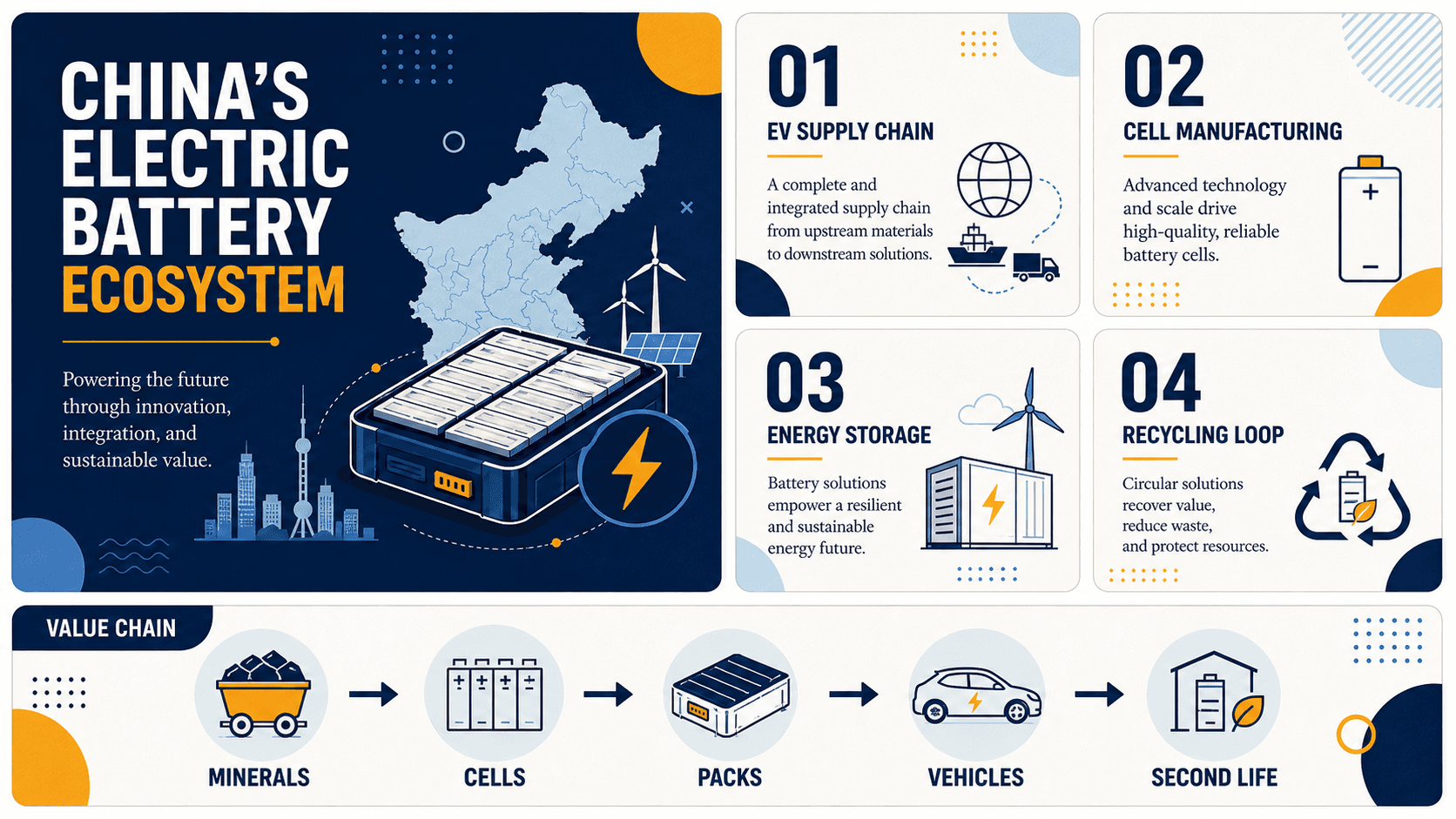
The scale of China's battery manufacturing dominance is not the product of a single company or region. It is the result of more than a decade of coordinated investment across the full battery value chain: raw material processing, cell chemistry research, component manufacturing, cell assembly, pack integration, and recycling infrastructure. China now controls approximately 65 percent of global lithium refining capacity, 75 percent of cathode active material production, 85 percent of anode production, and over 70 percent of battery cell manufacturing according to BloombergNEF and Benchmark Mineral Intelligence.
For Australian businesses evaluating energy storage procurement — whether for grid-scale projects, commercial solar installations, telecommunications backup, or off-grid power systems — understanding battery technology has become a prerequisite for cost-effective purchasing. The days of treating batteries as a commodity are over. The technology choices an importer makes at the specification stage determine compliance costs, shipping options, system lifespan, and total cost of ownership over a 10- to 20-year asset life.
This report provides a technology-focused examination of the electric battery supply chain from China, covering the chemistry choices that matter for Australian applications, the manufacturing geography that determines cost and lead time, the grid-scale storage opportunity that represents the largest battery procurement pipeline in Australian history, and the regulatory framework every Australian battery importer must navigate.
Battery Chemistry Deep Dive: LFP vs NMC and Beyond
The single most important procurement decision for any Australian business sourcing batteries from China is chemistry selection. Two lithium-ion chemistries dominate the market, and they serve fundamentally different applications.
LFP (Lithium Iron Phosphate)
LFP chemistry uses iron phosphate as the cathode material. It delivers lower energy density than alternative chemistries but offers superior thermal stability, longer cycle life, and lower material cost. These characteristics make LFP the dominant chemistry for stationary energy storage applications.
| Property | LFP (LiFePO4) | NMC (Lithium Nickel Manganese Cobalt Oxide) |
|---|---|---|
| Energy density | 90-160 Wh/kg | 150-220 Wh/kg |
| Cycle life (to 80% capacity) | 3,000-5,000 cycles | 1,000-2,000 cycles |
| Calendar life | 10-15 years | 8-12 years |
| Thermal runaway threshold | ~270 degrees Celsius | ~210 degrees Celsius |
| Typical cost (FOB China, 2026) | A$62-95/kWh | A$88-130/kWh |
| Best Australian application | Solar storage, grid backup, off-grid | EVs, e-bikes, portable equipment |
| Dominant Chinese manufacturer | CATL, BYD, Gotion | CATL, Samsung SDI, LG Energy Solution |
| Shipping classification | Class 9 DG | Class 9 DG |
| SOC limit for shipping | 30% | 30% |
The cost differential between LFP and NMC has widened in 2026. Battery-grade lithium carbonate prices have stabilised at approximately US$8-12/kg, down from US$70+/kg during the 2022 shortage. Iron and phosphate raw materials have remained relatively stable. The result: LFP cell production costs in China are approximately 30-35 percent lower than NMC on a per-kilowatt-hour basis at the cell level.
For Australian solar installers and energy storage integrators, LFP has become the default choice. A 10-kilowatt-hour LFP home battery system sourced from a verified Chinese manufacturer at current pricing (A$72-85/kWh FOB) lands in Australia at a unit cost of approximately A$900-1,200 including all duties, freight, and compliance costs — down from A$1,800-2,400 in early 2024. The same system retails in Australia at A$2,500-3,500, producing gross margins of 55-65 percent for importers who manage their supply chain efficiently.
NMC (Lithium Nickel Manganese Cobalt Oxide)
NMC delivers higher energy density, which translates to more power in a smaller, lighter package. This makes it the preferred chemistry for electric vehicles, power tools, portable electronics, and any application where weight and space are constrained.
The trade-off is reduced cycle life and lower thermal stability. NMC batteries typically degrade to 80 percent capacity after 1,000-2,000 charge cycles — roughly half the lifespan of equivalent LFP cells in stationary applications. The thermal runaway threshold is approximately 60 degrees Celsius lower than LFP, meaning NMC cells require more sophisticated thermal management systems in both operation and transport.
For Australian importers, NMC remains relevant for specific applications: marine battery systems where weight matters, telecommunications backup where space is constrained, and high-performance power equipment. However, for the vast majority of stationary energy storage applications, LFP is the more economical and safer choice.
Emerging Chemistries
Two emerging chemistries deserve attention from Australian procurement professionals, though neither has reached the manufacturing scale that makes them viable for volume importing in 2026.
Sodium-ion batteries use sodium instead of lithium as the charge carrier. The raw material cost advantage is substantial — sodium is approximately 1,000 times more abundant than lithium. CATL launched its first-generation sodium-ion battery in 2023 and has been scaling production through 2025-2026. Current sodium-ion cells achieve 100-160 Wh/kg energy density, approaching LFP territory, with projected costs of A$55-80/kWh at scale. The limitation is production volume: sodium-ion manufacturing capacity remains below 10 GWh globally, compared to over 1,000 GWh for lithium-ion. Australian importers should monitor this chemistry for 2027-2028 procurement cycles, particularly for grid-scale storage where weight is not a constraint.
Solid-state batteries replace the liquid electrolyte with a solid electrolyte, promising higher energy density and improved safety. Multiple Chinese manufacturers including CATL and Qing Tao Energy (a Beijing-based solid-state specialist) have announced production timelines. However, commercial-scale solid-state manufacturing remains 3-5 years from volume production. The technology is relevant for Australian importers to track but not yet a procurement option.
China's Battery Manufacturing Geography
The geography of Chinese battery manufacturing is not random. It reflects deliberate industrial policy, raw material logistics, and the gravitational pull of anchor customers. Understanding which region produces which products helps Australian importers make better sourcing decisions.
Fujian Province: CATL's Home Base
Fujian province, on China's southeast coast, is the headquarters and primary manufacturing base of Contemporary Amperex Technology Co. Limited (CATL) — the world's largest battery manufacturer with approximately 37 percent global market share as of early 2026.
CATL's Ningde facility is the largest battery production site on earth, with an annual production capacity exceeding 200 GWh. The facility produces LFP cells for stationary storage, NMC cells for premium EVs, and the company's proprietary cell-to-pack technology that eliminates module assembly. For Australian importers, CATL's position in Fujian provides proximity to Ningde Port and Fuzhou Port, both with direct container shipping services to Melbourne and Sydney with typical transit times of 14-18 days.
The Fujian manufacturing ecosystem extends beyond CATL. Dozens of mid-tier battery manufacturers and component suppliers cluster within a 100-kilometre radius of Ningde, producing everything from electrolyte and separators to battery management systems and finished battery packs. An Australian importer visiting Fujian can evaluate multiple battery suppliers within a single trip — a practical advantage that the China factory tour guides on this site address in detail.
Guangdong Province: BYD and EVE Energy
Guangdong province, anchored by Shenzhen, is home to BYD's battery division and EVE Energy, two of China's top ten battery manufacturers. BYD's blade battery — an LFP cell design that prioritises safety and thermal management — has become the standard for energy storage applications globally.
BYD's Shenzhen facilities produce batteries for the company's own EV production as well as stationary storage products sold under the BYD Battery-Box brand. The logistics advantage for Australian importers is substantial: Shenzhen's Yantian and Shekou ports are the most frequent departure points for Australia-bound container vessels, with 6-8 sailings per week and typical ocean transit of 12-16 days.
EVE Energy, also based in Guangdong, has emerged as a significant supplier of LFP cells for the Australian solar storage market. Unlike CATL's policy of selling primarily to large OEMs, EVE Energy maintains an active export business to smaller distributors and integrators — making it a practical supplier for Australian SMEs who cannot meet CATL's minimum order requirements.
The Guangdong manufacturing cluster extends to Huizhou (battery management systems), Dongguan (power electronics), and Zhuhai (battery testing equipment). An Australian importer sourcing batteries from Guangdong is embedded in the most mature battery supply chain ecosystem on earth, which our EV supply chain analysis covers in the broader context of charging infrastructure and components.
Anhui Province: Gotion High-Tech and CATL Expansion
Anhui province, located inland and west of Shanghai, has emerged as China's third major battery manufacturing hub. Gotion High-Tech, headquartered in Hefei (Anhui's capital), is China's third-largest battery manufacturer and a major supplier of LFP cells for stationary storage applications.
Gotion has aggressively expanded its Australian export business in 2026, responding to the EV market slowdown discussed in our China EV market decline analysis. The company has appointed dedicated Australian sales representatives and is offering extended warranty terms of 7-10 years on LFP storage products — a competitive response to CATL and BYD's market dominance.
CATL has also established a major manufacturing base in Anhui, near Hefei, adding to its Fujian capacity. The Anhui facilities supply battery systems to NIO, Volkswagen's Chinese joint venture, and increasingly to export markets including Australia.
The inland location of Anhui manufacturing means containers move via the Yangtze River or rail to Shanghai or Ningbo for export. Total transit time from factory to Australian port is typically 18-22 days — 3-5 days longer than Guangdong exports but comparable to Fujian.
| Region | Key Manufacturers | Primary Products | Nearest Port | Transit to Melbourne |
|---|---|---|---|---|
| Fujian (Ningde) | CATL | LFP cells, NMC cells, cell-to-pack systems | Ningde, Fuzhou | 14-18 days |
| Guangdong (Shenzhen) | BYD, EVE Energy | Blade batteries, LFP packs, BMS | Yantian, Shekou | 12-16 days |
| Anhui (Hefei) | Gotion, CATL (expansion) | LFP storage, NMC cells | Shanghai, Ningbo | 18-22 days |
| Zhejiang (Ningbo) | Several mid-tier | LFP cells, consumer batteries | Ningbo | 14-18 days |
| Jiangsu (Nanjing) | LG Energy Solution, several | NMC cells, automotive packs | Nanjing, Shanghai | 16-20 days |
For Australian importers, the sourcing decision is not just about which manufacturer offers the best price. It is about which region's logistics profile matches the import timeline, which manufacturer's minimum order quantity fits the business scale, and which supplier has verified Australian compliance certifications — a process covered in greater depth in our Australia import requirements guide.
Grid-Scale Energy Storage: Australia's Multi-Billion-Dollar Opportunity
Australia's grid-scale energy storage pipeline is the largest procurement opportunity for battery importers in the country's history. It dwarfs the residential solar storage market by an order of magnitude and will determine the shape of Australian battery imports for the next decade.
The Pipeline
As of mid-2026, the Australian Energy Market Operator's (AEMO) Generation Information system lists over 40 GW of announced grid-scale battery energy storage system projects across the National Electricity Market. The majority are in various stages of development — from early feasibility through to financial close and construction.
Projects that have reached financial close or are under construction as of Q2 2026 include:
| Project | Location | Capacity | Developer | Status |
|---|---|---|---|---|
| Waratah Super Battery | New South Wales | 850 MW / 1,680 MWh | Akaysha Energy | Under construction |
| Melbourne Renewable Energy Hub | Victoria | 600 MW / 1,600 MWh | Equis | Financial close |
| Woolooga Battery Energy Storage | Queensland | 500 MW / 1,000 MWh | Neoen | Under construction |
| Blykalla Battery | South Australia | 250 MW / 500 MWh | Amp Energy | Financial close |
| Collie Battery Stage 2 | Western Australia | 500 MW / 2,000 MWh | Synergy | Under construction |
The total addressable battery storage procurement market from these announced projects is estimated at A$15-25 billion between 2026 and 2035, based on current battery pack pricing of A$100-150/kWh landed for utility-scale systems.
Why China Supplies Grid-Scale Batteries
Grid-scale battery storage is a volume game. A single 500-megawatt installation requires approximately 1,000-2,000 megawatt-hours of battery capacity — equivalent to 10,000-20,000 home battery systems. No domestic Australian manufacturer can produce at this scale. No European or North American manufacturer can match Chinese pricing at this volume.
Chinese manufacturers dominate grid-scale battery supply for the same structural reasons they dominate every other battery segment: manufacturing scale, supply chain integration, and cost structure. CATL alone has the production capacity to supply every announced Australian grid-scale project simultaneously. BYD's blade battery, originally developed for EVs, has become a preferred form factor for utility-scale storage installations due to its safety characteristics and ease of thermal management.
For Australian project developers, the procurement decision is not whether to source from China. It is which Chinese manufacturer, which cell chemistry, and which contracting structure best suits the specific project's duration requirements, cycling profile, and financial return targets.
Australian businesses imported over A$1.2 billion in lithium batteries from China in 2025 — and that figure is growing at 45% year-on-year.
The question is not whether to source batteries from China. It is whether you have the right battery technology, the right supplier, and the right compliance framework for your specific application. WAG has verified battery manufacturers across LFP, NMC, and emerging chemistry categories. Free initial consultation — we will assess your battery requirements and recommend verified suppliers within our network.
Get Free Battery Sourcing AssessmentThe Battery Chemistry Question for Grid Scale
The chemistry decision at grid scale differs from residential or commercial applications. Grid-scale batteries cycle deeper and more frequently, operate in more challenging thermal environments, and must deliver consistent performance over 15-20 year asset lives.
LFP has become the default chemistry for grid-scale projects globally. The cycle life advantage (3,000-5,000 cycles vs 1,000-2,000 for NMC) translates directly to project economics. A 500 MW / 1,000 MWh LFP installation that cycles daily can operate for 10-14 years before reaching 80 percent capacity degradation. An equivalent NMC installation would reach 80 percent capacity in 5-7 years under identical cycling.
The levelised cost of storage is approximately 35-45 percent lower for LFP in daily-cycling grid applications, according to analysis from BloombergNEF and CSIRO's Australian Energy Storage Roadmap. This gap has driven a decisive shift: approximately 85 percent of announced grid-scale battery projects globally now specify LFP chemistry.
Battery Import Regulations: Beyond the Basics
Battery import regulations in Australia are not static. The regulatory framework has become more stringent through 2025-2026 as the volume of imported batteries has increased and after the ACCC identified non-compliant battery imports as a priority enforcement area.
Current Regulatory Requirements
Every lithium battery imported into Australia must satisfy four regulatory layers:
Transport safety (UN 38.3). This is the mandatory testing standard for lithium cell and battery transport safety. Each battery model requires a valid UN 38.3 test report from an accredited laboratory. The report must cover the specific cell and battery configuration being imported — a UN 38.3 certificate for a 100Ah LFP cell does not cover a 200Ah LFP cell even from the same manufacturer. Test reports typically expire after 3-5 years depending on the issuing body, and must be maintained current for ongoing imports.
The UN 38.3 requirement is the most frequently failed regulatory check for new battery importers. Our experience with Australian clients shows that approximately 25-30 percent of Chinese battery suppliers either cannot produce valid UN 38.3 reports or present reports that do not cover the specific models being ordered. The verification process — checking the report number with the issuing laboratory, confirming test conditions match the product specification, and validating the report expiry date — is straightforward but frequently skipped.
Australian Dangerous Goods Code (ADG 7.5). The ADG Code governs the transport of dangerous goods within Australia after import. All lithium batteries classified as Class 9 dangerous goods must be transported, stored, and handled in accordance with ADG requirements. This affects warehousing, last-mile delivery, and installation logistics. Importers who plan to hold inventory of lithium batteries in Australian warehouses should confirm that their storage facility is licensed for dangerous goods storage.
ACCC mandatory safety standards. The ACCC enforces mandatory safety standards for batteries sold to Australian consumers. These standards cover labelling requirements (chemistry type, capacity, safety warnings), overcharge and short-circuit protection, and temperature testing. The ACCC issued over A$2.4 million in penalties for non-compliant battery imports in 2025, and enforcement activity has increased in 2026.
Electrical product compliance. Batteries with integrated inverters, chargers, or AC connection capability require RCM (Regulatory Compliance Mark) compliance with relevant Australian Standards. This includes AS/NZS 3000 (wiring rules), AS/NZS 4777 (grid connection), and product-specific standards. The compliance pathway depends on the specific product configuration — a standalone battery module (DC-only) has different requirements than an integrated battery-inverter system.
Practical Compliance Strategy
The most cost-effective compliance strategy is to verify certifications before production begins, not after the container has shipped. The sequence that works for verified Australian importers:
- Select cell chemistry and battery model based on application requirements
- Request UN 38.3, IEC 62133, and MSDS documentation from the manufacturer
- Verify each certificate with the issuing laboratory (not from the document alone)
- Engage a third-party testing laboratory for pre-production sample compliance testing
- Include compliance documentation requirements in the purchase contract
- Conduct pre-shipment inspection with compliance documentation verification
This process adds 2-4 weeks to the procurement timeline but eliminates the risk of non-compliant shipments being detained or destroyed by Australian Border Force. For a detailed breakdown of each verification step, our electric battery sourcing guide provides a complete compliance checklist.
Battery Recycling and Second-Life Applications
Battery recycling in Australia is not yet regulated at the federal level, but the regulatory landscape is changing rapidly. The Australian Government has committed to developing a national battery recycling framework through the Department of Climate Change, Energy, the Environment and Water, with consultation documents expected in late 2026.
The Scale of the Coming Waste Stream
CSIRO estimates that Australia will generate approximately 30,000 tonnes of lithium-ion battery waste annually by 2030, rising to over 100,000 tonnes annually by 2035. The current recycling capacity is estimated at less than 5,000 tonnes per year across all battery chemistries.
For Australian importers of Chinese batteries, this creates two practical implications:
Importer obligation schemes. Several states are developing or expanding battery stewardship schemes that place obligations on battery importers to fund or facilitate end-of-life recycling. New South Wales and Victoria have indicated they will introduce extended producer responsibility (EPR) requirements for batteries, similar to the existing schemes for packaging, electronics, and tyres. Importers who plan for these obligations now will avoid compliance costs and supply chain disruptions when EPR requirements become mandatory.
Second-life storage opportunity. LFP batteries removed from EV or grid-scale applications at 70-80 percent remaining capacity retain substantial value for less demanding stationary storage applications. Chinese companies including CATL's Brunp Recycling subsidiary and GEM Co. have developed industrial-scale battery testing, grading, and repurposing operations. Australian importers with access to these second-life supply chains can source battery systems at 40-60 percent of new-equivalent cost for applications such as solar time-shifting, backup power for telecommunications, and off-grid energy storage.
A Melbourne-based renewable energy company that began importing second-life LFP packs from a verified Chinese repurposing facility in early 2026 reported landed costs of A$40-50/kWh — approximately 45 percent below the cost of new LFP packs. The packs carry a two-year warranty from the repurposing facility, which is appropriate for the application profile (daily cycling at 50 percent depth of discharge for telecom backup).
Frequently Asked Questions
What is the difference between LFP and NMC batteries for Australian applications?
LFP (lithium iron phosphate) offers longer cycle life (3,000-5,000 cycles), better thermal safety (thermal runaway at approximately 270 degrees Celsius), and lower cost (A$62-95/kWh FOB China). NMC (nickel manganese cobalt oxide) offers higher energy density (150-220 Wh/kg vs 90-160 Wh/kg) but shorter cycle life and lower thermal stability. For Australian stationary storage applications — solar storage, grid backup, off-grid power — LFP is the recommended chemistry. For applications where weight and space are critical (marine, portable equipment, some EV categories), NMC remains relevant.
Which Chinese battery manufacturers supply to Australian buyers?
CATL (37 percent global market share) supplies primarily to large OEMs and project developers. BYD supplies through its Battery-Box product line and direct project contracts. EVE Energy, Gotion High-Tech, and several mid-tier manufacturers in Guangdong and Fujian actively supply to Australian distributors and integrators of all sizes. The choice depends on order volume, application requirements, and certification status rather than manufacturer size alone.
What certifications are required to import lithium batteries into Australia?
Every lithium battery import requires UN 38.3 (transport safety test report), a Material Safety Data Sheet (MSDS), and compliance with the Australian Dangerous Goods Code (ADG 7.5). AC-connected battery systems require RCM compliance with relevant Australian Standards (AS/NZS 3000, AS/NZS 4777). Consumer batteries must meet ACCC mandatory safety standards. Certificate verification should be completed before production, not after shipment.
How much can an Australian business save by sourcing grid-scale batteries from China versus alternatives?
For utility-scale battery systems, Chinese-manufactured LFP batteries currently land in Australia at A$100-150/kWh including all duties, freight, and compliance costs. Equivalent systems from Korean or European manufacturers typically cost A$180-280/kWh landed. At a 500 MWh installation, the difference represents A$40-90 million in capital cost savings. For smaller commercial installations (100-500 kWh), Chinese batteries achieve 45-55 percent landed cost savings compared to Australian-distributed alternatives.
Is Australia a good market for grid-scale battery projects?
Australia has one of the best grid-scale battery investment environments in the world. The combination of high solar penetration (creating the duck curve and midday oversupply), ageing coal-fired generation retiring through 2026-2035, strong state-level renewable energy targets, and the Australian Energy Market Operator's Integrated System Plan creates a clear revenue stack for grid batteries. The announced project pipeline of over 40 GW represents a procurement addressable market of A$15-25 billion for battery systems between 2026 and 2035.
What are the shipping requirements for lithium batteries from China?
Lithium batteries are Class 9 dangerous goods under international shipping regulations. All shipments must comply with UN packaging requirements, ship at 30 percent or lower state of charge (SOC), include a dangerous goods declaration, and carry appropriate Class 9 labelling. Sea freight from Chinese ports to Melbourne typically costs A$3,500-6,000 for a dedicated DG container and takes 14-18 days from Guangdong or 18-22 days from Fujian and Anhui. Air freight is restricted to small sample quantities (30 percent SOC, limited cell count) at A$12-18/kg.
The Battery Procurement Landscape in 2026
The electric battery market in 2026 presents a rare alignment of favourable conditions for Australian importers. Battery cell prices are at multi-year lows due to manufacturing overcapacity created by the China EV market slowdown. Manufacturers are actively seeking non-automotive buyers. Shipping capacity on China-Australia routes remains ample, with container rates below 2024 levels.
At the same time, the technology landscape is shifting. LFP has decisively won the chemistry battle for stationary storage, but sodium-ion and solid-state technologies are developing rapidly and will reshape procurement decisions within 3-5 years. The regulatory framework in Australia is becoming more stringent, particularly around battery safety and end-of-life obligations.
The businesses that capture the most value from this market will be those that combine three capabilities: a genuine understanding of battery technology and its application to their specific use case, verified supplier relationships in the right Chinese manufacturing regions, and compliance systems that match the increasingly rigorous Australian regulatory environment.
Winning Adventure Global works with Australian businesses across all three areas. We have verified battery manufacturers in Fujian, Guangdong, and Anhui — spanning LFP and NMC chemistries, small-scale cells through grid-scale systems, and first-life through second-life products. Our verification process covers business license validation, UN 38.3 certification verification, manufacturing facility assessment, and Australian compliance documentation review.
The Australian battery import market grew 45 percent in 2025 and is projected to exceed A$2 billion annually by 2028. More than 200 Australian SMEs have used our sourcing and verification network to establish Chinese supplier relationships. The businesses among them that entered the battery supply chain in 2024 and 2025 are now scaling procurement volumes as Australian demand accelerates. The businesses that enter in 2026 will capture the grid-scale storage opportunity that represents the largest battery procurement pipeline in the country's history.
If you are evaluating battery suppliers in China, or if you want to understand which chemistry and manufacturing region best matches your business requirements, Winning Adventure Global offers a free initial consultation. We will tell you directly which battery technology suits your application, what verification steps are essential, and what a realistic procurement timeline and cost structure look like for your specific requirements.
Get Your Free Battery Sourcing Assessment
Data sources: BloombergNEF Battery Survey 2025-2026; Benchmark Mineral Intelligence Lithium Ion Battery Cell Pricing; China Customs lithium-ion battery export statistics (2025 full year); AEMO Generation Information (Q2 2026); CSIRO Australian Energy Storage Roadmap; ACCC Product Safety Report 2025-2026.
This article is part of our ongoing technology and supply chain coverage. For related analysis, see our EV supply chain opportunities for Australian SMEs, the BYD Zhengzhou-Melbourne logistics analysis, and our essential guide to Australian import requirements.
China Sourcing Strategy
Australian businesses imported over A$1.2 billion in lithium batteries from China in 2025 — and that figure is growing at 45% year-on-year.
The question is not whether to source batteries from China. It is whether you have the right battery technology, the right supplier, and the right compliance framework for your specific application. WAG has verified battery manufacturers across LFP, NMC, and emerging chemistry categories. Free initial consultation — we will assess your battery requirements and recommend verified suppliers within our network.
Get Free Battery Sourcing AssessmentFree initial consultation · We respond within 4 business hours